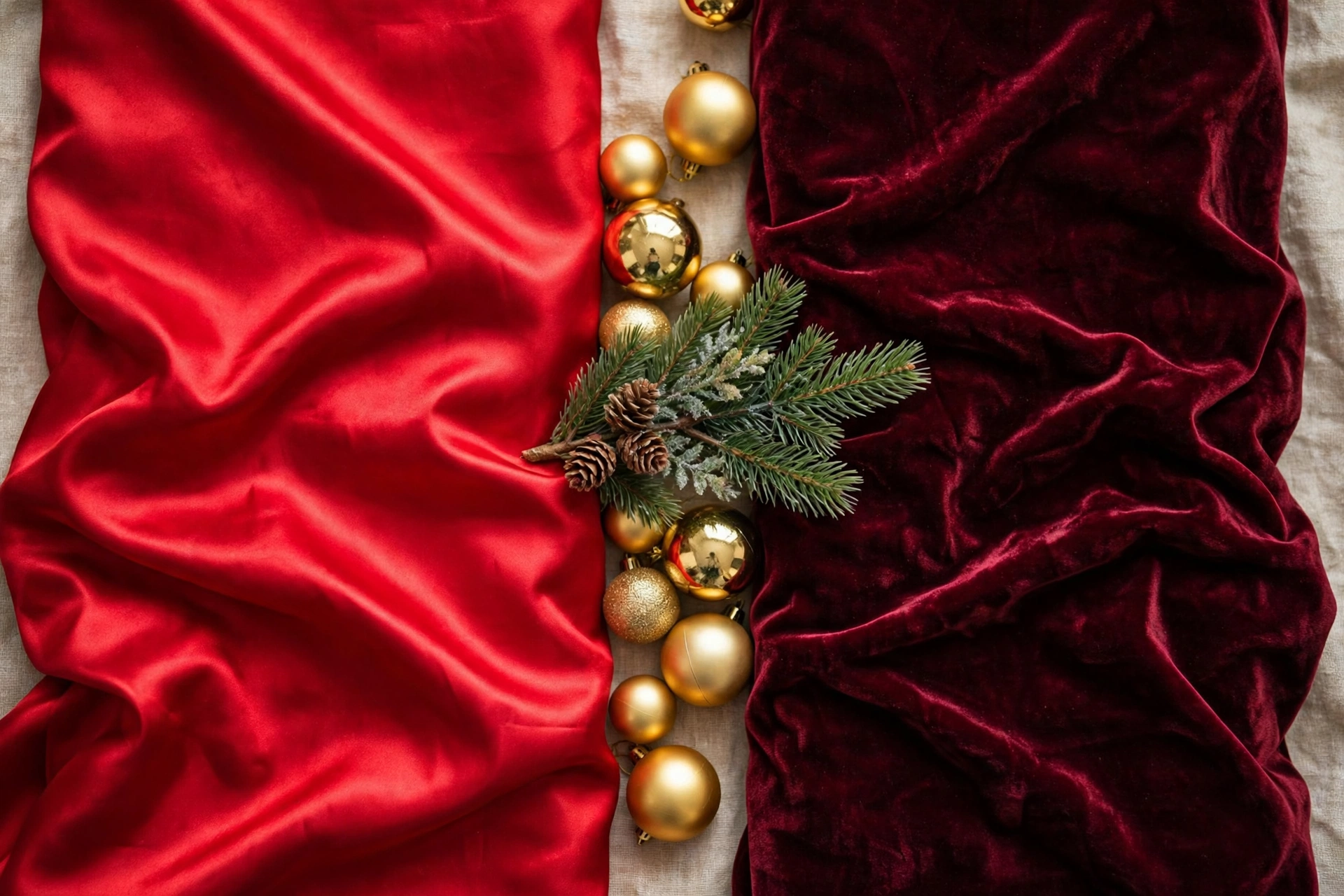
The Christmas dress question: shine or softness?
Every December, the same decision lands in front of anyone sewing a Christmas dress: satin or velvet? Both are festive, both photograph beautifully, and both are sold by the yard at ValentinaTextile.com — but they behave very differently on the body, under the sewing machine, and on a cold December evening. Satin is the fabric of shine: smooth, fluid and light-catching. Velvet is the fabric of depth: soft, warm and rich. Here is how they compare for a Christmas dress, and which one suits the dress you have in mind.
Satin for Christmas dresses: shine, drape and movement
Satin makes a Christmas dress that moves. The smooth face of the fabric catches the light as you walk, so a satin dress changes as the room changes — bright under the tree lights, softer in candlelight. It drapes in long, fluid folds, which makes it the natural choice for full skirts, bias-cut dresses, A-line silhouettes and anything with movement built in. A satin dress looks elegant without trying, and it is the fabric most people picture when they think of a Christmas party dress.
Satin is also the lighter of the two fabrics, which matters at a long evening event. A satin dress stays comfortable through dinner, dancing and photographs, and it packs and travels well — a useful thing when the party is not at your house. Mikado satin, the heavier structured cousin of dress satin, holds a shape beautifully, so it is the pick for a fitted bodice, a sculpted skirt or a dress with a defined silhouette. Our Mikado Satin is sold by the yard, and the full Satin Fabrics collection covers bridal satin, charmeuse and more.
Satin’s limits are practical ones. It shows water spots, so keep drinks away from the dress, and it can feel cool against the skin on a winter evening — a wrap or a shawl is a wise companion. It also slips under the sewing machine, so pin generously, use a sharp needle, and cut with the fabric flat and weighted rather than hanging. Satin rewards patience, and the result is a dress that photographs like a magazine page.
Velvet for Christmas dresses: warmth, depth and drama
Velvet makes a Christmas dress that feels like Christmas. The pile catches the light in a different way from satin: instead of a bright shine, velvet gives a deep, soft glow that changes colour as you move. A burgundy velvet dress looks almost black in shadow and wine-red in the light; a forest green velvet dress shifts between deep green and emerald. That depth is why velvet is the fabric of winter evenings, candlelit dinners and formal Christmas photographs.
Velvet is also the warmer of the two fabrics, and on a cold December night that is not a small thing. A velvet dress with long sleeves is genuinely cosy, and it does not need a wrap. It suits structured silhouettes — a fitted bodice, a sheath dress, a wrap dress — because the pile gives the fabric body and presence. Stretch velvet adds comfort: it moves with you, which makes it the easiest velvet to wear all evening. Our Premium Velvet includes soft stretch velvet in 49 colours, and the Velvet Fabric collection covers royal velvet and silk rayon velvet too.
Velvet is the more demanding fabric to sew: it slips, it shows pin marks, and pressing it the wrong way crushes the pile. Use a walking foot, pin inside the seam allowance, and steam rather than iron. It is also the least washable of the two — dry-clean a velvet dress, or spot-clean it gently. But a velvet Christmas dress is a keepsake: the one you bring out every December and wear for years.
Satin vs velvet at a glance
Look: satin shines bright and fluid; velvet glows deep and soft. A satin dress looks glamorous; a velvet dress looks luxurious. Both photograph beautifully, but satin photographs bright and velvet photographs rich.
Warmth: velvet is clearly warmer — the pile insulates, and a long-sleeved velvet dress needs no wrap. Satin is lighter and cooler, which suits a heated room and a long evening of dancing.
Ease of sewing: both slip under the machine, but velvet is harder — it shows pin marks and crushed pile, while satin forgives a little more and presses more easily. A first-time dressmaker will find satin the friendlier of the two; an experienced sewer will enjoy velvet’s drama.
Care: satin can usually be hand-washed or dry-cleaned depending on the fibre; velvet should be dry-cleaned or spot-cleaned gently. Both should be stored hanging, out of direct sun, so the dress is ready next December.
Cost per dress: satin is usually the cheaper of the two per yard, and a simple A-line satin dress needs around three yards. Velvet costs a little more, and a long-sleeved velvet dress needs three to four yards — but both are sold by the yard in one continuous cut, so the colour stays consistent across the whole dress.
Which fabric should you choose?
Choose satin for a Christmas party dress: a full skirt, a bias cut, a dress that moves when you dance. Choose velvet for a formal Christmas dinner, a family photograph, or a cold evening when warmth matters as much as looks. Choose Mikado satin when the dress needs structure — a fitted bodice, a sculpted skirt — and choose stretch velvet when comfort matters most, because it moves with you all evening.
Colour matters too. For satin, classic Christmas colours are red, emerald, champagne and black — all shine beautifully. For velvet, burgundy, forest green, navy and plum are the colours that show off the pile best. And if you truly cannot decide, make both: a satin dress for the party and a velvet dress for Christmas Day is the kind of problem every sewer would like to have. Our Velvet vs Satin guide compares the two fabrics in more detail, and our Satin vs Charmeuse guide helps you pick the right satin.
Shop satin and velvet by the yard at ValentinaTextile.com
There is still time to sew this year’s Christmas dress, and the fabric is the easy part. Browse the Satin Fabrics collection and the Velvet Fabric collection at ValentinaTextile.com, order by the yard in one continuous cut, and make a dress that will be photographed, complimented and remembered — and if you are making the whole Christmas look, our Christmas stockings guide shows how the same fabrics finish the mantelpiece too.
Frequently asked questions
Is satin or velvet better for a Christmas dress?
Satin is better for a party dress that moves — full skirts, bias cuts and dancing. Velvet is better for a formal or cold-weather Christmas dress — it is warmer, richer and more dramatic. Both are festive; the choice depends on the occasion.
How much fabric do I need for a Christmas dress?
Most Christmas dresses need three to four yards, depending on the style and your size. A simple A-line satin dress needs around three yards; a long-sleeved velvet dress needs three to four. Buying by the yard in one continuous cut keeps the colour consistent.
Can I wash a satin or velvet Christmas dress?
Satin can usually be hand-washed or dry-cleaned, depending on the fibre — check the care label on your fabric. Velvet should be dry-cleaned or spot-cleaned gently, and never ironed directly, or the pile will crush.