Spring events call for light fabrics — and three of them do the heavy lifting
Spring is the season of garden weddings, baby showers, brunches and outdoor parties, and the décor that suits it best is light, airy and soft. Heavy velvets and dark satins belong to winter; spring wants fabric that moves in a breeze, catches the light and photographs in pastels.
This guide shows how to use pastel chiffon, organza and lace for spring event décor: what each fabric does best, how to combine them without the look getting busy, and how much to buy. All three are sold by the yard at ValentinaTextile.com.
Pastel chiffon: the fabric that makes a room feel soft
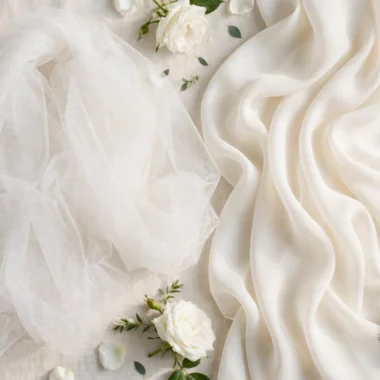
Chiffon is a sheer woven fabric with a fluid, liquid drape. It falls in soft folds instead of standing away from the body of a table or a wall, which makes it the best of the three for large swags and ceiling draping. A length of blush or lavender chiffon gathered along a wall or strung between trees turns a plain space into something romantic, and because chiffon is sheer, light passes through it — the drape glows rather than blocks the room.
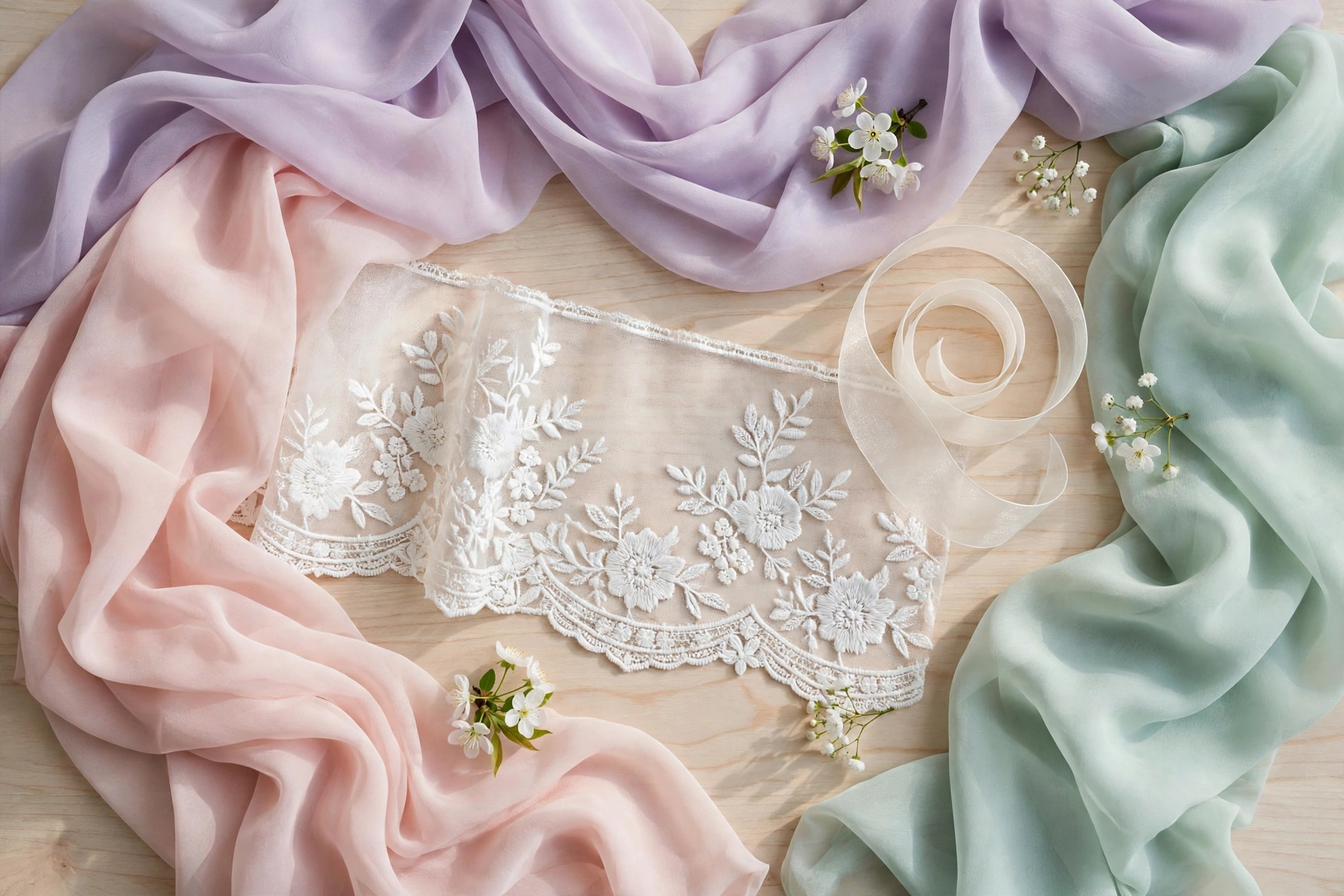
For spring, choose chiffon in blush pink, lavender, mint or pale peach. These colours layer well together — blush with lavender is the classic spring pairing, and mint keeps the palette from looking too sweet. Our Chiffon Fabric collection is sold by the yard in one continuous cut, so a long drape comes as a single piece with no joins to hide. If you are choosing between chiffon and organza for a veil or an overlay, our chiffon vs organza comparison explains how the two sheers differ.
Organza: structure, sparkle and shape
Organza is the sheer with backbone. It is crisp and springy, holding a shape instead of collapsing into folds, which makes it the right choice wherever chiffon is too soft: bows that must stand up, chair sashes with a defined loop, table overlays that should hover over the cloth beneath, and overskirts that need volume.
Organza also has a subtle sparkle that chiffon does not. Its fine weave catches the light and glints, so it reads beautifully in photographs — a good reason to use it where the camera will be, such as the head table, the cake table or the photo backdrop. In pastel shades it is almost luminous: ivory organza over a coloured cloth makes the colour glow through.
Use organza where you want definition. A wide organza ribbon tied around a bouquet, a row of organza bows along a head table, or organza poufs gathered at the corners of a canopy all hold their shape for the whole event. Our Tulle & Organza collection includes organza in the pastel range, and our tulle vs organza for weddings guide covers the pairing in more detail for bridal use.
Lace: the detail that makes it look finished
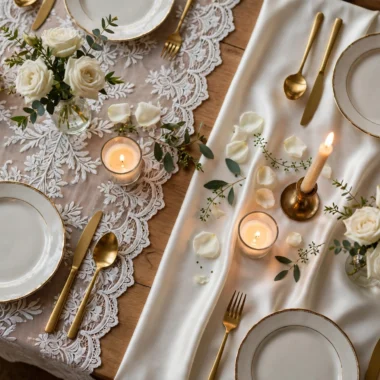
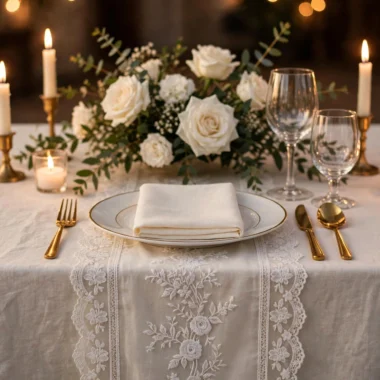
Lace is the finishing layer. Where chiffon and organza give you colour and movement, lace gives you pattern — the embroidered floral or geometric motif that makes a table setting look deliberate instead of improvised. A lace runner down the centre of a table, a lace overlay on a cake table, or lace-trimmed napkins are small touches that carry the whole look.
Spring lace works best in ivory or white, letting the pastel chiffon and organza supply the colour. A white embroidered lace runner over a blush chiffon cloth, or a lace overlay on a mint tablecloth, gives a layered look with depth: the eye reads the colour first and the lace pattern second.
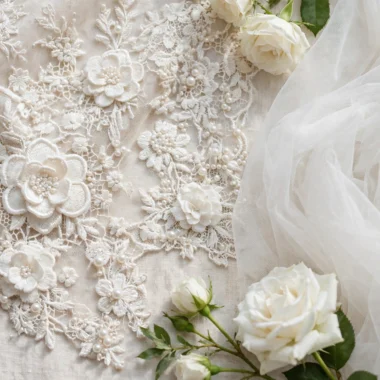
Choose the lace weight to match the job. A fine embroidered mesh lace is right for overlays and runners, where you want the table beneath to show through; a heavier 3D lace suits a statement piece such as a backdrop panel or a cake-table front. Our Lace Fabric collection covers both, and our lace fabric types guide explains the difference between 3D, beaded and embroidered lace.
Combining the three without the look getting busy
Three sheer fabrics on one table can look layered and luxurious, or it can look like a pile of fabric. The rule is simple: one fabric carries the colour, one carries the shape, one carries the detail — and only one of them is the star in any single spot.
On a table, let chiffon or organza carry the colour as a cloth or a swag, and let lace carry the detail as a runner or an overlay. Do not put a lace runner over a lace cloth, and do not drape chiffon and organza in the same colour over the same surface — two sheers in the same shade cancel each other out and look like one muddy layer. Instead, contrast them: blush chiffon under ivory lace, or mint organza over a white cloth with a lace runner on top.
How much fabric do you need?
Event décor is measured by the metre of fabric per metre of surface, plus gathering. For a table runner, buy the table length plus about 30 cm at each end for the drop. For a tablecloth overlay, buy the table length plus twice the drop you want on each side. For draping and swags, buy two to three times the straight-line distance, because a gathered swag uses that much fabric to make its folds — a 3-metre wall needs 6 to 9 metres of chiffon for a full, soft drape.
For chair sashes, allow about 2.5 metres of organza per chair for a full bow, or about 1.5 metres for a simple knot. For a backdrop, measure the width and the height, then add at least half again for gathering. Because all three fabrics are sold by the yard in one continuous cut at ValentinaTextile.com, order the full length in one piece: a join across a drape or a runner is almost impossible to hide.
Shop pastel chiffon, organza and lace by the yard at ValentinaTextile.com
Spring décor does not need expensive props — it needs the right fabrics in the right colours, cut in one continuous piece and used with a clear plan. Start with chiffon for softness and colour, add organza where you need shape and sparkle, and finish with lace where you want detail. Browse the Chiffon Fabric collection, the Tulle & Organza collection and the Lace Fabric collection at ValentinaTextile.com, and order by the yard for a spring event that looks light, layered and finished.
Frequently asked questions
Which fabric is best for draping a spring event backdrop?
Chiffon is the best choice for large drapes and swags: it falls in soft folds, lets light through and gathers beautifully. Organza is better for bows and structured accents, and lace is best as a detail layer — a runner, an overlay or a centre panel — rather than the main drape.
Can I mix chiffon, organza and lace on the same table?
Yes, if one fabric carries the colour, one the shape and one the detail. A blush chiffon cloth with an ivory lace runner is the classic combination. Avoid using two sheers in the same colour on the same surface, and keep the palette to two pastels plus ivory or white.
How much chiffon do I need for a draped backdrop?
Buy two to three times the straight-line width for a full, gathered drape — a 3-metre wall needs 6 to 9 metres of chiffon. Order the full length in one continuous cut so there is no join across the drape.