Felt looks easy — until your first cut goes ragged
Felt is the fabric every beginner reaches for at Christmas: it does not fray, it holds its shape, and scissors plus a bottle of glue are enough to turn it into ornaments, stockings and garlands. But anyone who has tried it knows the other side. Edges come out wobbly, glue seeps through and stiffens the felt, and pieces that looked perfect on the table peel apart by morning.
The good news is that all three problems have simple fixes. Cut felt the right way, pick the right glue for the job, and start with projects that forgive small mistakes, and your Christmas crafts will look shop-bought. This guide covers tools, cutting, gluing, and three beginner projects you can finish in an afternoon.
Everything here uses the Premium Acrylic Felt Fabric by the Yard from ValentinaTextile.com: 100% acrylic, 72 inches wide, 1.6mm thick, non-fraying, in 40 colours — one order covers your whole project list.
Why felt is the best beginner fabric for Christmas crafts
Felt forgives beginners in ways almost no other fabric does. Because it is pressed, not woven, it has no grain to fight and no raw edge that unravels. Cut a star, a tree or a snowflake, and the edge stays exactly as you cut it — no hemming, no overlocking, no fray-check.
The felt we use is 1.6mm thick — the sweet spot: thick enough to hold its shape, thin enough to cut with ordinary scissors. Sold by the yard in one continuous cut, a single yard gives you a generous sheet for dozens of ornaments, and the 72-inch width means a large stocking needs no joins.
The tools you actually need
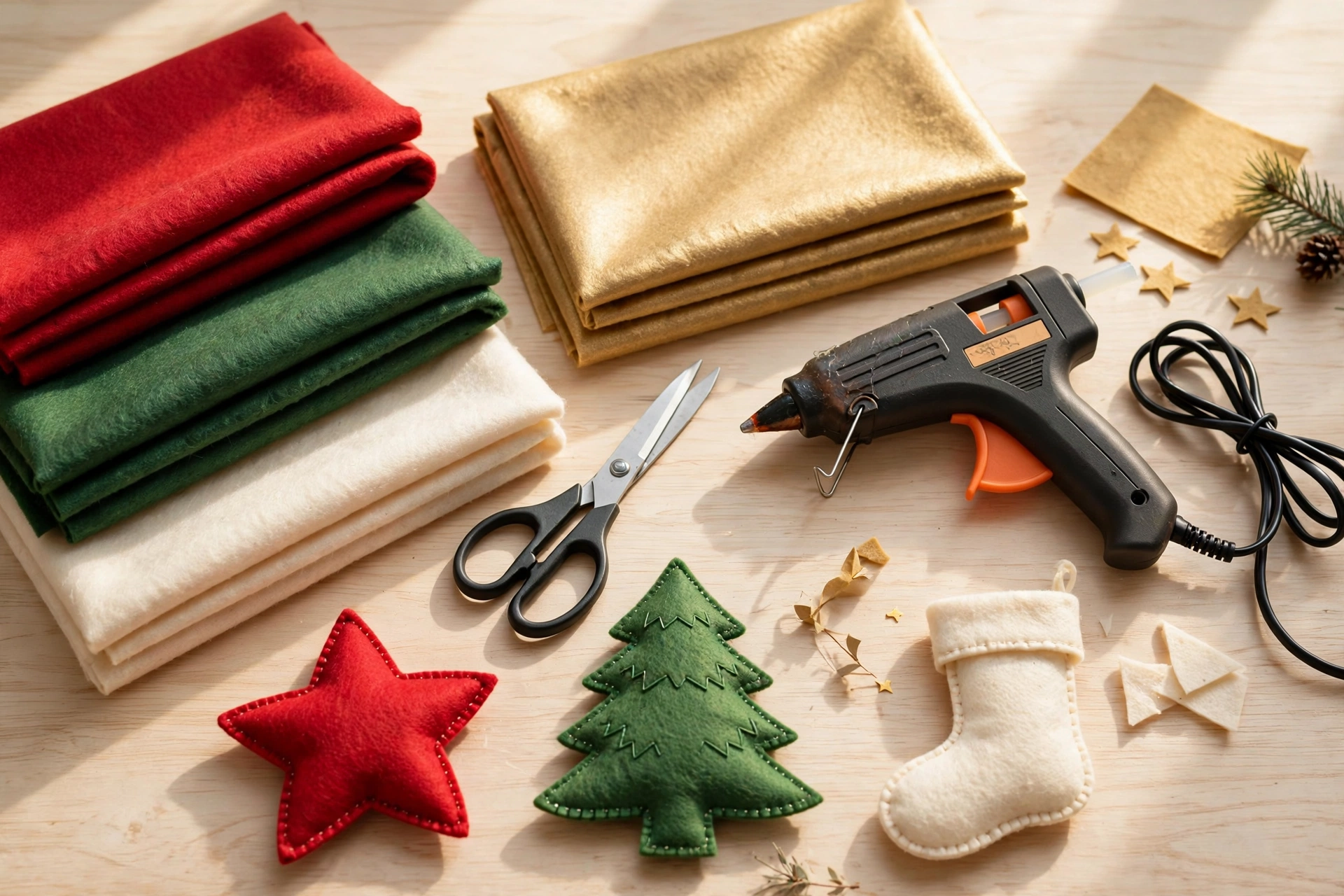
Five things cover nearly every felt project: sharp fabric scissors (or a rotary cutter and mat for straight edges), a fabric marker or tailor’s chalk, straight pins, a low-temperature glue gun, and a bottle of clear fabric glue for detail work. A self-healing cutting mat protects your table; a metal ruler helps with garland strips.
One thing worth spending on is the scissors. Dull scissors are the single biggest cause of ragged felt edges — they push the fibres instead of cutting them, leaving a fuzzy, chewed line. Keep one pair reserved for fabric only; cutting paper dulls the edge fast.
How to cut felt cleanly, step by step
Clean cutting is a technique, not a talent. Press the felt flat first — a low iron with a cloth barrier removes creases. Lay it on your cutting mat and pin your template with two pins so it cannot shift.
Cut with long, smooth strokes, keeping the felt flat on the table — lifting it creates wavy edges. For tight curves, stop, pivot the felt (not the scissors), and continue. Short snips around curves leave a stepped edge; one slow, continuous cut leaves a smooth one.
For straight strips, a rotary cutter and ruler beat scissors. Roll the cutter in one firm pass and do not go back over a half-cut line — a second pass wanders and leaves a ridge. If an edge comes out rough, a quick trim with sharp scissors fixes it — felt’s non-fraying edge means you can tidy it without the cut unravelling.
How to glue felt so it actually holds
Glue is where most felt projects fail, and the fix is choosing the right glue for the joint. Fabric glue is best for flat, detailed work: spread a thin layer, press the pieces together, and leave them for at least an hour. The mistake is using too much — a thick puddle soaks through, dries stiff, and shows as a dark patch. Less is more; a toothpick spreads it precisely.
Hot glue is best for structural joints — ornament loops, stocking cuffs, garland pieces that get handled a lot. Use a low-temperature gun: high heat can scorch acrylic felt and leaves hard, brittle blobs. Apply, press firmly for ten seconds, and do not wiggle the joint. Hot glue grabs fast and forgives nothing once cool, so dry-fit first.
For anything a child will pull at, use both: fabric glue for a neat bond, plus a hidden stitch or hot glue at stress points. Always test glue on a scrap first — a thirty-second test saves a ruined ornament.
Three beginner projects to start with
Start with felt ornaments. Cut two identical shapes — stars, trees, hearts — glue or stitch them together, leaving a small gap, stuff lightly with cotton wool, and close the gap. Add a ribbon loop with a dot of hot glue. A set of six takes about an hour, and any imperfect cut disappears on the tree.
Next, a felt stocking: trace a stocking shape onto folded felt for a front and back in one cut, glue or stitch the edges, and add a contrasting cuff and a simple appliqué — a star, an initial, a snowflake. The 72-inch width means even an adult-size stocking cuts from a single piece, with no seams to match.
Finally, a garland: cut strips in alternating Christmas colours, fold each into a loop, and glue or staple the ends to form a chain. A garland is the most forgiving project of all: one uneven piece just reads as handmade charm.
For more ideas, our Christmas crafts with felt guide covers ornaments, stockings and garlands in more detail, and our 10 easy DIY felt crafts show the same skills at work in any season.
Mistakes every beginner makes (and how to avoid them)
First, cutting with dull scissors — it causes half of all ragged edges. Second, gluing before testing the fit; always dry-fit, then glue. Third, pressing felt with a hot iron directly on the fabric, which can flatten and shine it — always use a cloth barrier and low heat.
Fourth, the wrong felt weight. Thin craft-store felt squares are fine for one ornament, but they flop and curl on larger pieces; 1.6mm premium felt holds its shape, which matters for anything that hangs. Fifth, buying too little: felt is inexpensive, and spare colours let you experiment — order a yard of each colour from the Felt Fabric collection and you will have enough for the project plus practice pieces.
Shop felt by the yard at ValentinaTextile.com
Christmas crafts are supposed to be relaxing, and felt is the fabric that makes that possible — no fraying, no hemming, no special skills, just sharp scissors, the right glue, and a little patience. Start with ornaments, work up to a stocking and a garland, and by the time the tree goes up your decorations will look shop-bought.
Browse the Felt Fabric collection at ValentinaTextile.com — 40 colours, 72 inches wide, sold by the yard in one continuous cut, with fast US shipping. Order your Christmas colours now, while the full range is in stock.
Frequently asked questions
What is the best glue for felt crafts?
Clear fabric glue is best for flat, detailed work because it dries flexible and invisible; a low-temperature hot glue gun is best for structural joints because it grabs instantly. Use a thin layer — too much soaks through and dries stiff — and always test on a scrap first.
Does felt fray when you cut it?
No. Premium acrylic felt is pressed, not woven, so cut edges do not unravel. The 1.6mm felt at ValentinaTextile.com is non-fraying, which is why it suits Christmas ornaments, appliqué and garlands.
What thickness of felt should I use for Christmas crafts?
Use 1.6mm felt for most Christmas crafts: thick enough to hold its shape, yet thin enough to cut with ordinary scissors and fold without cracking. Thinner felt flops and curls; much thicker felt is hard to cut cleanly by hand.