
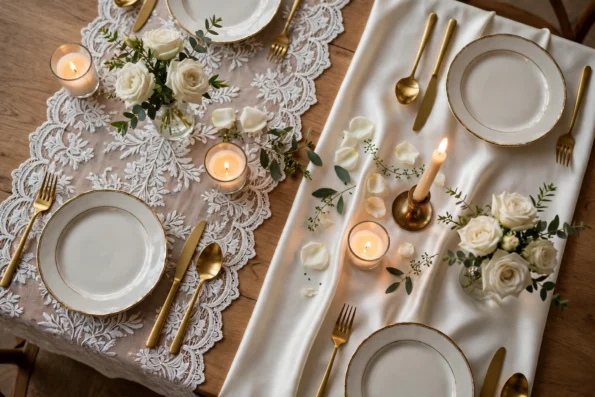
White lace table runner beside a smooth ivory satin runner on an event table with gold cutlery and white roses

Lace Runners vs Satin Runners for Event Tables

The runner sets the tone of the whole table — and lace and satin set very different ones At a wedding, a banquet or a party, guests notice the runner before they notice the plates. It runs down the centre of the table, frames the flowers and candles, and appears in almost every photograph. The two fabrics event planners reach for most are lace and satin, and they could hardly be more different: lace is patterned, textured and romantic; satin is smooth, reflective and formal. Choosing between them is not about which is better — it is about which one matches the event, the table and the rest of the décor. What a lace runner does for a table A lace runner brings pattern to a table. Its embroidered floral or geometric motif gives the eye something to follow down the length of the table, and because lace is open — a mesh with embroidery on it — the tablecloth beneath shows through. That layering is lace’s great strength: a white lace runner over a coloured cloth creates a two-tone effect, and the same runner over a white cloth reads as a subtle texture rather than a colour block. Lace suits events with a romantic, vintage or garden feel: weddings, bridal showers, christenings and afternoon teas. It photographs beautifully in close-up, and it pairs naturally with flowers and candles. Lace has two practical limits. It snags — jewellery, rough wood and metal cutlery can catch the embroidery — so it needs a smooth cloth underneath and careful handling when the table is set. And it is harder to clean: food and wine sit in the open mesh, so lace runners are best spot-cleaned or hand-washed rather than put through a machine. What a satin runner does for a table A satin runner brings shine to a table. Its smooth, reflective surface catches the light and throws it back, which makes the whole table look brighter and more formal. A satin runner in ivory, gold or burgundy is the classic choice for evening events, galas and black-tie weddings, where the light is low and the table needs to glow. Satin’s drape is its other advantage. It falls in clean, fluid folds with no stiffness, so a satin runner lies flat and smooth down the centre of the table and drops neatly over the ends. That clean line suits modern and minimalist décor. The price of that shine is that satin shows everything: every crease and water mark is visible on a reflective surface, so a satin runner must be pressed before the event and laid out as late as possible before guests arrive. Our Satin Fabrics collection includes bridal, mikado and charmeuse satins in the colours used for event runners, and our satin vs charmeuse comparison covers the shine and drape differences within the satin family. Lace vs satin at a glance Look: lace is patterned and textured, satin is smooth and reflective. Lace adds detail to a table; satin adds light. A lace runner makes a plain table interesting, while a satin runner makes a dark room brighter. Drape: satin wins for a clean, flat lay — it falls smoothly and holds a straight edge. Lace is softer and more forgiving: it drapes over uneven surfaces and hides creases, but its edge is a scallop or a pattern rather than a straight line, so it reads as decorative rather than tailored. Care: satin is the easier fabric to live with. Spills wipe off, it irons flat, and it does not snag. Lace needs gentle handling, spot cleaning and careful storage — roll it rather than folding it, and keep it away from rough surfaces and jewellery. Which runner for which event? Weddings: lace for a daytime or garden wedding, satin for an evening or ballroom wedding. A lace runner over a white cloth is the classic daytime look; a satin runner in ivory or gold is the classic evening look. Many weddings use both — lace on the guest tables and satin on the head table, or a satin cloth with a lace runner on top. Bridal and baby showers: lace. The event is daytime, the mood is soft, and the photographs are close-ups — exactly where lace is strongest. A lace runner with fresh flowers and pastel accents is the shower table in its most familiar form. How to measure and make a runner A runner should be about one-third the width of the table — roughly 30 to 40 cm on a standard 90 cm banquet table — and it should hang about 15 to 30 cm over each end. Measure the table length, add 30 to 60 cm for the drop at both ends, and that is the length to buy. For a 2.4-metre banquet table, that means about 3 metres of fabric per runner. For lace, buy a lace width made for runners — 20-inch lace trim is a standard size — or cut a wider lace to width and finish the long edges with a narrow hem or a lace edging. For satin, cut the fabric to the runner width and hem all four edges. In both cases, buy the full length in one continuous cut: a join across a runner is visible in every photograph. Our Table Linens collection covers the cloths and linens a runner sits on, and our table linens guide explains how runners, cloths and overlays work together. Can you layer lace over satin? Yes — and it is one of the best-looking combinations in event décor. A satin runner gives the table its colour and shine, and a lace runner laid over it adds pattern and texture. The key is contrast: the satin should be a solid colour, and the lace should be ivory or white, so the pattern reads clearly against the shine. A white lace runner over a burgundy satin runner is a classic wedding combination; an ivory lace runner over a gold satin runner is a
CONTINUE READING ➞
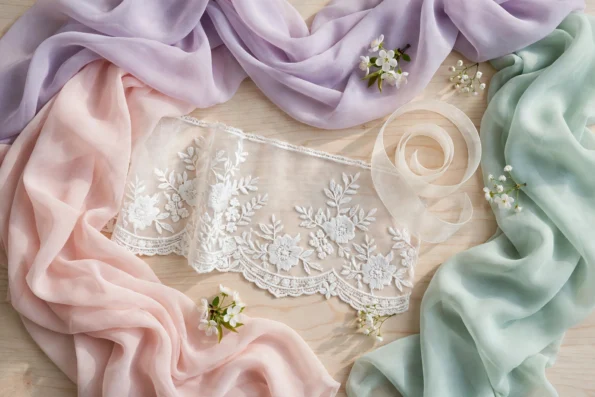
Pastel chiffon in blush, lavender and mint with ivory embroidered lace and an organza ribbon

Spring Event Décor: Pastel Chiffon, Organza and Lace

Spring events call for light fabrics — and three of them do the heavy lifting Spring is the season of garden weddings, baby showers, brunches and outdoor parties, and the décor that suits it best is light, airy and soft. Heavy velvets and dark satins belong to winter; spring wants fabric that moves in a breeze, catches the light and photographs in pastels. This guide shows how to use pastel chiffon, organza and lace for spring event décor: what each fabric does best, how to combine them without the look getting busy, and how much to buy. All three are sold by the yard at ValentinaTextile.com. Pastel chiffon: the fabric that makes a room feel soft Chiffon is a sheer woven fabric with a fluid, liquid drape. It falls in soft folds instead of standing away from the body of a table or a wall, which makes it the best of the three for large swags and ceiling draping. A length of blush or lavender chiffon gathered along a wall or strung between trees turns a plain space into something romantic, and because chiffon is sheer, light passes through it — the drape glows rather than blocks the room. For spring, choose chiffon in blush pink, lavender, mint or pale peach. These colours layer well together — blush with lavender is the classic spring pairing, and mint keeps the palette from looking too sweet. Our Chiffon Fabric collection is sold by the yard in one continuous cut, so a long drape comes as a single piece with no joins to hide. If you are choosing between chiffon and organza for a veil or an overlay, our chiffon vs organza comparison explains how the two sheers differ. Organza: structure, sparkle and shape Organza is the sheer with backbone. It is crisp and springy, holding a shape instead of collapsing into folds, which makes it the right choice wherever chiffon is too soft: bows that must stand up, chair sashes with a defined loop, table overlays that should hover over the cloth beneath, and overskirts that need volume. Organza also has a subtle sparkle that chiffon does not. Its fine weave catches the light and glints, so it reads beautifully in photographs — a good reason to use it where the camera will be, such as the head table, the cake table or the photo backdrop. In pastel shades it is almost luminous: ivory organza over a coloured cloth makes the colour glow through. Use organza where you want definition. A wide organza ribbon tied around a bouquet, a row of organza bows along a head table, or organza poufs gathered at the corners of a canopy all hold their shape for the whole event. Our Tulle & Organza collection includes organza in the pastel range, and our tulle vs organza for weddings guide covers the pairing in more detail for bridal use. Lace: the detail that makes it look finished Lace is the finishing layer. Where chiffon and organza give you colour and movement, lace gives you pattern — the embroidered floral or geometric motif that makes a table setting look deliberate instead of improvised. A lace runner down the centre of a table, a lace overlay on a cake table, or lace-trimmed napkins are small touches that carry the whole look. Spring lace works best in ivory or white, letting the pastel chiffon and organza supply the colour. A white embroidered lace runner over a blush chiffon cloth, or a lace overlay on a mint tablecloth, gives a layered look with depth: the eye reads the colour first and the lace pattern second. Choose the lace weight to match the job. A fine embroidered mesh lace is right for overlays and runners, where you want the table beneath to show through; a heavier 3D lace suits a statement piece such as a backdrop panel or a cake-table front. Our Lace Fabric collection covers both, and our lace fabric types guide explains the difference between 3D, beaded and embroidered lace. Combining the three without the look getting busy Three sheer fabrics on one table can look layered and luxurious, or it can look like a pile of fabric. The rule is simple: one fabric carries the colour, one carries the shape, one carries the detail — and only one of them is the star in any single spot. On a table, let chiffon or organza carry the colour as a cloth or a swag, and let lace carry the detail as a runner or an overlay. Do not put a lace runner over a lace cloth, and do not drape chiffon and organza in the same colour over the same surface — two sheers in the same shade cancel each other out and look like one muddy layer. Instead, contrast them: blush chiffon under ivory lace, or mint organza over a white cloth with a lace runner on top. How much fabric do you need? Event décor is measured by the metre of fabric per metre of surface, plus gathering. For a table runner, buy the table length plus about 30 cm at each end for the drop. For a tablecloth overlay, buy the table length plus twice the drop you want on each side. For draping and swags, buy two to three times the straight-line distance, because a gathered swag uses that much fabric to make its folds — a 3-metre wall needs 6 to 9 metres of chiffon for a full, soft drape. For chair sashes, allow about 2.5 metres of organza per chair for a full bow, or about 1.5 metres for a simple knot. For a backdrop, measure the width and the height, then add at least half again for gathering. Because all three fabrics are sold by the yard in one continuous cut at ValentinaTextile.com, order the full length in one piece: a join across a drape or a runner is almost impossible to hide. Shop pastel chiffon, organza and lace by the yard at

CONTINUE READING ➞
My Cart
Wishlist
Recently Viewed
Categories

SPIN TO WIN!

  • Try your luck to get a discount coupon
  • 1 spin per email
  • No cheating
Try Your Lucky
Never
Remind later
No thanks