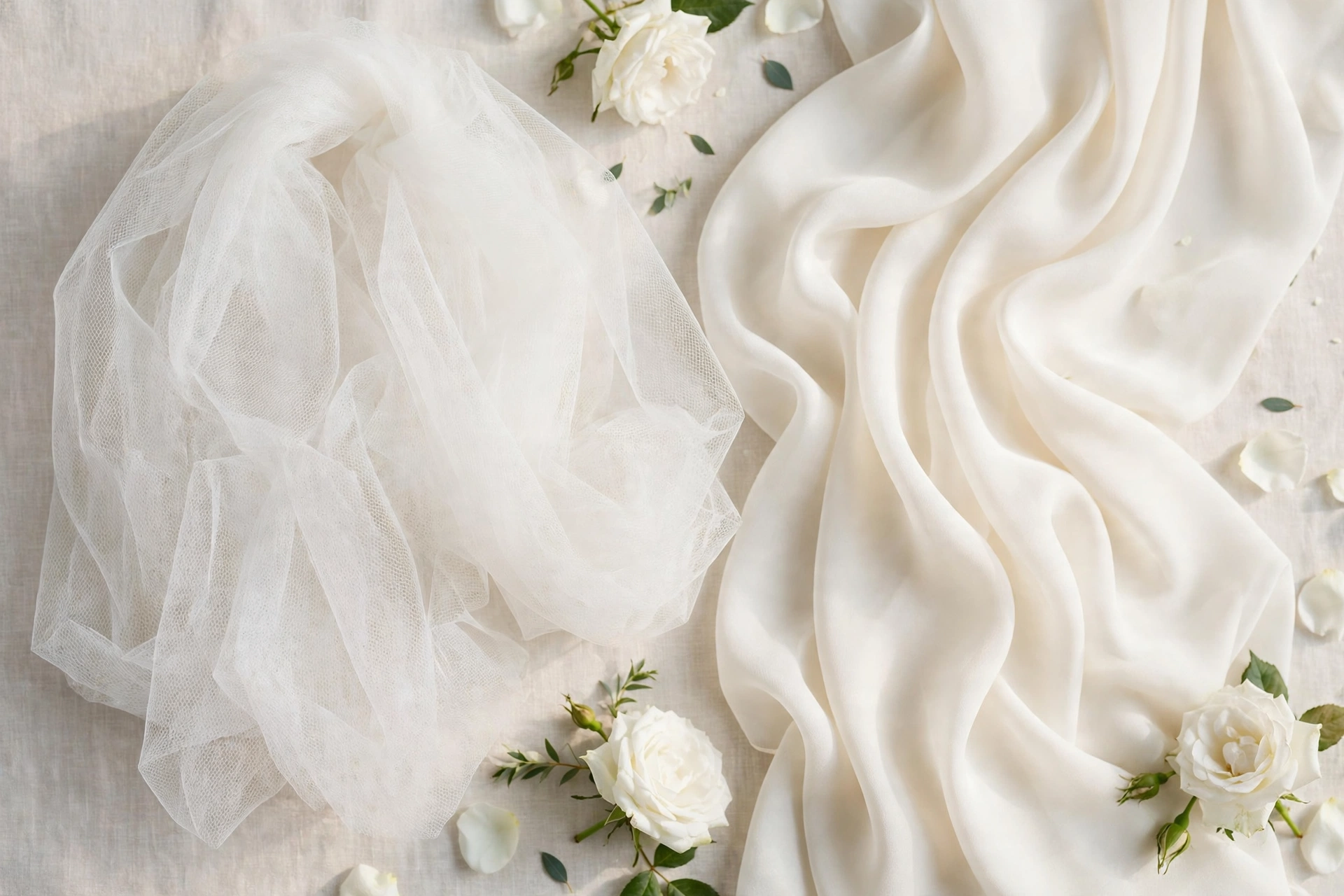
A veil is the first thing people see — and the fabric decides how it moves
A veil frames the face, catches the light in every photograph and moves with every step down the aisle. Choose the wrong sheer fabric and it fights you: too stiff and it sticks out like a tent, too heavy and it pulls, too transparent and the lace detail disappears. Tulle and chiffon are the two fabrics most brides and makers reach for, and they behave very differently once they are cut, gathered and worn.
This guide compares tulle and chiffon for veils and overlays — what each fabric is, how it drapes, how sheer it really is, and which one suits each veil style. Both are sold by the yard at ValentinaTextile.com.
What tulle is — and why it is the classic veil fabric
Tulle is a fine netting: open hexagonal mesh made from nylon or polyester, light as air and springy enough to hold a shape. It is the fabric of the classic bridal veil for a reason. A tulle veil stands away from the face instead of clinging to it, so it photographs as a soft halo around the bride, and it holds a gathered pouf or a blusher layer without collapsing.
That structure is also tulle’s main limitation. Because it is a net, tulle has no fluid drape — it will not fall in soft folds the way a woven fabric does. Short tulle veils look perky and full, but a long tulle veil needs volume and fullness to look intentional. Tulle also snags, so keep it away from beading, velcro and jewellery clasps.
Our Tulle & Organza collection includes tulle in bolt widths for veils and overlays, including the Tulle Bolt 54″ — a practical width for a single-panel veil with no centre seam. Buy the bolt, not the narrow roll, when the veil is wide: a seam down the middle of a veil is visible in photographs.
What chiffon is — and where it beats tulle
Chiffon is a woven sheer fabric, not a net. Its fine, tightly twisted yarns give it a soft, slightly grainy hand and a fluid drape that tulle cannot match. A chiffon veil or overlay falls in gentle, liquid folds, moves with the body, and catches the light in a soft shimmer rather than a sparkle. It is more opaque than tulle — still sheer, but with enough body to soften what is behind it rather than showing it plainly.
That fluidity makes chiffon the better choice when the veil is meant to flow rather than float. A long, single-layer chiffon veil trailing behind a dress looks romantic and weightless in motion, and a chiffon overlay on a skirt or bodice softens the silhouette underneath without adding stiffness.
Chiffon is less forgiving to sew than tulle. It slips under the presser foot, frays the moment it is cut, and shows every pin hole. Use a fine needle, a walking foot if you have one, and French seams or a rolled hem on the edges. Our Chiffon Fabric collection is sold by the yard in one continuous cut, so a long veil comes as a single piece with no joins.
Tulle vs chiffon at a glance
Sheerness: tulle is the more transparent of the two — you see clearly through it, which is why it suits a blusher layer worn over the face. Chiffon is sheer but softer, veiling the face or dress rather than revealing it. If the veil will be worn over the face, tulle is the traditional choice; if it is worn back, chiffon gives a prettier line.
Drape: chiffon wins outright. It falls in soft folds and moves with the wearer. Tulle holds its shape and springs away from the body — beautiful for a full, airy veil.
Weight: both are light, but tulle feels lighter because so much of it is air. A full tulle veil with several layers can still feel weightless; a long chiffon veil has a gentle pull you can feel on a comb or headpiece.
Care: both are delicate. Keep them away from heat, steam them rather than ironing them, and store a veil rolled in tissue rather than folded — folds in tulle crease permanently, and folds in chiffon press in as lines that are hard to remove.
Which fabric for which veil style?
Birdcage and shoulder-length veils: tulle. Its body holds the shape, and the short length shows off its airy fullness. A chiffon veil this short has nothing to drape with and can look limp.
Elbow and fingertip veils: either, and this is where the choice is really about the dress. A structured gown with a full skirt pairs well with tulle; a fluid, bias-cut or slip dress pairs better with chiffon, which echoes the dress’s movement.
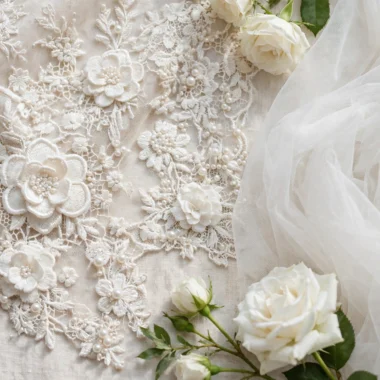
Floor-length and cathedral veils: chiffon for a single-layer veil that trails and photographs in motion; tulle for a multi-layer veil with volume and drama. If the veil has lace appliqué, tulle is the easier base — appliqué sits flatter on a net and the open mesh lets the lace pattern read clearly.
Overlays on skirts, sleeves and bodices: chiffon. An overlay needs to fall, not stand, and chiffon layers over satin or lace without stiffening the silhouette. Tulle as an overlay works only when volume is the point — a tulle overskirt on a ballgown, for example.
How much fabric do you need?
A veil is cut from the fabric’s width as much as its length. For a standard single-panel veil, buy the veil length plus about 15 cm for the gathered top and the hem. A fingertip veil of about 90 cm needs roughly 1 metre of 54-inch-wide fabric; a floor-length veil of about 180 cm needs about 2 metres.
For overlays, measure the garment panel the overlay will cover and add 10–15 cm on each side for the drape. Because both fabrics are sold by the yard in one continuous cut at ValentinaTextile.com, order the full length in one piece — a join across a veil or an overlay is almost impossible to hide. If you are also choosing between tulle and organza, our tulle vs organza for weddings guide covers that pairing, and our chiffon vs organza comparison explains how chiffon differs from the other classic sheer.
Shop tulle and chiffon by the yard at ValentinaTextile.com
There is no wrong answer — only the wrong fabric for the veil you have in mind. Choose tulle when you want lift, volume and a classic bridal halo; choose chiffon when you want flow, softness and movement. Browse the Tulle & Organza collection and the Chiffon Fabric collection at ValentinaTextile.com, and order by the yard in one continuous cut for a veil with no seams and no compromises.
Frequently asked questions
Is tulle or chiffon better for a wedding veil?
Tulle is the classic choice: it holds its shape, floats away from the face and photographs as a soft halo. Chiffon is better when the veil should flow and move with the dress, especially for a long single-layer veil or a fluid gown. For a blusher worn over the face, tulle is the clearer and more traditional option.
Can I use chiffon as a veil overlay on a dress?
Yes — chiffon falls in soft folds and layers over satin or lace without stiffening the silhouette. Use tulle as an overlay only when volume is the point, such as a tulle overskirt on a ballgown.
How much tulle or chiffon do I need for a veil?
Buy the veil length plus about 15 cm for gathering and hemming: roughly 1 metre for a fingertip veil and 2 metres for a floor-length veil from 54-inch-wide fabric. A two-layer veil needs double the length. Order the full length in one continuous cut so there is no seam across the veil.