
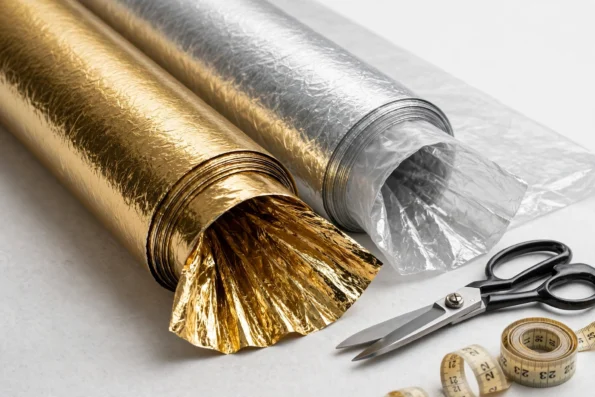
Gold metallic foil lame fabric roll beside silver nylon tissue lame with shears and measuring tape

Polyester vs Nylon Lamé: Shine, Stretch and Care

The short answer: polyester lamé stretches and shines, nylon lamé is light and crisp Lamé is the fabric that makes a room look twice: a metallic foil finish over a lightweight base, giving a liquid, mirror-like shine in gold, silver or a jewel tone. But buy the wrong lamé and your project will fight you — a dress that needs stretch made from a crisp tissue lamé will not move, and a backdrop that needs to hold a fold made from stretch lamé will not sit still. Two lamés cover almost every project: polyester lamé and nylon lamé. Each one shines in a different way and behaves differently under the needle. This guide compares them using real products from ValentinaTextile.com, so you can match the fabric to the outfit, costume or décor you actually want. What is lamé? Lamé is a metallic fabric made by coating or bonding a metallic foil to a lightweight base fabric. The foil gives the shine; the base gives the behaviour. A stretch base makes a wearable, forgiving lamé for dresses and dancewear. A tissue base makes a light, crisp lamé for costumes, backdrops and décor. The foil finish is what makes lamé lamé — and what makes it delicate: heat, friction and rough handling can dull or crack it. Polyester lamé: stretch, shine and wearability Polyester lamé is the wearable one. A foil finish over a stretch spandex blend gives it a liquid shine with two-way to four-way stretch, so a lamé dress moves with the body, does not restrict dancing, and forgives a slightly imperfect fit. It is the lamé for outfits that will actually be worn: party dresses, dance costumes, jumpsuits, fitted tops. Our Metallic Foil Fabric is a stretch spandex blend with an all-over foil finish, 58/60 inches wide, with two-way to four-way stretch. The stretch is what makes it wearable — a dress in this fabric moves, dances and sits comfortably, where a stiff foil fabric would not. The 58/60-inch width gives generous cutting room for dresses and wide-leg trousers. Polyester lamé suits simple, confident silhouettes: a slip dress, a wrap dress, a fitted top, wide-leg trousers, a jumpsuit. The shine is the whole design, so the cut should stay clean. Pair it with a matte fabric — velvet or a plain satin — to balance the shine, and keep accessories quiet. Our costume fabrics guide covers lamé alongside faux fur and velboa, and our dancewear fabrics guide explains how stretch velvet, lamé and mesh work together. Sewing polyester lamé needs care: use a fine needle, a stretch stitch or a serger, and never iron directly on the foil — heat dulls the finish. Press from the wrong side on low heat with a pressing cloth, or steam from a distance. Keep the foil face clean, because the finish shows every fingerprint and crease. Nylon lamé: light, crisp and economical Nylon lamé — also called tissue lamé — is the light, crisp one. A metallic finish over a lightweight nylon base gives it a bright shine with a papery hand that holds a fold and catches light in a different way: less liquid, more glittering. It is the lamé for costumes, backdrops, table décor, bows and crafts — anywhere the fabric needs to be seen rather than worn for hours. Our Nylon Metallic Tissue Lamé is the tissue lamé in our range — lightweight, bright, and economical by the yard. It is the fabric for a gold backdrop, a silver table runner, a costume cape, a dance prop. Because it is light, a lot of it goes a long way: a backdrop or a table drape needs yardage, and tissue lamé covers it without weight or cost. Nylon lamé is less forgiving to sew than polyester lamé: it has no stretch, it frays, and the foil can crack if it is creased sharply or ironed hot. Sew it with a fine needle, finish the edges, and press from the wrong side on low heat. For costumes that will be worn briefly — a school play, a Halloween costume, a dance recital prop — tissue lamé is the practical choice: bright, light, and inexpensive enough to use generously. Polyester vs nylon lamé: a quick comparison Polyester lamé stretches and shines; use it for dresses, dancewear, jumpsuits and outfits that will be worn and moved in. Nylon lamé is light and crisp; use it for costumes, backdrops, table décor, bows and crafts. Polyester lamé is 58/60 inches wide with two-way to four-way stretch. Nylon tissue lamé is lightweight and economical for large-area décor. Both need the same care: fine needle, no direct iron on the foil, press from the wrong side. If you are choosing lamé for a party outfit, our winter party outfits guide compares sequin lace, lamé and velvet for evening wear. Care: keeping the shine Both lamés need gentle care. Hand-wash cold or dry-clean; never iron directly on the foil side — heat dulls and can melt the finish. Press from the wrong side on low heat with a pressing cloth, or steam from a distance. Store lamé hung or rolled, never folded sharply, because sharp creases can crack the foil. Our fabric care guide covers washing and storing velvet, satin, lace and fleece. Shop lamé by the yard Whether you need stretch lamé for a dress or tissue lamé for a backdrop, you will find it at ValentinaTextile.com — sold by the yard, cut fresh from the roll, and shipped as one continuous piece. Start with the Metallic Foil Fabric (stretch spandex, 58/60 inches) for wearable shine, or the Nylon Metallic Tissue Lamé for light, economical sparkle. Frequently asked questions What is the difference between polyester lamé and nylon lamé? Polyester lamé is a foil finish over a stretch spandex blend — it stretches, moves with the body, and suits dresses and dancewear. Nylon lamé is a metallic finish over a lightweight tissue base — it is crisp, light, and suits costumes, backdrops and décor. Can I
CONTINUE READING ➞
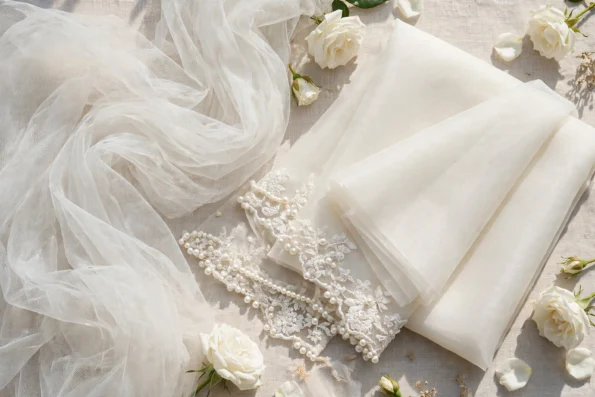
White tulle veil netting beside crisp ivory organza and embroidered lace with pearl beads and white roses

Wedding Veil Fabrics: Tulle, Organza and Lace Compared

The short answer: tulle for softness, organza for structure, lace for detail A wedding veil looks simple — a piece of sheer fabric gathered onto a comb — but the fabric you choose decides everything about how it looks and moves. Choose a fabric that is too stiff and the veil stands out from the head like a lampshade; choose one that is too soft and it collapses against the dress; choose one without detail and it can look unfinished in photographs. Three fabrics cover almost every veil: tulle, organza and lace. Each one does a different job. Tulle is the classic veil fabric — soft, floaty, romantic. Organza is the structured veil fabric — crisp, sculptural, polished. Lace is the detail fabric — usually an edging or appliqué that turns a plain veil into a statement piece. This guide compares all three using real products from ValentinaTextile.com, so you can match the fabric to the veil you actually want. What makes a good veil fabric? A veil fabric needs to be sheer, lightweight, and able to hold a shape without looking stiff. It should drape softly over the face and shoulders, gather neatly onto a comb or headband, and photograph well in both natural light and flash. The best veil fabrics are also easy to cut and finish: a raw edge, a rolled hem, or a lace trim. Tulle: the classic veil fabric Tulle is a fine net fabric made from very fine yarns woven into a small hexagonal mesh. It is feather-light, softly transparent, and famously used for bridal veils, tutus and wedding skirts. Because tulle is a net rather than a woven cloth, it does not fray the way woven fabrics do, and layers of it build up a cloud-like fullness without weight. Our Soft Bridal Tulle is made for veils: 63 inches wide, sold by the yard, soft enough to drape over the face and shoulders without standing out. The extra width matters — a 63-inch veil can be cut in one piece without a centre seam, even for a cathedral length. Our Tulle Bolt is the economical alternative: a 54-inch-wide, 40-yard bolt of 100% soft polyester diamond netting, lightweight and easy to drape. The bolt is ideal if you are making several veils, or a veil plus matching décor — one bolt covers a whole wedding party. Tulle veils are forgiving to make. Cut with a rotary cutter on a flat surface, gather the top edge onto a comb, and finish the edge with a rolled hem, a narrow serged edge, or leave it raw — soft tulle does not fray. Layer it to build fullness: a single layer reads as a whisper of fabric, two layers read as a classic veil, three layers give the full, floating look of a cathedral veil. Our guide to tulle vs chiffon for veils covers veil lengths and yardage in detail. Organza: the structured veil fabric Organza is a sheer, plain-weave fabric with a crisp, slightly stiff hand. Where tulle is a net, organza is a tightly woven cloth, which is why it holds its shape, catches the light with a subtle sheen, and gives a more structured, polished look. An organza veil does not collapse — it holds a soft bell shape away from the face and shoulders. Our Sheer Crystal Organza is 60 inches wide, sold by the yard, with the crisp hand and subtle sheen that make organza veils photograph so well. The 60-inch width gives generous cutting room for a blusher veil or a short, sculptural veil with a crisp edge. Organza suits shorter veils best: a blusher that sits over the face, a birdcage veil, a shoulder-length veil with body. It is also the fabric for veils with a defined edge — the crispness holds a rolled hem or a ribbon trim in a clean line. The trade-off is that organza does not drape as softly as tulle: a long cathedral veil in organza will stand out from the body rather than float behind it. Many makers combine the two — a tulle veil with an organza bow or trim — to get softness and structure in one piece. Our tulle vs organza for weddings guide compares the two sheers side by side. Lace: the detail that finishes a veil Lace is rarely the whole veil — it is the detail that finishes it. A lace-edged veil, a veil with lace appliqué scattered over tulle, a mantilla veil edged all around with lace: these are the veils guests remember. Lace brings texture, pattern and romance, and it photographs beautifully because its pattern catches light in a way plain sheer fabric cannot. Our Premium 3D Beaded Lace (VT-32) — floral appliqué lace with beading, approximately 54–55 inches wide — is the kind of lace used for veil appliqué and mantilla edging. The three-dimensional flowers give the veil depth and sparkle without extra embellishment. Explore the full tulle and organza collection to compare veil bases, and pair them with lace for the finish. A lace-trimmed tulle veil is the most-loved combination: soft tulle for the drape, lace for the detail. A lace-edged organza veil is more structured and formal. A full lace mantilla — lace edging all around, worn flat over the hair — is the most traditional and the most dramatic. Lace veils need careful handling: the appliqué can snag, and beaded lace adds weight, so a lace veil should be supported by a sturdy comb. Tulle vs organza vs lace: a quick comparison Tulle drapes and floats; use it for classic veils of any length, especially fingertip and cathedral veils. Organza holds shape; use it for short, sculptural veils, blushers and veils with a crisp edge. Lace adds detail; use it as edging, appliqué or a mantilla border over a tulle or organza base. Widths differ too: soft bridal tulle is 63 inches, the tulle bolt is 54 inches, and sheer crystal organza is 60 inches — check the width before you

CONTINUE READING ➞
My Cart
Wishlist
Recently Viewed
Categories

SPIN TO WIN!

  • Try your luck to get a discount coupon
  • 1 spin per email
  • No cheating
Try Your Lucky
Never
Remind later
No thanks