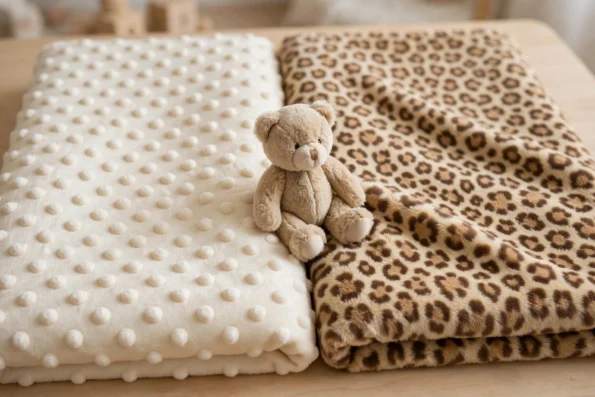
Cream dotted minky fabric beside leopard-print velboa fabric with a small plush teddy bear

Minky vs Velboa for Plush Toys: Softness and Durability

If you are sewing a plush toy — a teddy bear, a bunny, a cushion character or a soft toy for a baby — the fabric you choose decides how it feels in the hand, how well it holds its shape, and how it survives washing and cuddling. Two fabrics come up again and again for plush toys: minky and velboa. Both are soft, both are synthetic plush fabrics, and both are sold by the yard for home sewing. But they feel different, sew differently, and suit different toys. This guide compares minky vs velboa for plush toys so you can pick the right one first time. What Is Minky? Minky is a very soft plush fabric with a short, dense pile. It is best known in its dotted form, where small raised dots are embossed into the surface, and in smooth and rosebud forms. Minky has a slight stretch, which helps it hug curves and stuffing without puckering. It is widely used for baby blankets, and that same softness makes it a favourite for baby-safe plush toys, loveys and comforters. If softness against skin is your top priority, minky is hard to beat. What Is Velboa? Velboa is a short-pile plush fabric with a smooth, velvety surface. It is most often seen in animal prints — leopard, tiger, dalmatian and similar patterns — and in solid colours. Velboa has little to no stretch, so it holds a printed pattern crisply and keeps seams stable. It is the fabric behind many costume ears, tails and animal-print plush toys, because the print does the work of suggesting the animal before you add a single detail. Our earlier guide, What Is Velboa?, explains the fabric in more detail. Softness: How They Feel in the Hand Minky is the softer of the two. The pile is finer and the fabric drapes more fluidly, so a minky toy feels squishy and cuddly straight away. Dotted minky adds a gentle texture that babies often find soothing. Velboa is soft too, but its pile is slightly firmer and the fabric feels more structured. A velboa toy holds its silhouette better and feels a little more like a traditional stuffed animal. Neither fabric is rough — the difference is between cloud-soft and firm-soft. For a newborn gift or a comfort toy, most makers choose minky. For a toy that needs to look like a specific animal, most makers choose velboa. Durability and Washing Both fabrics are polyester plush, so both handle regular washing well when you follow gentle care: cool wash, mild detergent, and air dry or low tumble. Minky keeps its softness through many washes, though the raised dots on dotted minky can flatten slightly if the fabric is ironed or dried on high heat — avoid both. Velboa’s printed surface is very durable, and because the fabric has little stretch, seams are less likely to distort over time. For a toy that will be washed often, either fabric works; for a toy that will be dragged, chewed and loved hard, velboa’s stable base gives it a small edge in keeping its shape. Sewing: Stretch, Seams and Stuffing This is where the two fabrics behave most differently. Minky’s slight stretch is helpful around curves but can shift under the presser foot, so pin generously, use a walking foot if you have one, and sew with a slightly longer stitch. Take care not to stretch the fabric as you feed it, or seams can wave. Velboa feeds more predictably because it barely stretches, which makes it a friendly choice for beginners and for patterns with lots of small pieces. Both fabrics shed a little when cut, so cut with sharp scissors, shake off loose fibres outdoors, and consider a mask if you are sensitive to fluff. For either fabric, sew with the pile direction running the same way on every piece so the finished toy looks even in the light. Appearance: Solids, Dots and Animal Prints Minky comes in soft solid colours, dotted textures and gentle prints that suit nurseries and baby gifts. It reads calm and modern. Velboa comes in bold animal prints and rich solids that read playful and characterful. A leopard-print velboa bear or a dalmatian-print puppy needs almost no extra decoration — the fabric tells the story. If your pattern includes ears, muzzles and tails in contrasting colours, velboa’s crisp prints make those details pop. If your toy is a simple, minimalist shape where the feel matters more than the look, minky’s texture carries the design on its own. For a closer look at minky textures, see our comparison of Minky Dot vs Minky Rosebud. Which Fabric for Which Toy? Choose Minky For Baby comfort toys, loveys and first teddies where softness matters most. Minky also suits simple, rounded shapes — bears, bunnies, blobs and cushions — where a little stretch helps the fabric sit smoothly over stuffing. If the toy will be slept with, choose minky. Choose Velboa For Animal toys, costume-style plushies and any design where the print is part of the character. Velboa also suits toys with lots of small, precise pieces, because the stable fabric keeps edges where you put them. If the toy will be played with, dressed up and carried everywhere, choose velboa. Using Both Together Many makers combine the two: a velboa body in an animal print with a minky belly, muzzle or inner ears for contrast in both colour and feel. The combination looks deliberate and feels lovely. Just remember to stabilise the minky pieces with extra pins so the stretch does not pull against the stable velboa. How Much Fabric Do You Need? A small plush toy, roughly ten to twelve inches tall, typically needs half a yard of fabric with room for mistakes. A larger toy or a set of matching toys needs a full yard. Buying a little extra is wise for plush fabrics because pile direction matters — you cannot always rotate pieces to save fabric the way you can
CONTINUE READING ➞
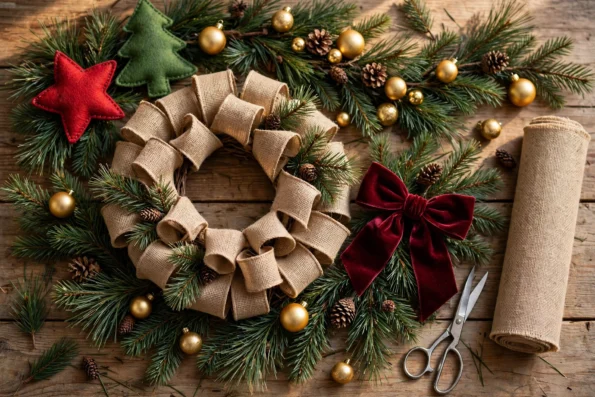
Burlap wreath with red felt star, green felt tree and burgundy velvet bow on pine garland

Christmas Wreaths and Garlands: Burlap, Felt and Velvet

If you want a Christmas wreath or garland that looks handmade, warm and a little bit special, fabric is your best friend. Burlap gives you rustic, farmhouse texture. Felt gives you clean shapes, bright colour and zero fraying. Velvet gives you richness and a soft sheen that catches candlelight beautifully. Used on their own, each fabric makes a lovely decoration. Used together, they make a piece you will want to bring out every year. Why Make Wreaths and Garlands from Fabric? Fresh greenery is beautiful, but it dries out, drops needles and only lasts a few weeks. Fabric wreaths and garlands last for years, store easily, and can be refreshed each season with a new bow or a few extra ornaments. Fabric is also forgiving to work with. Burlap loops hide uneven edges, felt cuts cleanly without hemming, and velvet bows cover joins and wire. If you have never made a wreath before, fabric is the easiest place to start because small mistakes disappear into the texture. Burlap: The Rustic Base That Works with Everything Burlap, also sold as hessian or jute, is a coarse woven fabric with an open weave and a natural tan colour. It is the workhorse of farmhouse Christmas décor because it pairs with almost anything — pine, berries, plaid, gold, red, or plain greenery. For wreaths, burlap ribbon or strips cut from burlap by the yard are looped and bunched around a wire or foam ring to create a full, ruffled base. For garlands, burlap can be twisted into a soft rope, cut into pennant flags, or tied in short strips along a length of twine for a rag garland. Even a plain burlap wreath with nothing but a bow looks finished, because the weave itself is decorative. How to Make a Burlap Wreath Start with a wire wreath frame or a foam ring. Cut burlap into wide strips, or use burlap ribbon straight from the roll. Gather a section, push a loop through the frame, and secure it with floral wire or by tying it in place. Work around the ring, keeping loops roughly the same size, until the frame is covered. Fluff and adjust as you go — burlap holds its shape well. Finish with a bow, pine sprigs, or felt ornaments wired into the loops. The whole project takes about an hour, and no sewing is required. How to Make a Burlap Garland Cut burlap into rectangles or triangles and fold each piece over a length of twine or jute cord, securing with hot glue or a simple stitch. Alternate burlap pieces with felt shapes for contrast. A burlap rag garland — short strips tied along a cord — drapes beautifully along a mantel or staircase banister. Browse our Jute & Burlap collection to find the weight and width that suits your project. Felt: Clean Shapes, Bright Colour, No Fraying Felt is a non-woven fabric made from matted fibres, which means cut edges do not fray. That makes it perfect for Christmas shapes — stars, trees, stockings, snowflakes and hearts all cut cleanly with scissors and keep their shape without hemming. Felt is also easy to glue, easy to stitch, and available in strong festive colours. On a wreath, felt works best as the detail layer over a burlap or greenery base. On a garland, felt shapes strung along twine make a cheerful, lightweight decoration. Felt is also the safest choice if children are helping, because there are no sharp edges and no fraying threads. Felt Shapes for Wreaths and Garlands Cut two matching shapes, add a little stuffing if you want a padded ornament, and stitch or glue around the edge. A blanket stitch in contrasting thread gives a charming handmade finish. Wire finished shapes into a burlap wreath, spacing them evenly and mixing sizes. For a garland, string felt shapes along twine or glue them onto a ribbon backing, leaving a little space between each piece so the garland drapes naturally. Our Premium Acrylic Felt by the yard gives you enough material for a full set of shapes plus spares, cut from one continuous piece so colours match across every ornament. Velvet: Richness, Sheen and the Perfect Bow Velvet brings luxury to Christmas décor. Its soft pile catches light, so colours look deeper and richer than flat fabrics. A velvet bow on a burlap wreath instantly lifts the whole piece from rustic to elegant. A velvet garland draped along a mantel adds warmth and a sense of occasion. Velvet is a little more delicate to work with — cut with sharp scissors, avoid crushing the pile, and use a light hand with glue. In return, it gives you the most polished finish of the three fabrics. Burgundy, emerald, navy and gold are classic Christmas choices, and they pair beautifully with both natural burlap and bright felt. Velvet Bows and Finishing Touches Cut a wide strip, form two loops and two tails, pinch the centre, and wrap it with a narrow band of the same fabric. Wire the bow onto your wreath or tie it at intervals along a garland. For a fuller look, make velvet rosettes or small padded hearts and cluster them with felt shapes. Explore our Premium Velvet fabric and the wider Velvet Fabric collection to find the colour that matches your scheme. Combining All Three: A Layered Look That Always Works The most successful fabric wreaths and garlands usually combine at least two of these fabrics. Burlap provides the base and texture. Felt provides colour and playful shapes. Velvet provides the finishing bow. Try this formula for a wreath: a full burlap loop base, five to seven felt ornaments spaced around the ring, a few pine sprigs tucked into the loops, and one generous velvet bow. For a garland: a twine or burlap base with alternating felt shapes and small velvet bows. Both projects use offcuts well — see our guide to Christmas gift wrapping with fabric for ideas that share the same materials. Colours, Quantities

CONTINUE READING ➞
My Cart
Wishlist
Recently Viewed
Categories

SPIN TO WIN!

  • Try your luck to get a discount coupon
  • 1 spin per email
  • No cheating
Try Your Lucky
Never
Remind later
No thanks