Two sheers, two very different dresses
Chiffon and tulle are the two fabrics every party-dress maker reaches for when a dress needs to float, and they are also the two fabrics most often confused with each other. Both are sheer, both are light, and both show up in party dresses, prom gowns and evening wear — but they behave nothing alike once they are cut and sewn. Chiffon flows. Tulle stands up.
What chiffon is
Chiffon is a lightweight, plain-woven sheer with a soft, slightly grainy hand and a fluid drape. Our Soft Sheer Chiffon Fabric by the Yard is 60 inches wide, a polyester chiffon sold by the yard in a wide range of colours, and it is the fabric to reach for when the dress itself is the movement.
Chiffon is almost always used as an overlay or in layers. On its own it is too sheer to be a dress: you can see through a single layer, so a chiffon party dress is usually chiffon over a lining or over a solid underdress, with the chiffon doing the visual work and the lining doing the coverage. Browse the full Chiffon Fabric collection to see the colour range, from soft pastels for spring parties to deep jewel tones for winter evenings.
What tulle is
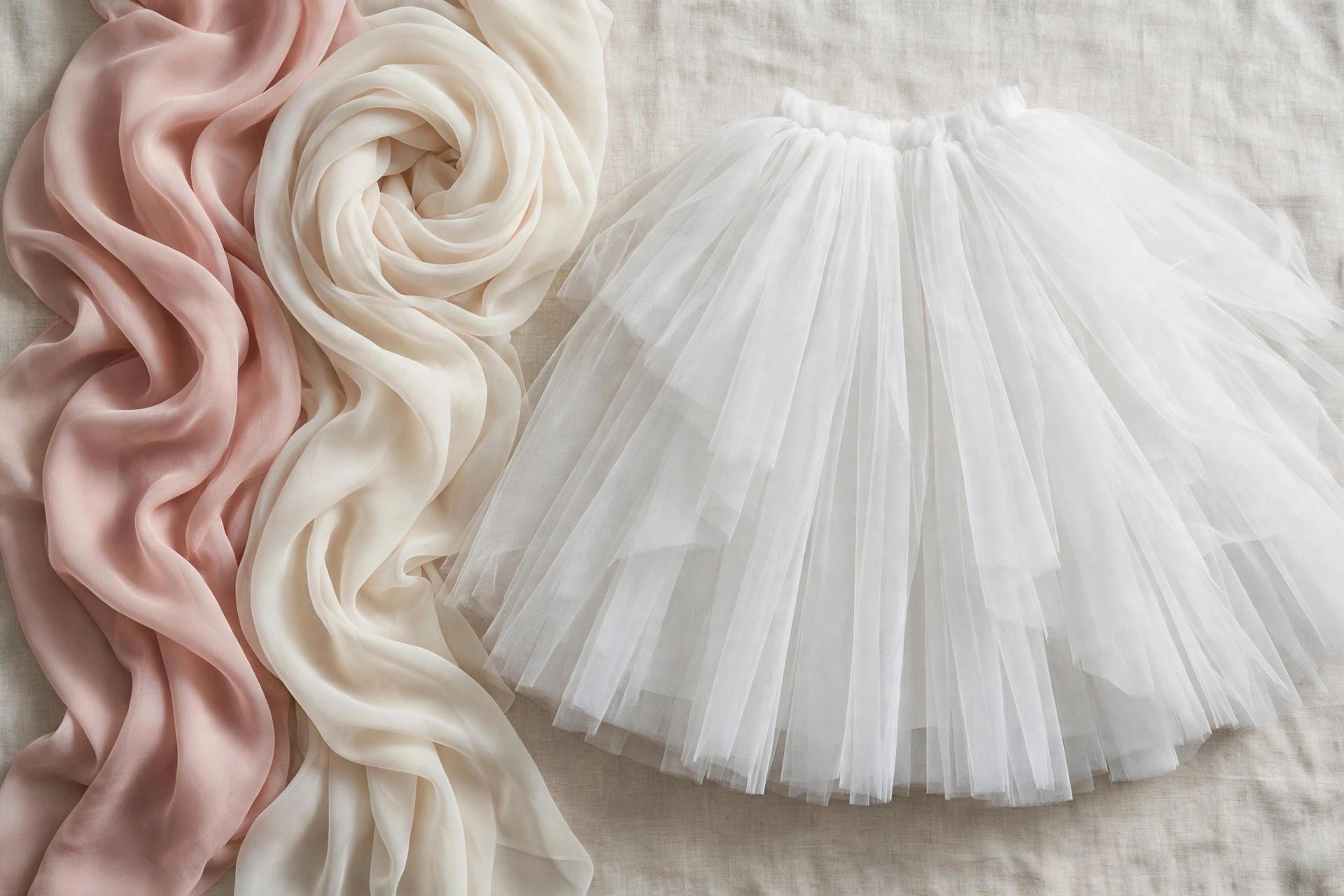
Tulle is a fine netting, not a woven cloth: an open hexagonal mesh that is light, airy and naturally stiff. Where chiffon collapses into soft folds, tulle holds its shape. A tulle skirt does not need a petticoat to stand out; several gathered layers of tulle create the fullness on their own.
Tulle comes in different stiffnesses, and the difference matters. Soft tulle drapes almost like a sheer curtain and works for flowing overlays and veils. Stiffer tulle — the kind sold as Tulle Bolt 54″ — holds a shape and is the right choice for a structured party skirt, a tutu or a dramatic overskirt that needs to keep its silhouette all evening. Browse the Tulle & Organza collection for both.
Drape and movement: the real difference
Hold a length of each fabric in your hands and the difference is obvious in seconds. Chiffon falls. It gathers into soft, narrow folds, it swings when you move, and it settles back into place without a crease. That is why chiffon is the fabric of the flowing party dress: an A-line skirt that moves with you, a wrap dress with a flutter sleeve, a gown with a train that pools softly on the floor.
Tulle, by contrast, stands. It gathers into wide, airy volume, it holds a bell shape without support, and it springs back when you sit down. That is why tulle is the fabric of the statement party dress: the full skirt that makes an entrance, the overskirt that turns a simple dress into a ball gown, the layered tutu that photographs beautifully from every angle. Our Chiffon vs Organza guide covers a similar comparison with organza, the third sheer in the family, if you are weighing all three.
Sheerness and lining: what shows through
Both fabrics are sheer, but they are sheer in different ways, and the lining decision is different for each. A single layer of chiffon is transparent enough that you need a lining or an underdress for any dress that covers the body — but the chiffon itself reads as a soft, continuous colour, so the lining colour shows through as a gentle tint rather than a hard edge.
Tulle is sheer in a different way: you can see through the open mesh, but the mesh itself reads as a texture rather than a colour wash. A tulle skirt over a solid underdress looks like a cloud over a dress — the underdress provides the colour and the coverage, and the tulle provides the volume and the sparkle. Our Tulle vs Chiffon for Veils and Overlays guide covers the same two fabrics for bridal veils, where the sheerness question matters even more.
Which fabric for which party dress?
Choose chiffon when the dress should flow: a long evening gown, a wrap dress, a maxi dress with a soft skirt, a dress with flutter or bishop sleeves, or any design where the fabric’s movement is the feature. Chiffon is also the better choice for a dress you will sit in for hours — a dinner party, a wedding reception — because it does not crush or hold a crease.
Choose tulle when the dress should make a shape: a full party skirt, a prom dress with a bell silhouette, a tutu-style dress, an overskirt over a fitted gown, or a children’s party dress that needs to look like a princess dress without weighing anything. Tulle is also the right choice for decoration on a dress — a tulle ruffle on a sleeve, a tulle bow, a layered tulle sash — because it holds a shape that chiffon cannot.
Many of the best party dresses use both. A chiffon bodice and sleeves with a tulle skirt gives you the soft drape on top and the volume below. A tulle overskirt over a chiffon dress gives you a flowing base with a dramatic silhouette on top. If you are making a dress for a specific event, buy a yard of each and hold them together — the combination usually decides itself once you see them side by side.
Sewing and care: what to expect
Both fabrics need a light touch at the machine, but for different reasons. Chiffon is slippery: it shifts under the presser foot, so use a fine needle, a short stitch length, and plenty of pins — or a walking foot if you have one. French seams are the classic finish for chiffon because they hide the raw edge inside the seam and keep the sheer fabric looking clean from both sides.
Tulle is easier to cut — it does not slide the way chiffon does — but it is harder to finish neatly, because the open mesh frays and snags. The good news is that tulle rarely needs hemming at all: a raw tulle edge looks finished, so most tulle skirts are simply cut to length and left. For care, both fabrics prefer a gentle hand wash or a delicate machine cycle in a mesh bag, then air drying — never a hot iron directly on tulle, which can melt, and never a hot dryer on chiffon, which can set creases you cannot remove.
Shop chiffon and tulle by the yard
The right sheer makes the dress, and the wrong one fights you all evening. Shop Soft Sheer Chiffon by the Yard in 60-inch width for flowing party dresses, and the Tulle & Organza collection for full skirts, overskirts and tutus — all at ValentinaTextile.com, with every cut in one continuous piece.
Frequently asked questions
Is chiffon or tulle better for a party dress?
It depends on the silhouette. Choose chiffon for a flowing dress that moves with you — a long gown, a wrap dress, a flutter sleeve. Choose tulle for a full, structured skirt that holds its shape — a prom dress, a tutu-style dress or a dramatic overskirt.
Do I need to line a chiffon party dress?
Yes. A single layer of chiffon is sheer enough to see through, so a chiffon dress needs a lining or a solid underdress.
Does tulle need hemming?
Usually not. A raw tulle edge looks finished because of the open mesh, so most tulle skirts are cut to length and left unhemmed. A narrow rolled hem works if you want a finished edge, but check the look first — the raw edge is often cleaner.