
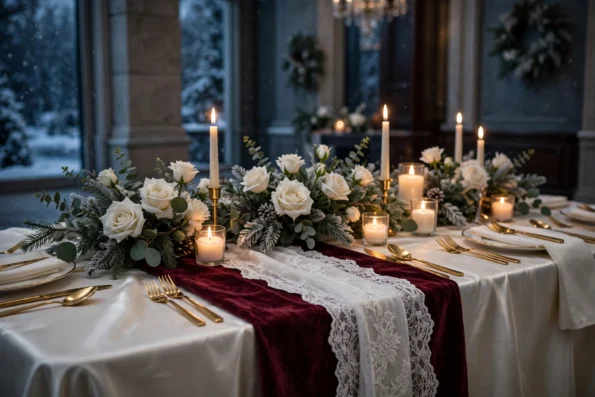
Winter wedding table with ivory satin cloth, burgundy velvet runner and white lace runner, candles and white roses

Winter Wedding Fabrics: Satin, Lace and Velvet for Cold-Weather Ceremonies

A winter wedding asks more of its fabrics A summer wedding forgives a thin fabric. A winter wedding does not. The ceremony is in a cold church or a draughty hall, the photographs are outside in the snow, and the reception runs long into the evening — and every fabric in the room has to look good and feel right in all three settings. Three fabrics carry almost every winter wedding: satin, lace and velvet. Satin: the shine that photographs beautifully in winter light Satin is the fabric of the winter wedding dress for a simple reason: it has weight, it has shine, and it photographs beautifully in the low, golden light of a winter afternoon. For a bride, that combination — structure, shine and warmth — is hard to beat in December or January. Not all satins behave the same way, and the choice matters in winter. Mikado satin is the heavier, more structured option: a rich, slightly stiff satin with a subtle lustre that holds a ball-gown silhouette without collapsing, which is exactly what you want when the dress has to look the same at the end of a long reception as it did walking down the aisle. Bridal satin is softer and more fluid, with a higher shine — better for a fitted or A-line gown that should move with the bride. Our Bridal Satin Buying Guide covers the weights and finishes in detail, and the Satin Fabrics collection carries both, sold by the yard in 58 to 60 inch widths. Satin also earns its place beyond the dress. A satin tablecloth in ivory or champagne reflects candlelight across the whole reception room, and a satin runner over a darker cloth gives a table a focal line without adding bulk. Lace: the detail that makes a winter dress feel handmade Lace is the fabric that turns a winter wedding dress from a beautiful gown into a memorable one. A lace bodice over a satin base, lace sleeves on an otherwise plain dress, a lace veil over a simple hairstyle — each one adds a layer of detail that photographs beautifully and reads as craftsmanship rather than decoration. The lace you choose should match the weight of the rest of the wedding. A heavy beaded lace belongs on a structured winter gown; a fine embroidered lace belongs on a softer dress. Our Premium 3D Beaded Lace VT-32 is the statement choice: three-dimensional floral appliqué with beads and sequins, made for a bodice, a train or a veil that needs to be the centre of attention. The Lace Fabric collection carries the full range, and our How to Choose Lace for a Wedding Dress guide covers which lace belongs on the bodice, the sleeves and the veil. Lace also belongs on the tables. A lace runner over a satin or velvet cloth is the classic winter wedding table: the solid cloth gives the colour and the weight, and the lace gives the pattern and the light. It works especially well in winter, when the lace catches candlelight and the solid cloth underneath keeps the table looking warm rather than bare. Velvet: the warmth and the drama Velvet is the fabric that makes a winter wedding feel like winter — in the best sense. It is warm to the touch, it absorbs light instead of reflecting it, and it gives a room a depth that no other fabric can match. A velvet table runner in burgundy or forest green, a velvet wrap for the bride, velvet chair sashes or a velvet backdrop behind the head table: each one adds a layer of richness that reads as luxury without needing anything else in the room to compete with it. Velvet’s warmth is practical as well as visual. A velvet shawl or wrap over a satin gown keeps the bride warm for outdoor photographs without ruining the silhouette, and velvet cushion covers on reception chairs make a cold hall feel like a room people want to stay in. The Velvet Fabric collection carries the range, from soft stretch velvet for wraps and dresses to structured royal velvet for table dressing and décor. Velvet also pairs beautifully with the other two fabrics. A velvet runner over a satin cloth, with a lace overlay at the centre of the table, is the classic three-fabric winter table: satin gives the shine, velvet gives the depth, and lace gives the detail. Use the same three fabrics across the whole wedding — dress, tables, backdrop — and the ceremony and the reception feel like one design. Putting the three fabrics together The simplest way to plan a winter wedding in satin, lace and velvet is to give each fabric one job and let it do that job everywhere. Satin is the base: the dress, the tablecloths, the lining of the wraps. Lace is the detail: the bodice, the sleeves, the veil, the runners. Velvet is the accent: the wraps, the sashes, the backdrop, the cushions. When the same three fabrics appear in the ceremony and the reception, in the dress and on the tables, the wedding photographs as one coherent design instead of a collection of separate decisions. Colour ties the three together. Pick one deep winter colour — burgundy, forest green, navy or plum — and use it in the velvet and in small satin accents, with ivory or champagne satin and lace carrying the rest. Our Wedding Table Linens guide covers the sizing for runners, cloths and overlays if you are dressing the tables yourself. Care and timing for a winter wedding Winter weddings reward buying early. Satin and velvet both benefit from being cut and sewn well ahead of the day, and lace — especially a beaded lace — needs time for hand finishing. Order the fabric at least two months before the wedding, and keep a spare half yard of each fabric for last-minute repairs: a torn hem on a satin gown or a stained velvet runner is fixable on the day
CONTINUE READING ➞
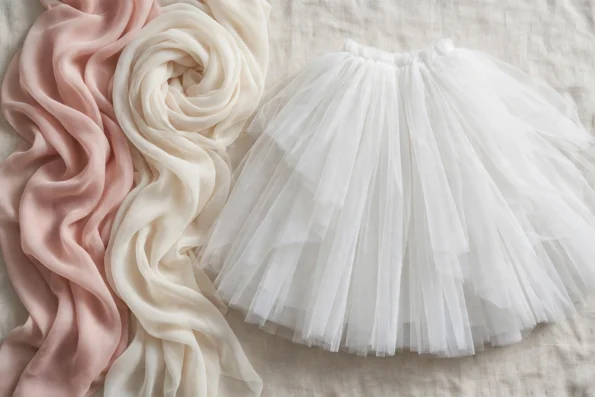
Flowing blush and ivory chiffon fabric beside a white tulle party skirt

Chiffon vs Tulle for Party Dresses

Two sheers, two very different dresses Chiffon and tulle are the two fabrics every party-dress maker reaches for when a dress needs to float, and they are also the two fabrics most often confused with each other. Both are sheer, both are light, and both show up in party dresses, prom gowns and evening wear — but they behave nothing alike once they are cut and sewn. Chiffon flows. Tulle stands up. What chiffon is Chiffon is a lightweight, plain-woven sheer with a soft, slightly grainy hand and a fluid drape. Our Soft Sheer Chiffon Fabric by the Yard is 60 inches wide, a polyester chiffon sold by the yard in a wide range of colours, and it is the fabric to reach for when the dress itself is the movement. Chiffon is almost always used as an overlay or in layers. On its own it is too sheer to be a dress: you can see through a single layer, so a chiffon party dress is usually chiffon over a lining or over a solid underdress, with the chiffon doing the visual work and the lining doing the coverage. Browse the full Chiffon Fabric collection to see the colour range, from soft pastels for spring parties to deep jewel tones for winter evenings. What tulle is Tulle is a fine netting, not a woven cloth: an open hexagonal mesh that is light, airy and naturally stiff. Where chiffon collapses into soft folds, tulle holds its shape. A tulle skirt does not need a petticoat to stand out; several gathered layers of tulle create the fullness on their own. Tulle comes in different stiffnesses, and the difference matters. Soft tulle drapes almost like a sheer curtain and works for flowing overlays and veils. Stiffer tulle — the kind sold as Tulle Bolt 54″ — holds a shape and is the right choice for a structured party skirt, a tutu or a dramatic overskirt that needs to keep its silhouette all evening. Browse the Tulle & Organza collection for both. Drape and movement: the real difference Hold a length of each fabric in your hands and the difference is obvious in seconds. Chiffon falls. It gathers into soft, narrow folds, it swings when you move, and it settles back into place without a crease. That is why chiffon is the fabric of the flowing party dress: an A-line skirt that moves with you, a wrap dress with a flutter sleeve, a gown with a train that pools softly on the floor. Tulle, by contrast, stands. It gathers into wide, airy volume, it holds a bell shape without support, and it springs back when you sit down. That is why tulle is the fabric of the statement party dress: the full skirt that makes an entrance, the overskirt that turns a simple dress into a ball gown, the layered tutu that photographs beautifully from every angle. Our Chiffon vs Organza guide covers a similar comparison with organza, the third sheer in the family, if you are weighing all three. Sheerness and lining: what shows through Both fabrics are sheer, but they are sheer in different ways, and the lining decision is different for each. A single layer of chiffon is transparent enough that you need a lining or an underdress for any dress that covers the body — but the chiffon itself reads as a soft, continuous colour, so the lining colour shows through as a gentle tint rather than a hard edge. Tulle is sheer in a different way: you can see through the open mesh, but the mesh itself reads as a texture rather than a colour wash. A tulle skirt over a solid underdress looks like a cloud over a dress — the underdress provides the colour and the coverage, and the tulle provides the volume and the sparkle. Our Tulle vs Chiffon for Veils and Overlays guide covers the same two fabrics for bridal veils, where the sheerness question matters even more. Which fabric for which party dress? Choose chiffon when the dress should flow: a long evening gown, a wrap dress, a maxi dress with a soft skirt, a dress with flutter or bishop sleeves, or any design where the fabric’s movement is the feature. Chiffon is also the better choice for a dress you will sit in for hours — a dinner party, a wedding reception — because it does not crush or hold a crease. Choose tulle when the dress should make a shape: a full party skirt, a prom dress with a bell silhouette, a tutu-style dress, an overskirt over a fitted gown, or a children’s party dress that needs to look like a princess dress without weighing anything. Tulle is also the right choice for decoration on a dress — a tulle ruffle on a sleeve, a tulle bow, a layered tulle sash — because it holds a shape that chiffon cannot. Many of the best party dresses use both. A chiffon bodice and sleeves with a tulle skirt gives you the soft drape on top and the volume below. A tulle overskirt over a chiffon dress gives you a flowing base with a dramatic silhouette on top. If you are making a dress for a specific event, buy a yard of each and hold them together — the combination usually decides itself once you see them side by side. Sewing and care: what to expect Both fabrics need a light touch at the machine, but for different reasons. Chiffon is slippery: it shifts under the presser foot, so use a fine needle, a short stitch length, and plenty of pins — or a walking foot if you have one. French seams are the classic finish for chiffon because they hide the raw edge inside the seam and keep the sheer fabric looking clean from both sides. Tulle is easier to cut — it does not slide the way chiffon does — but it is harder to finish neatly, because the open mesh

CONTINUE READING ➞
My Cart
Wishlist
Recently Viewed
Categories

SPIN TO WIN!

  • Try your luck to get a discount coupon
  • 1 spin per email
  • No cheating
Try Your Lucky
Never
Remind later
No thanks