The short answer: runners dress the centre, tablecloths dress the whole table
If you are planning a wedding, a holiday dinner, or a party, the table is where guests spend most of the evening — and the fabric you choose sets the tone before anyone sits down. Two options come up again and again: a lace runner laid down the centre of the table, or a full tablecloth that covers it edge to edge. Both look beautiful, but they do very different jobs. A runner is a decorative accent that leaves much of the table surface visible; a tablecloth transforms the entire table and hides whatever is underneath. This guide explains when to choose each, how to size them, and how to layer them for an event-ready look.
What is a lace runner?
A table runner is a long, narrow strip of fabric that runs down the centre of a table, usually with an overhang at each end. Lace runners are especially popular for weddings and celebrations because the open, embroidered pattern adds romance and detail without covering the table itself. At ValentinaTextile.com, lace runners are sold by the yard as runner fabric, so you can cut exactly the length your table needs. Floral Lace Table Runner (VT-18) is 14 inches wide with floral embroidery and sequins on lace mesh, in 14 colours; Beaded Lace Table Runner (VT-33) is 13 inches wide with 3D embroidered flowers hand-beaded with pearls and sequins, in 10 colours. Because you buy by the yard, one long continuous runner can dress a whole banquet table with no joins.
What is a tablecloth?
A tablecloth is a finished cloth sized to cover a whole table, with a drop hanging down on every side. It is the practical choice when you want a complete transformation: it hides a scratched, stained, or mismatched table, protects the surface from spills, and gives the whole setting a unified colour. Finished tablecloths, like the Gingham Tablecloth — a 100% polyester rectangular cloth, 60 by 108 inches, in a classic 1-inch check across 20 colours — arrive ready to lay out, with no cutting or hemming. Tablecloths also come in the wider Table Linens collection, which gathers the finished cloths and linen styles in one place.
Lace runners vs tablecloths at a glance
Look and formality
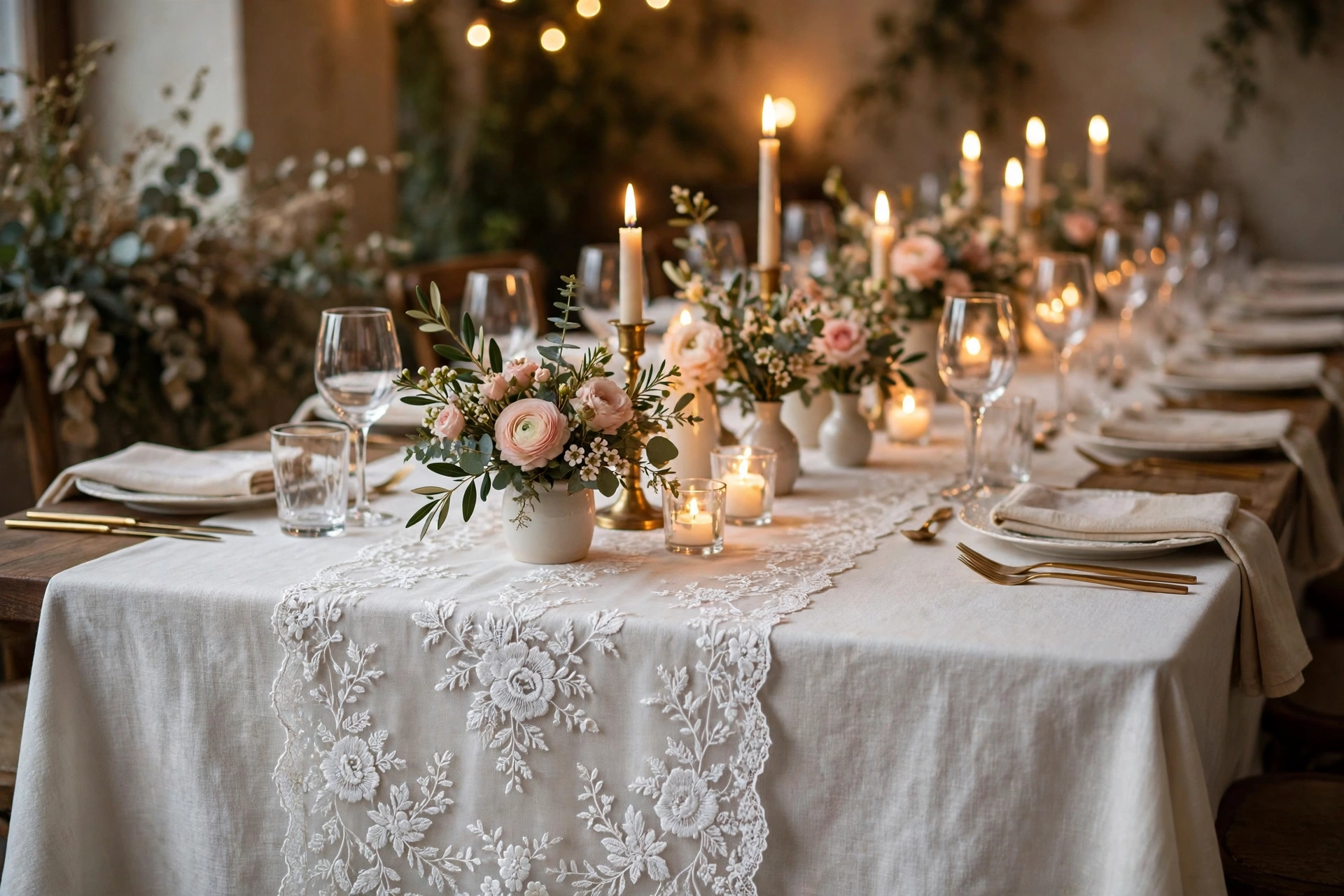
A lace runner reads as decorative and detailed: guests see the embroidery, the table surface, and any centrepieces all at once, which suits weddings, showers, and elegant dinners where the table itself is part of the look. A tablecloth reads as complete and polished: one colour and texture from edge to edge, which suits banquets, restaurants, and events where many tables must look identical. Layering both — a runner over a cloth — gives you the best of each: a clean base with a detailed centrepiece strip.
Sizing: how to measure
For a runner, measure the length of your table and add the overhang you want at each end — a short accent needs just a few inches, while a formal look usually drops 6 to 12 inches past each end. Buying runner fabric by the yard makes this easy: order the total length, including overhang, in one continuous cut. For a tablecloth, measure the table’s length and width, then add twice the drop you want on each side. A casual drop is around 6 to 8 inches past the table edge; a formal drop reaches the floor. For example, on a 72-inch table, a 108-inch cloth gives an 18-inch drop at each end. Always measure your own table before ordering — table sizes vary far more than people expect.
Practicality and care
Runners are lighter, easier to store, and simpler to swap between events — one box can hold runners for a dozen themes. They also leave the table surface usable for place settings that sit outside the runner’s width. Tablecloths protect the whole surface and hide imperfections, but they are bulkier to launder and store, and a stained cloth affects the whole table rather than one strip. As always, check the care details on the exact product page: lace runners with beading and sequins need gentler handling than a sturdy polyester tablecloth.
Cost and flexibility
For a single table, a runner is usually the smaller outlay and the more flexible buy — the same runner fabric can be cut for a head table, a cake table, and a gift table in matching colours. For a large event with many tables, finished tablecloths give a consistent look with less measuring and cutting per table. Many event stylists mix the two: tablecloths for guest tables, where consistency matters, and lace runners for the head table, cake table, and sign-in table, where detail matters most.
How to choose for your event
Choose a lace runner for weddings, showers, and feature tables
If the table itself is beautiful — wood, marble, or a hired table you want to show off — a runner lets it shine while adding lace detail down the centre. It is also the right pick for head tables, cake tables, and gift tables, where a single dramatic strip photographs better than a plain cloth. Start with VT-18 for floral sparkle or VT-33 for 3D beaded texture, and order by the yard in one continuous cut.
Choose a tablecloth for banquets, restaurants, and everyday dining
If you need every table to look the same, want to hide folding or mismatched tables, or need easy spill protection, a finished tablecloth is the workhorse. The Gingham Tablecloth is a good example of a versatile everyday-to-party cloth, and the Table Linens collection covers the wider range of finished styles.
Layer both for the most polished look
The classic event formula is simple: a plain or subtly patterned cloth as the base, a lace runner down the centre, and centrepieces on top of the runner. The cloth gives coverage and colour; the runner gives texture and a focal line; candles and flowers sit naturally along it. If you are also dressing chairs or backdrops, keep the runner’s colour family consistent — browse the Lace Fabric collection to match lace tones across runners, trims, and accents.
Shop table linens at ValentinaTextile.com
Whether you need a beaded lace runner cut to your banquet table’s exact length or a finished tablecloth ready to lay out, you will find both at ValentinaTextile.com — runners sold by the yard, tablecloths ready to use. Start with VT-18 and VT-33, compare the Table Linens collection, and measure your table before you order — the right length is what turns good table linens into a great-looking event.
Frequently asked questions
How long should a table runner be?
Measure your table’s length and add the overhang you want at each end. A short accent runner needs only a few inches past each end; a formal look usually drops 6 to 12 inches past each end. Buying by the yard lets you order the exact total in one continuous cut.
Can I put a lace runner over a tablecloth?
Yes — this is the classic event look. The tablecloth gives full coverage and colour, the lace runner adds texture and a focal line down the centre, and centrepieces sit neatly along it.
Are lace runners sold by the yard or as finished pieces?
At ValentinaTextile.com, the VT-18 and VT-33 lace runners are sold by the yard as runner fabric, so you cut the length your table needs. Finished tablecloths, like the Gingham Tablecloth, arrive ready to lay out in a fixed size.