
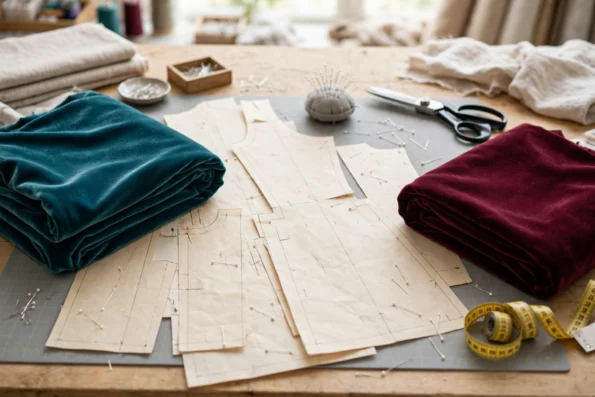
Teal and burgundy stretch velvet with dress pattern, shears and measuring tape

How to Sew with Stretch Velvet: Cutting, Seaming and Care

Stretch velvet rewards patience and punishes rushing Stretch velvet is one of the most satisfying fabrics to wear and one of the easiest to ruin in the first five minutes. Cut it with the pile running two different ways and your finished dress looks two-tone. Sew it with a straight stitch and the seam pops the first time you sit down. Press it with a hot iron and the pile crushes flat in a shiny stripe you cannot undo. None of that means stretch velvet is hard — it means it has three rules, and once you know them, it sews beautifully. This guide walks through cutting, seaming and care for stretch velvet, step by step, so your first project comes out looking like the fabric deserves. Our Premium Velvet Fabric by the Yard is an ultra-soft stretch velvet in a flexible spandex blend, 58 inches wide, in more than 50 vibrant, fade-resistant colours, cut as one continuous piece — the fabric used for the examples below. Before you cut: understand the pile and the stretch Velvet has a pile — thousands of tiny fibres standing up from the surface — and the pile has a direction, often called the nap. Run your hand down the fabric one way and it feels smooth and looks deep; run it the other way and it feels rough and looks paler. Every pattern piece must be cut with the pile running the same way, or panels will catch the light differently and the garment will look patchy. Mark the pile direction on the back of the fabric with chalk arrows before you lay out a single piece. Stretch velvet also stretches, usually more across the width than along the length. That stretch is what makes it comfortable in a fitted dress or top, but it means the fabric moves while you cut. Lay it out flat, let it relax for a few minutes after unrolling, and never let the cut pieces hang off the edge of the table — the weight will stretch them out of shape before you sew a stitch. Cutting stretch velvet without tears Lay out in a single layer Cut stretch velvet in a single layer, face up, rather than folding it. Folding lets the two layers creep against each other, and the pile makes the shift worse. A single layer takes longer but keeps every piece honest. Use pattern weights or a few pins placed in the seam allowance, never a row of pins through the middle of a piece — pin holes can show in the pile. Use the right tools Sharp dressmaking shears or a rotary cutter with a fresh blade will glide through the pile; dull scissors chew it and leave a ragged edge. Cut with long, confident strokes and keep the fabric flat on the table. Mark notches with small chalk marks on the back rather than clipping into the seam allowance, which can weaken a stretch seam. Give yourself extra fabric Because every piece must run the same pile direction, velvet uses more yardage than a plain fabric of the same width. Order with that in mind and check our yardage guide before you buy. Browse the Stretch Velvet collection to compare colours in the same range, so any extra piece matches perfectly. Seaming stretch velvet so it stays sewn Needle and stitch Use a stretch or ballpoint needle — a sharp universal needle can cut the spandex fibres and start a run. Sew with a narrow zigzag stitch or a serger, never a plain straight stitch on a seam that has to stretch. A straight stitch has no give, so the first time the garment stretches, the thread snaps. A narrow zigzag moves with the fabric and survives being worn. Stop the layers creeping Two layers of velvet pile grip each other and creep as they feed through the machine, so one layer arrives at the end of the seam longer than the other. Pin generously in the seam allowance, or hand-baste long seams before machining. Sew slowly, let the feed dogs move the fabric, and do not pull it through — pulling stretches the seam as you sew and it will pucker when it relaxes. Finish and press the right way Velvet does not fray much, but a serged or zigzagged edge keeps a stretch garment tidy inside. Never press velvet flat with a hot iron. Steam it from a distance, or press on the back with a pressing cloth and the lightest touch. The pile is the beauty of the fabric — your job is to protect it, not flatten it. Our guide on how to sew a velvet dress applies the same rules to a full dress project, and our stretch velvet vs royal velvet comparison helps you pick the right velvet before you start. Care: keeping the pile alive Wash stretch velvet gently. Hand wash in cool water with a mild detergent, or use a delicate machine cycle inside a laundry bag if the garment allows it. Never wring it — press the water out, reshape the garment, and dry it flat or on a hanger away from direct heat. A tumble dryer is the fastest way to dull the pile. Store velvet garments hanging on padded hangers or folded with tissue between the layers, never crushed at the bottom of a drawer. If the pile looks flattened after storage, a gentle steam from a distance will lift it again. Brush the pile lightly in one direction with a soft clothes brush to restore the even sheen. Treated this way, a stretch velvet dress keeps its deep colour and soft hand for years — the spandex blend recovers its shape wear after wear, which is exactly why dancers and dressmakers both reach for it. Common mistakes and how to avoid them The two-tone garment comes from cutting pieces in opposite pile directions — chalk arrows on the back prevent it. The popped seam comes from a straight
CONTINUE READING ➞
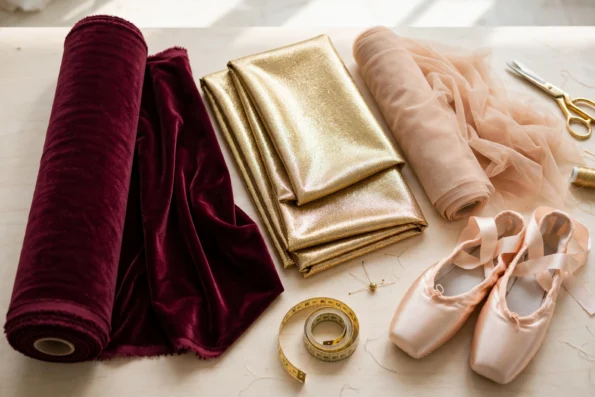
Burgundy stretch velvet, gold lamé and nude mesh with ballet pointe shoes

How to Choose Fabric for Dance Costumes: Stretch Velvet, Lamé and Mesh

Start with the routine, not the fabric roll A dance costume has to survive a full routine — jumps, lifts, floor work, quick changes — and still read clearly from the back of the hall. The wrong fabric gives itself away in the first rehearsal: it pulls across the back, rides up at the waist, goes see-through under stage lights, or splits a seam at full extension. Three fabrics cover almost every dance costume: stretch velvet for rich colour and comfort, metallic lamé for shine that survives bright lighting, and stretch mesh for the sheer layer that makes a costume look designed. This guide shows you how to choose between them by dance style and by garment part. Stretch velvet: the comfort and colour choice If the costume is worn close to the body for a long routine, stretch velvet is usually the right starting point. Our Premium Velvet Fabric by the Yard is an ultra-soft stretch velvet in a flexible spandex blend, 58 inches wide, in more than 50 vibrant, fade-resistant colours, cut as one continuous piece. The pile does two jobs at once: it feels soft against the skin during a long rehearsal, and it shifts tone as the dancer moves, so the costume looks alive rather than flat. Choose stretch velvet for leotards, unitards, fitted bodices and wrap tops — anything that must stretch with the body and recover afterwards. It suits ballet, lyrical, contemporary and character dance. One warning: keep the pile direction the same on every piece, or panels will look like different colours under stage lights. Metallic lamé: the shine choice for stage lights When the costume has to compete with a lighting rig, lamé earns its place. Our Metallic Foil Fabric by the Yard is a shiny polyester-spandex blend with an all-over foil finish, 2-way to 4-way stretch, 58/60 inches wide, cut as one continuous piece, in seven colours — Black, Fuchsia, Gold, Purple, Red, Royal Blue and Silver. That foil surface throws light back at the audience, so a simple shape reads as a full costume from distance. Choose lamé for jazz, hip-hop, competition dance and show numbers where sparkle is part of the choreography. It is lighter and cooler than velvet, which helps on long competition days. Fold it rather than creasing it hard, pin in the seam allowance, and sew with a ballpoint needle. If full lamé feels too loud, use it for the bodice or a skirt panel and let velvet or mesh carry the rest. Stretch mesh: the sheer layer that finishes the look Mesh rarely makes a costume on its own, but it finishes almost every costume well. Our Micro Stretch Mesh Nude Fabric by the Yard is a very lightweight sheer mesh, 60 inches wide, with 10% stretch on the grain, sold by the yard and cut to order. On a dance costume it becomes illusion necklines, sheer sleeves, skirt overlays, back panels and the modest layer that lets a dramatic neckline stay secure. Buy nude mesh first. It disappears against the skin, so the audience sees the velvet or lamé underneath while the dancer gets coverage. A nude mesh sleeve on a velvet bodice reads as a bare arm from the seats. Cut mesh with sharp shears, let it relax before cutting, and always layer it over a solid fabric — on its own it is an overlay, not a costume. Choose by dance style Ballet and lyrical Start with stretch velvet in a deep colour — burgundy, emerald, navy or black — and add nude mesh sleeves or an illusion neckline. The pile suits slow, controlled movement, and the stretch supports every arabesque without pulling. Keep shine minimal; the colour is the statement. Jazz, tap and competition dance Start with lamé. The shine reads under stage lights, the light weight keeps dancers cool, and the 2-way to 4-way stretch handles kicks, turns and floor work. Add a mesh skirt overlay or mesh sleeves if you want to tone the shine down without losing it. Contemporary and character dance Mix the fabrics. A velvet bodice with a mesh overlay skirt gives you movement and modesty in one costume. For character pieces that need a plush or textured element, our costume fabrics guide compares faux fur, velboa and lamé for theatre and fancy dress. Choose by garment part A fitted bodice needs stretch and recovery, so velvet or lamé. Sleeves and necklines that should look bare need nude mesh. A floating skirt needs mesh over a solid base. Our dancewear fabrics comparison covers the three fabrics side by side if you want the full comparison before you order. Comfort, durability and care All three fabrics sew with a stretch or ballpoint needle and a narrow zigzag or serged seam. Test your stitch on a scrap first — velvet pile and foil finishes both show a wrong stitch choice, and a seam that pops in rehearsal is better than one that pops on stage. Keep velvet pile direction consistent, keep lamé flat while cutting, and finish mesh edges so they do not curl. Hand wash dance costumes in cool water with mild detergent, never wring velvet or lamé, and dry flat or on a hanger away from direct heat. Store costumes flat or on padded hangers, and keep lamé away from anything sharp that could scratch the foil. Before you order, measure the dancer and check our yardage guide — ordering a little extra in the same cut keeps colours matched across panels. Shop dance costume fabrics by the yard Shop Premium Velvet — ultra-soft stretch velvet, spandex blend, 58 inches wide, 50+ colours — for ballet, lyrical and fitted costumes, Metallic Foil Lamé — shiny polyester-spandex blend, 2-way to 4-way stretch, 58/60 inches wide, seven colours — for jazz and competition shine, and Micro Stretch Mesh Nude — very lightweight sheer mesh, 60 inches wide, 10% stretch — for illusion sleeves, necklines and overlays. Browse the Stretch Velvet collection and the full Velvet collection at

CONTINUE READING ➞
My Cart
Wishlist
Recently Viewed
Categories

SPIN TO WIN!

  • Try your luck to get a discount coupon
  • 1 spin per email
  • No cheating
Try Your Lucky
Never
Remind later
No thanks