
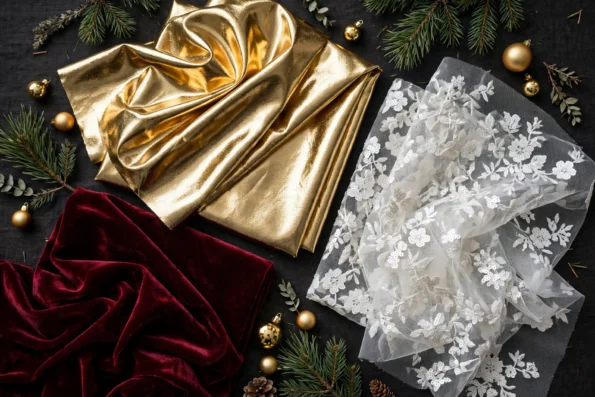
Gold metallic foil lamé, white sequin lace and burgundy velvet with pine and gold baubles

Winter Party Outfits: Sequin Lace, Lamé and Velvet

Three fabrics that own the winter party season Winter parties have their own dress code: the lights are low, the candles are lit, the photographs are taken in the evening — and the fabrics that win are the ones that catch light. A plain fabric disappears in a winter party room; a fabric with shine, shimmer or depth does not. Three fabrics carry almost every winter party outfit: sequin lace, metallic lamé and velvet. Each one shines in a different way, and together they cover every event on the winter calendar. Sequin lace: sparkle with structure Sequin lace is the most festive of the three fabrics. Sequins stitched onto a lace mesh catch every light in the room, so the outfit sparkles as the wearer moves. Unlike a plain sequin fabric, sequin lace has the lace pattern underneath — floral or geometric — which gives the sparkle depth and keeps the outfit from looking flat or costume-like. Our Floral Sequin Lace (VT-10) is embroidered bridal lace on mesh, 51 inches wide, with sequins worked into a floral pattern. The mesh base keeps it light enough for a dress or a top, and the 51-inch width gives generous cutting room for sleeves and bodices. Explore the full lace fabric collection to compare sequin, beaded and embroidered options. Sequin lace works best where it can be seen: a bodice, a full dress, an overlay over a satin skirt, or a statement top with plain trousers. Because the sequins do the visual work, the silhouette should stay simple — a sheath dress, a straight skirt, a fitted top. Our sequin lace vs beaded lace guide compares the two kinds of shine for evening wear. Sequin lace needs a lining. The mesh base is sheer, and sequins can scratch against bare skin, so a smooth lining layer is essential for comfort. Choose a lining in the same colour as the lace so the pattern stays crisp, and trim sequins back from the seam allowance — otherwise the needle will break and the seam will sit badly. Metallic lamé: liquid shine Metallic lamé is the boldest of the three fabrics. A foil finish over a stretch base gives it a liquid, mirror-like shine that reads as pure glamour — gold, silver or a jewel tone that looks lit from within. It is the fabric for the outfit that should be noticed the moment its wearer walks in. Our Metallic Foil Fabric is a stretch spandex blend with an all-over foil finish, 58/60 inches wide, with two-way to four-way stretch. The stretch is what makes lamé wearable: a lamé dress moves with the body, it does not restrict dancing, and it forgives a slightly imperfect fit in a way a stiff foil fabric never would. Lamé suits simple, confident silhouettes: a slip dress, a wrap dress, a fitted top, wide-leg trousers, a jumpsuit. The shine is the whole design, so the cut should stay clean. Pair it with a matte fabric — velvet or a plain satin — to balance the shine, and keep accessories quiet. Our costume fabrics guide covers lamé alongside faux fur and velboa, and our dancewear fabrics guide explains how stretch velvet, lamé and mesh work together. Sewing lamé needs care: use a fine needle, a stretch stitch or a serger, and never iron directly on the foil — heat dulls the finish. Press from the wrong side on low heat with a pressing cloth, or steam from a distance. Keep the foil face clean, because the finish shows every fingerprint and crease. Velvet: depth, warmth and luxury Velvet is the warmest and most comfortable of the three fabrics. Where sequin lace sparkles and lamé shines, velvet glows: its dense pile absorbs light and gives it back as deep, saturated colour. A velvet outfit in burgundy, emerald or navy looks rich rather than shiny. Our Premium Velvet is a soft stretch velvet, sold by the yard — the pile is short and smooth, the stretch gives it ease, and it suits dresses, tops, skirts and trousers alike. Browse the full velvet fabric collection and the satin fabrics collection for pairing options: velvet with a satin sash or a satin lining is one of the most striking winter combinations there is. Velvet’s strengths are softness, depth of colour and warmth. It is the most comfortable party fabric to wear, it flatters every figure, and it is genuinely warm — a velvet dress with long sleeves is the right choice for a cold evening. Our satin vs silk rayon velvet guide compares the two kinds of evening light. Velvet’s one rule is the nap. Every piece must be cut with the nap running the same way, or the finished outfit will look two different colours in the light. Cut a single layer at a time, mark the nap direction on every piece, and never press directly on the pile — press from the wrong side, or steam from a distance. How the three fabrics work together The most striking winter party outfits use two of the three fabrics, not all three at once. A velvet dress with a sequin lace bodice pairs depth with sparkle; a lamé skirt with a velvet top pairs liquid shine with soft warmth; a sequin lace top with velvet trousers is festive on top, comfortable and warm below. Choose the lead fabric by the event. For a formal dinner, velvet should lead: it reads as luxury and it keeps the wearer warm. For a dance floor or a New Year’s Eve party, sequin lace or lamé should lead: they move with the light and photograph brilliantly in a dark room. Choosing by event: dinner, dance floor or New Year’s Eve A winter dinner party suits velvet first. A velvet dress or a velvet top with tailored trousers is warm, elegant and comfortable through a long meal, and it looks its best in the low light of a dining room. Add a sequin lace shawl or a lamé sash
CONTINUE READING ➞
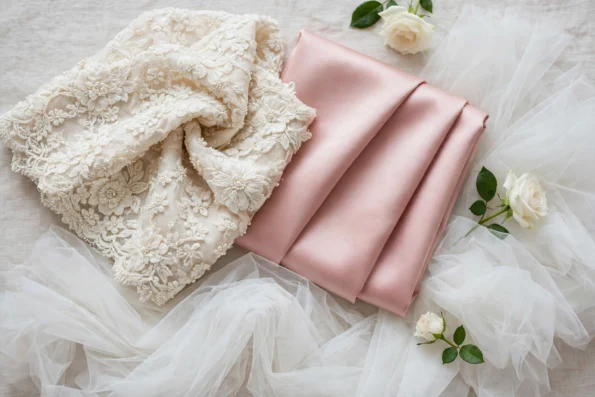
Ivory 3D beaded lace beside blush satin and white tulle with white roses

How to Choose Fabric for a Quinceañera Dress: Lace, Satin and Tulle

A once-in-a-lifetime dress starts with the right fabric A quinceañera dress is the centrepiece of the whole celebration — the photographs, the entrance, the first dance. The fabric decides almost everything about how that dress looks and moves: the volume of the skirt, the shine under the lights, the way the bodice holds its shape all evening. Three fabrics carry almost every quinceañera gown: lace, satin and tulle. Most dresses use all three at once, each doing a different job. This guide explains what each one does and how to combine them into a gown that looks spectacular and feels comfortable all night. The three fabrics at a glance Lace is the detail fabric. It brings texture, pattern and romance — floral appliqués, beading, sequins — and it is usually the fabric guests notice first. Satin is the structure fabric: it gives the bodice its shape, the skirt its shine and the gown its formal finish. Tulle is the volume fabric, layered under or over the skirt to create the full ball-gown silhouette. Lace: the showpiece of the gown Lace is where a quinceañera dress gets its personality. A beaded lace bodice, a lace overlay on the skirt, a lace-trimmed neckline — these details make one gown different from every other. Lace photographs beautifully because its texture catches light in a way flat fabric cannot. Our Premium 3D Beaded Lace (VT-32) is a natural choice for a bodice or overlay: floral appliqué lace with beading, approximately 54–55 inches wide. The three-dimensional flowers give the bodice depth and sparkle without extra embellishment. Explore the full lace fabric collection to compare beaded, sequin and embroidered options. A lace bodice with a satin skirt is the classic combination — the bodice carries the detail, the skirt carries the shine. A lace overlay over the whole skirt gives a softer, more romantic look, but it needs a solid satin layer underneath so the colour stays rich. Our lace fabric types guide explains 3D, beaded and embroidered lace, and our wedding-dress lace guide covers the same bodice and sleeve decisions. Lace needs a lining: it is open and textured, and looks and feels best over a smooth satin layer, so the pattern stays crisp. Budget for lining fabric as well as the lace itself. Satin: the structure and the shine Satin is the backbone of the gown: the bodice is usually satin, the skirt’s main layer is usually satin, and the shine that makes the dress glow in photographs comes mostly from satin. It is a weave, not a fibre — a smooth face with a matte back, made to catch light. Our Mikado Satin is a heavier satin with body, the structured choice when a gown needs to hold its shape. For a ball gown, that structure matters: a light satin can collapse under tulle, while Mikado holds the silhouette all evening. Our Mikado satin guide explains why designers love it for gowns; browse the full satin fabrics collection to compare weights and finishes. Satin suits every quinceañera colour — blush, lavender, royal blue, emerald, classic white — and pairs with everything: lace overlays, sequin trims, beaded bodices. Its weaknesses are that it shows every mark, it slips under the machine, and it creases — so a satin gown needs careful handling, a good lining, and a steamer on the day. A tulle overskirt guards the satin skirt from scuffs while dancing. Tulle: the volume that makes the silhouette Tulle is the fabric that turns a dress into a ball gown. Layered in the skirt, it creates the full, floating silhouette that every quinceañera photograph depends on. It is light, sheer and inexpensive by the yard, so you can afford the many layers a full skirt needs. The classic skirt uses tulle in two places: as an underskirt over a petticoat to build volume, and as an overskirt that softens the satin beneath and catches the light as the wearer moves. Three to five layers give a full ball-gown shape; more layers add drama but also weight and warmth, so balance volume against comfort. Browse the tulle and organza collection, including our tulle bolt, 54 inches wide. Tulle comes soft or stiff: soft tulle drapes and floats for the outer layers, stiff tulle holds a shape for the inner layers. Our tulle vs organza guide explains when each sheer fabric suits a skirt, a veil or décor. How the three fabrics work together The most-loved combination is simple: a lace bodice, a satin skirt, and tulle layers above and below. The lace carries the detail and the sparkle, the satin the colour and the shine, the tulle the volume and the movement. Together they photograph as one gown, each fabric doing the job it does best. Other combinations work too. A satin bodice with a lace overlay skirt reads more formal and structured; a tulle overskirt over a lace skirt reads softer and more romantic. If the budget is tight, put the lace where guests look first — the bodice and the neckline — and let satin and tulle carry the skirt. Choosing by silhouette and season A ball gown silhouette — fitted bodice, full skirt — is the traditional choice, and it needs all three fabrics: structured Mikado satin for the bodice and skirt base, tulle for the volume, lace for the bodice detail. An A-line silhouette needs less tulle and suits a lighter satin. A mermaid silhouette needs the most structure: a heavier satin, a firm lining, and lace only on the bodice and the flared skirt. Yardage and buying tips Buy the full length of each fabric in one continuous piece. A quinceañera gown uses a lot of fabric — a full ball-gown skirt can take many yards of tulle alone — and a second order later may come from a different dye lot, with a visible colour difference. Our yardage guide helps you calculate how much you need — remember to measure your pattern pieces against the actual fabric

CONTINUE READING ➞
My Cart
Wishlist
Recently Viewed
Categories

SPIN TO WIN!

  • Try your luck to get a discount coupon
  • 1 spin per email
  • No cheating
Try Your Lucky
Never
Remind later
No thanks