
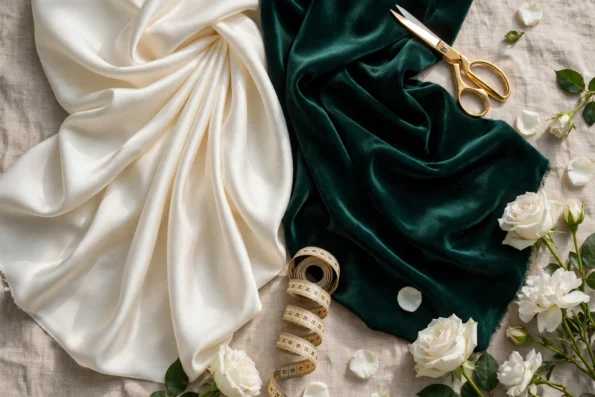
Ivory satin drape beside emerald silk rayon velvet with scissors, tape and white roses

Satin vs Silk Rayon Velvet for Evening Gowns

Two fabrics, two very different gowns An evening gown lives or dies by its fabric. The silhouette can be perfect and the fit flawless, but if the fabric does not move and shine the way the occasion demands, the gown falls flat. Two fabrics dominate evening wear: satin, the smooth, light-catching classic, and silk rayon velvet, the soft, deep-piled luxury for gowns that need warmth and depth. They look nothing alike and behave very differently under the needle. This guide compares them on shine, drape, warmth, sewing and care. Satin at a glance Satin is a weave, not a fibre: a smooth face with a matte back, made to catch light and throw it back across the room. A satin gown photographs beautifully because the fabric itself does the work — every fold shows as a line of light. It drapes in fluid folds and reads as glamour from across a ballroom. Our Mikado Satin is the structured end of the satin family: a heavier satin with body, the one designers reach for when a gown needs to hold its shape — a fitted bodice, a full skirt, a train that keeps its line. Explore the full satin fabrics collection to compare weights and finishes. Satin’s strengths are shine, drape and versatility. It suits almost any evening silhouette and pairs with everything — lace overlays, sequin trims, beaded bodices. Its weaknesses are that it shows every mark, it slips under the machine, and it creases: a satin gown needs careful handling, a good lining, and a steamer before the event. Our satin vs charmeuse guide explains the different finishes. Silk rayon velvet at a glance Silk rayon velvet is velvet at its softest and most luxurious. The pile is short, dense and smooth, and it catches light very differently from satin. Where satin throws light back in bright lines, velvet absorbs it and gives it back as depth: the colour looks richer, and the gown glows from within rather than shining on the surface. Our Premium Silk Rayon Velvet is 45 inches wide, ultra-soft, and made for high-end apparel as well as upholstery. The 45-inch width matters when you plan yardage: it is narrower than most satins, so a full gown needs more yards. Browse the silk rayon velvet collection and the wider velvet fabric collection to see the colours available. Silk rayon velvet’s strengths are softness, depth of colour and warmth. It is the most comfortable evening fabric to wear, it flatters every figure because the pile hides small imperfections, and it is genuinely warm — a velvet gown with long sleeves is the right choice for a winter ball. It is the most delicate velvet in the family and must be dry-cleaned: never iron directly on the pile. Shine: bright reflection or deep glow? This is the biggest difference between the two fabrics. Satin shines: it reflects light in bright, moving highlights, and a satin gown under ballroom lights is impossible to miss. Silk rayon velvet glows: it holds light in the pile and returns it as rich, saturated colour. Choose satin when the gown should sparkle — a New Year party, a red-carpet moment. Choose silk rayon velvet when the gown should look rich rather than shiny — a winter wedding, a formal dinner, a deep jewel colour like emerald, burgundy or navy. They can also be combined: a velvet bodice with a satin skirt is one of the most striking evening combinations there is. Drape and silhouette: fluid or structured? Satin drapes. It falls in soft, fluid folds, it swings when the wearer turns, and it suits bias-cut gowns and flowing skirts. Mikado satin is the exception: its heavier body holds a shape, so it suits structured gowns — a fitted bodice, an A-line skirt, a train that keeps its line. Silk rayon velvet does not drape the way satin does. It has body and presence, it holds a soft, rounded shape, and it suits structured silhouettes — a fitted bodice, a sheath gown, a wrap gown. Flowing and bias-cut means satin; fitted and structured means velvet. Warmth and comfort: which gown will you enjoy wearing? An evening gown is worn for hours, and comfort decides whether the evening is enjoyable. Silk rayon velvet wins here: it is soft against the skin, it insulates, and a velvet gown with long sleeves is genuinely cosy at a winter event. Satin is cool and light, which is wonderful in summer but leaves the wearer cold at a winter ball unless the gown is lined and paired with a wrap. Many satins have no stretch at all, so the fit must be exact — a satin gown that is a fraction too tight will pull and gape. Velvet has a little natural give in the pile, and it forgives a slightly imperfect fit in a way satin never will. Sewing satin vs sewing silk rayon velvet Satin is the harder fabric to sew. It slips under the machine, it shows every pin mark, and a seam pressed the wrong way leaves a permanent shine mark. Use a fine needle, pin inside the seam allowance, baste before stitching, and press from the wrong side on low heat with a pressing cloth. A walking foot helps, and a lining is almost essential. Silk rayon velvet demands different care: cut a single layer at a time, keep the nap running the same way on every piece, and never press directly on the pile. The pile hides stitches and small mistakes, which makes velvet more forgiving than satin once you respect the nap. Our guide to sewing a velvet dress covers nap, cutting and pressing, and our yardage guide helps you calculate yardage — remember the 45-inch width when you measure. Care: what happens after the event? Silk rayon velvet should always be dry-cleaned — water and heat mat the pile flat and the fabric never recovers. For an evening gown, dry cleaning is the safe choice for satin too. Store either
CONTINUE READING ➞
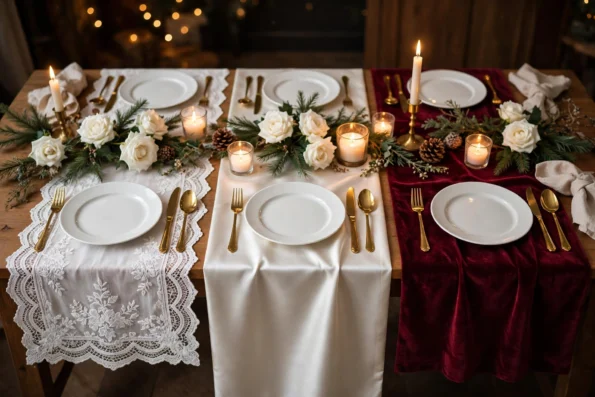
Christmas table with lace, satin and velvet runners, white roses and candles

Christmas Table Runners: Lace, Satin and Velvet Compared

The runner makes the Christmas table A Christmas table is decided long before the food arrives. Guests notice the table the moment they sit down, and the single piece that sets the whole look is the runner down the centre. It frames the candles, holds the greenery and tells everyone whether this is a formal dinner, a cosy family lunch or a glittering party. Three fabrics dominate Christmas runners: lace, satin and velvet. Each creates a completely different table and suits a different kind of celebration. This guide compares all three on look, feel and practicality. Our Christmas table settings guide covers the full table if you are starting from scratch. Lace runners: delicate, traditional, light-catching A lace runner is the most traditional choice, and still the most elegant. The openwork pattern lets the cloth beneath show through, so the runner reads as decoration rather than a solid band of colour. Candlelight catches the embroidery and the sequins, and a lace runner photographs beautifully. Our Floral Lace Table Runner VT-18 is embroidered sequin lace, 14 inches wide, sold by the yard — wide enough for candles and greenery, narrow enough to leave room for plates. For a table that needs sparkle, the Beaded Lace Table Runner VT-33 is 3D embroidered lace with pearls and sequins, 13 inches wide, and it turns an ordinary table into a celebration table the moment the lights go down. Lace is at its best over a solid cloth: white or ivory lace over a deep red, green or navy tablecloth gives you the classic Christmas contrast. It also layers beautifully — lace over satin is the most luxurious combination in this guide, and the one to choose for a formal dinner. Browse the full lace table runners collection to compare widths and patterns. The trade-off is practicality: lace snags, so keep it away from rough centrepieces, and it shows crumbs more than a solid fabric does. Store it rolled rather than folded, and it will come out every Christmas for years. Satin runners: shine, smoothness and drama Satin is the runner for drama. Its smooth, light-catching surface reflects candlelight across the whole table, and a satin runner in champagne, gold or deep red makes even a plain table look dressed for a party. Satin drapes over the table ends in soft folds, which is exactly the look a festive table needs. Satin is also the most versatile of the three. A white or ivory satin runner works with any colour scheme, a gold satin runner warms up a green or red table, and a black satin runner with gold candles is the most striking New Year table you can set. Because satin is sold by the yard and cut as one continuous piece at ValentinaTextile.com, you can order exactly the length your table needs. Explore the satin fabrics collection for the full range of colours and finishes. Satin’s weakness is that it shows every mark, so protect it with candle plates and coasters — our satin vs charmeuse guide explains the finishes and how each behaves on a table. Velvet runners: warmth, richness and luxury Velvet is the warmest, richest runner of the three, and the one that makes a Christmas table feel like Christmas. Its dense pile absorbs light instead of reflecting it, so a velvet runner in burgundy, emerald or navy gives the table depth and warmth that no other fabric matches. Candles and gold cutlery glow against it, and the whole table looks expensive without extra decoration. Our Premium Velvet is a spandex-blend velvet, 58 inches wide, in more than 50 colours, sold by the yard and cut as one continuous piece. Buy the width you need and cut it to runner width, or use a full-width length as a tablecloth with a lace or satin runner layered on top. Browse the velvet fabric collection to find your colour. Velvet is also the most forgiving runner in daily use. Its pile hides crumbs, it does not show water rings the way satin does, and it lies flat and stays put. Its one demand is care: never press it with a hot iron directly on the pile, and steam creases out from a few inches away. Our fabric care guide covers washing and storing velvet, satin and lace. Lace vs satin vs velvet: side by side For look, lace is delicate and traditional, satin is shiny and dramatic, and velvet is rich and warm. For a formal Christmas dinner, lace over satin is the classic luxury pairing. For a party table that needs to sparkle, satin wins. For a cosy family Christmas, velvet wins. For practicality, velvet is the easiest to live with: it hides marks and stays in place. Satin needs the most protection, and lace the gentlest handling. For layering, the three fabrics work better together than any one alone: a velvet cloth with a lace runner is the warmest, most traditional Christmas table, and a satin cloth with a velvet runner is the most dramatic. Which runner for which Christmas table? For the formal Christmas dinner — good china, candles, a set menu — choose lace, or lace over satin. The embroidery and sequins catch the candlelight, and the runner itself becomes part of the decoration. VT-33, the beaded lace runner with pearls and sequins, was made for exactly this table. For the Christmas party — a buffet, drinks, a big crowd — choose satin or velvet. Satin gives you the sparkle a party needs, and velvet gives you the warmth and forgiveness a busy table needs. If children will be at the table, velvet is the safer choice. For the family lunch, choose velvet, or a lace runner over a velvet cloth. Our wedding table linens guide covers runners, cloths and overlays for larger tables, and the same sizing rules apply at Christmas. How much fabric do you need for a runner? Measure the table length, then add 12 to 24 inches so the runner drapes over each

CONTINUE READING ➞
My Cart
Wishlist
Recently Viewed
Categories

SPIN TO WIN!

  • Try your luck to get a discount coupon
  • 1 spin per email
  • No cheating
Try Your Lucky
Never
Remind later
No thanks