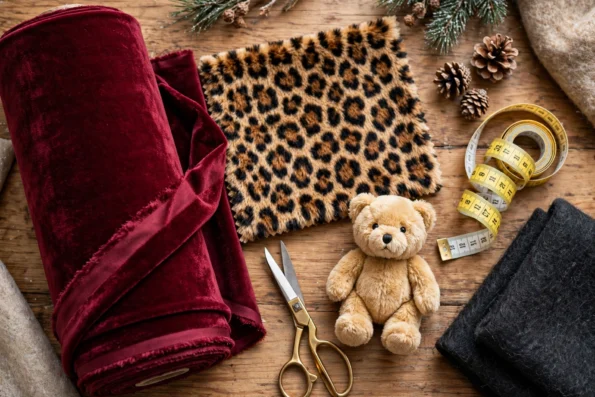
Burgundy stretch velvet roll beside leopard-print velboa swatch with a plush teddy bear, scissors and measuring tape

Velvet vs Velboa for Winter Costumes: Warmth, Weight and Look

Two plush fabrics, two very different costumes Winter is costume season — school plays, holiday pageants, fancy-dress parties and Christmas pantomimes all land in the coldest months, and the costume has to look the part and keep its wearer warm. Two fabrics dominate winter costumes: velvet, the rich, light-catching classic, and velboa, the short-pile plush that looks like fur without the fuss. They feel similar in the hand, but they behave very differently on the body and under the needle. This guide compares velvet and velboa on the things that decide a costume: warmth, weight, stretch, look and how easy each one is to sew. If you already know velboa from toys and blankets, our guide to what velboa is covers the fabric in detail, and our faux fur vs velboa comparison is the place to start if fur is also on your list. Velvet at a glance Velvet is a woven fabric with a short, dense pile that catches light from every angle, which is why it looks so rich on stage and in photographs. It drapes beautifully and reads instantly as luxurious — a velvet cape, gown or waistcoat needs no other decoration to look expensive. Our Premium Velvet Fabric by the Yard is a spandex-blend velvet, 58 inches wide, in more than 50 colours, sold by the yard and cut as one continuous piece. The stretch in the blend makes it a costume favourite: it moves with the wearer and forgives a slightly imperfect fit. Velvet’s weakness for costumes is that it is not a fur look. It reads as rich cloth, not as animal, so it suits royalty, magicians, Victorian characters, elves and elegant winter figures — but not a bear, a lion or a snow leopard. It also has a nap, so every pattern piece must be cut with the pile running the same way or the pieces will look like different colours under the lights. Velboa at a glance Velboa is a short-pile plush with a soft, slightly shaggy surface that reads as fur from a few feet away. It is the fabric behind most plush toys and animal costumes, and it comes in the animal prints velvet never will — leopard, tiger, dalmatian, giraffe and cow. Our Animal Print Velboa Fabric by the Yard covers the classic prints, and the Dalmatian Velboa is the go-to for a spotty dog costume. Velboa is lighter than it looks, it does not fray much, and it is very forgiving to sew — seams disappear into the pile and small mistakes vanish. Its weakness is drape: velboa is a plush, not a drapey cloth, so it suits soft, rounded shapes — animal suits, cuddly costumes, trims and linings — better than a flowing gown or a tailored waistcoat. Browse the full Velvet Fabric collection and the Minky & Fleece collection to compare the plush options side by side. Warmth: which keeps the wearer warmer? Both fabrics are warm, but velboa wins for a child standing around in a cold hall. Its pile is longer and loftier than velvet’s, and it traps a layer of air against the body, which is exactly how insulation works. Velvet is warm too — the dense pile holds heat well — but a thin velvet dress on its own is not enough for a cold evening; it needs a lining or a layer underneath. If the costume will be worn outside, velboa is the safer choice; worn indoors under stage lights, warmth stops mattering and the look takes over. Weight and drape: how they move Velvet drapes. It falls in soft folds, it swings when the wearer turns, and a velvet cape or skirt moves like a costume should. That drape is what makes velvet the right fabric for gowns, capes, robes and anything that should flow. Velboa does not drape — it holds a soft, rounded shape, which is perfect for a plush toy body or a padded animal suit but wrong for a flowing robe. The deciding question is movement: if the costume should flow, choose velvet; if it should look soft and cuddly, choose velboa. Stretch and fit: which forgives mistakes? Stretch velvet forgives a lot. The spandex in the blend lets a fitted bodice stretch over shoulders and hips, and a costume that is a little too tight still fits. That makes velvet the better choice for a fitted costume sewn to measurements you are not quite sure of. Velboa has very little stretch, so it needs a looser pattern and more ease built in; fit it like a coat, not like a dress. For a first costume, velboa in a loose pattern is the easier sew; for a fitted costume, stretch velvet is the easier fit. Look: rich cloth or realistic fur? The look is the real decision, and it is simple. Velvet looks like luxury: deep colour, soft sheen, elegant drape. It is the fabric for kings and queens, magicians, Father Christmas robes, elves and Victorian carol singers. Velboa looks like an animal: spotted, striped or plain plush with a soft, furry surface — bears, lions, leopards, dalmatians and snow animals. There is almost no overlap. Choose the look the character needs, and the fabric follows. Sewing velvet vs sewing velboa Velboa is the easier fabric to sew. It does not fray much, the pile hides stitches and small errors, and you can cut two layers at once without the pieces creeping. Use a slightly longer stitch, pin inside the seam allowance, and shake the finished costume outside to release loose fibres. Velvet demands more care: cut a single layer at a time, keep the nap running one way on every piece, pin or baste before stitching, and press from the wrong side on low heat so the pile never gets crushed. Our sewing with faux fur guide covers the same pile-handling techniques velboa needs. Which should you choose? Choose velvet when the costume should look rich and elegant, when it needs to drape and
CONTINUE READING ➞
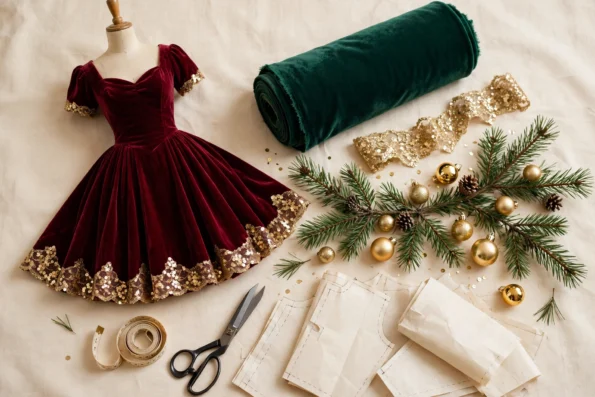
Burgundy velvet holiday dress on a dress form beside emerald velvet fabric, gold sequin lace, pine branches and sewing tools

How to Sew a Velvet Dress for the Holidays: Cutting, Seaming and Care

A velvet dress is the holiday party outfit Nothing photographs like velvet at a Christmas party or a New Year celebration. The pile catches candlelight and camera flashes, the colour looks deep from every angle, and a simple silhouette suddenly looks like it cost far more than the fabric in it. If you can sew a straight seam, you can sew a velvet dress. This guide is the festive version of our general guide to sewing a velvet dress: which velvet to pick, which colours read best under evening light, how to cut and seam velvet so the pile behaves, and how to finish the dress with trims that make it look store-bought. Why velvet is the holiday dress fabric Velvet earns its place at every December party for one reason: light. The short, dense pile absorbs light in one direction and reflects it in another, so the same dress looks almost black in shadow and richly coloured where the light hits it. Velvet is also forgiving to wear in winter — it drapes without clinging and hides small fitting imperfections better than satin. See our satin vs velvet for Christmas dresses guide for the full comparison. Choosing your velvet for a holiday dress Not all velvet behaves the same way, and the choice changes the dress you end up with. The two velvets most sewists reach for are stretch velvet and structured royal velvet, and for a party dress the difference matters more than the colour. Stretch velvet: the easy, comfortable choice Stretch velvet has spandex in the blend, so it moves with you — you can sit, dance and reach for the top shelf without the dress pulling. It is the best choice for a fitted bodice or a body-skimming sheath. Our Premium Velvet Fabric by the Yard is a spandex-blend velvet, 58 inches wide, in more than 50 colours, sold by the yard and cut as one continuous piece. Browse the Stretch Velvet collection for the full range. Royal velvet: structure and drama Royal velvet is stiffer, with a taller pile and a more formal look. It holds a shape — a full skirt, a dramatic sleeve, a structured bodice — in a way stretch velvet cannot. Choose it for a ball-gown silhouette or a full circle skirt. It is less forgiving to fit, so it suits a pattern with darts and a zip. See the Royal Velvet collection for colours and weights. Holiday colours that work Burgundy, forest green, navy and black are the classic holiday velvet colours, and they photograph beautifully. Emerald green is the standout of the season — it looks jewel-like under warm party lighting. If you want something softer, try dusty rose or champagne velvet with gold accessories. Cutting velvet for a party dress Cutting is where most velvet projects go wrong, and every mistake comes from the same cause: the pile. Velvet has a nap — a direction the pile leans — and pieces cut in opposite directions will look like two different colours. Before you cut anything, run your hand across the fabric both ways to find which way feels smooth, mark that direction on the back with chalk, and lay every pattern piece with the nap running the same way, usually downward toward the hem. Cut velvet as a single layer, right side down, with the pattern pinned to the wrong side. Never fold velvet and cut two layers at once — the layers creep, the pile compresses unevenly, and the pieces will not match. Use a rotary cutter or very sharp dressmaking shears, and cut slowly so the blade does not drag the pile. If your pattern has a “cut on fold” piece, trace it onto tissue, flip it, and cut it flat instead. Seaming velvet without puckers Velvet seams pucker when the layers shift under the presser foot, so the whole job is about stopping movement. Pin generously — every two inches along a seam — and pin inside the seam allowance so the holes never show. Better still, hand-baste the main seams before machine stitching. Use a walking foot if you have one, or a Teflon foot, and sew slowly with a slightly longer stitch length than usual. Press velvet with care, because a hot iron on the right side will flatten the pile permanently and leave a shiny mark. Always press from the wrong side, on a low heat, with a pressing cloth between the iron and the fabric. For seams, press them open over a rolled towel or a seam roll so the seam allowance does not leave an imprint on the right side. Finishing touches that make it look festive A plain velvet dress is already a party dress, but two details lift it from homemade to high street. The first is a trim: a band of gold sequin lace at the hem or the sleeve edge, a beaded lace collar, or a satin sash at the waist. Keep it to one trim — velvet plus one sparkle is elegant; velvet plus three sparkles is a costume. The second is a lining. A lightweight satin or polyester lining stops the dress clinging and makes it slide on easily over tights. Browse the Satin Fabrics collection for lining options in matching colours. How much velvet do you need? A knee-length A-line dress in 58-inch-wide velvet usually needs about two and a half to three yards, depending on your size and the sleeve length. A full circle skirt or a floor-length dress needs three and a half to four yards. Buy an extra quarter yard rather than running short — the nap means you cannot squeeze pieces in sideways the way you can with cotton. All our velvet is sold by the yard and cut as one continuous piece, so a long dress length arrives as a single length with no join. Our yardage guide covers measuring in detail. Caring for your holiday velvet dress Velvet does not like the washing machine. After the

CONTINUE READING ➞
My Cart
Wishlist
Recently Viewed
Categories

SPIN TO WIN!

  • Try your luck to get a discount coupon
  • 1 spin per email
  • No cheating
Try Your Lucky
Never
Remind later
No thanks