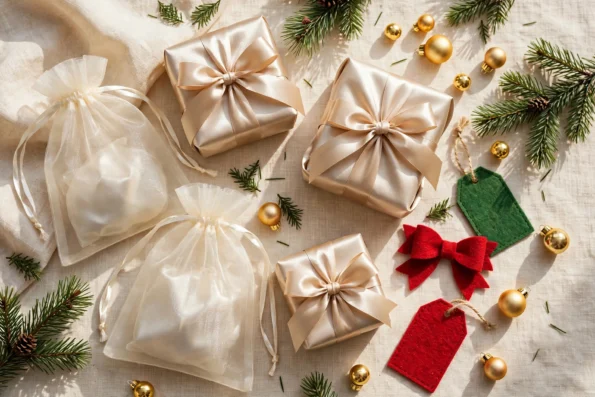
Gifts wrapped in champagne satin with bows, sheer organza bags, red and green felt tags, pine sprigs and gold baubles

Christmas Gift Wrapping with Fabric: Bows, Bags and Reusable Wraps

The wrapping paper problem Every December the same thing happens: a bin full of torn wrapping paper, glitter everywhere, and gifts that took longer to wrap than to choose. Paper wrapping is single-use by design — torn open in seconds and thrown away. Fabric wrapping is the opposite. A satin bow is untied and kept. An organza bag is refilled next Christmas. A felt tag goes back in the drawer and comes out again next year. The wrapping becomes part of the gift. Fabric wrapping also looks better than paper, and it is easier than it sounds. You do not need to be a sewer: a length of satin tied in a bow, a sheer organza bag with a drawstring, or a felt tag cut with scissors all take minutes. This guide shows three ideas — satin bows and wraps, sheer organza bags, and felt tags and bows — plus how to make them reusable, so the wrapping you buy this year is still wrapping gifts next year. Satin bows and wraps: the luxury finish Satin is the fabric that makes a plain box look expensive. A length of satin ribbon tied in a full bow over kraft paper, or a whole gift wrapped in a square of satin, turns the simplest present into something that looks bought from a boutique. Browse our Satin Fabrics collection: champagne and ivory for a classic Christmas, deep red and emerald for a traditional tree, gold and silver for New Year. Satin’s soft sheen catches the light, so even a narrow ribbon reads as luxurious. The trick with satin is to let the fabric do the work. Cut the ribbon long — longer than you think — and tie a proper bow with full loops instead of a tight knot. A wide ribbon, two to three inches, makes a better bow than a narrow one, and a double bow looks generous without extra effort. For a whole gift wrapped in satin, use the furoshiki method: lay the fabric flat, place the gift diagonally in the centre, fold two opposite corners over it, and tie the other two corners in a knot on top. No tape, no scissors. The same square wraps a different gift next year. Sheer organza bags: the quick win Organza bags are the fastest fabric wrapping there is, and the most useful for awkward gifts. Our Sheer Crystal Organza Fabric by the Yard is 60 inches wide, sheer and crisp, sold by the yard in continuous cuts. A rectangle of organza, folded and stitched — or simply gathered and tied — becomes a drawstring bag that holds jewellery, ornaments, sweets, bath products and small toys, and the sheer fabric lets the gift show through. Make a batch of bags in one sitting. Cut rectangles, sew three sides or simply gather the fabric around the gift and tie it with a satin ribbon — the ribbon doubles as closure and decoration. Ivory and white organza suit almost any gift; gold or red organza turns the bag itself into the decoration. The bags also solve oddly shaped presents: a pine cone ornament, a bottle, a handmade candle — all sit happily in an organza bag, and the bag goes back in the drawer afterwards, ready for the next gift. Browse the Tulle & Organza collection for the full range. Felt tags and bows: the handmade touch Felt is the fabric for the finishing touches that make wrapping feel handmade. Our Premium Acrylic Felt Fabric by the Yard is 72 inches wide and 1.6mm thick, soft, durable and non-fraying, so you can cut it with ordinary scissors and the edges stay clean — no hemming, no sealing, no fraying. That is what makes felt the easiest fabric to craft with: cut a shape and it is finished. Cut gift tags in red, green, cream and gold, punch a hole, thread ribbon through, and write the name in a metallic pen. Cut a bow shape — two loops and a centre band — and glue or stitch it onto a plain wrapped box, and the bow becomes a keepsake. Cut stars, trees and holly leaves and scatter them over the table and the presents, so wrapping and table match. Our Christmas crafts with felt guide has more ideas for ornaments, stockings and garlands in the same fabric, so the whole room can be made from one roll of felt. Reusable wraps: buy once, wrap for years The real advantage of fabric wrapping is that it is not used up. A set of satin squares in three sizes, a dozen organza bags and a box of felt tags will wrap a family’s Christmas for years, and each year you get faster at it. Keep the set in a box labelled for Christmas, ribbons rolled and tags stacked, and wrapping next year starts with opening a box instead of a trip to the shops. Reusable wrapping is also the kindest option for the planet and the tidiest for the house: no bin full of torn paper on Christmas morning, no glitter in the carpet, nothing to throw away. If you want the table to match, our Christmas table settings guide shows how velvet, satin and lace dress a festive table in the same colours as your wrapping, so the gifts under the tree and the table beside them tell one story. Matching the wrap to the gift Match the wrapping to the gift, not to the roll you have open. A small, precious gift — jewellery, an ornament, a bottle of perfume — deserves an organza bag, where the sheer fabric shows the gift and the drawstring keeps it safe. A big gift — a hamper, a blanket, a set of books — deserves a full satin wrap with a wide bow, where the wrapping is part of the occasion. A handmade gift deserves a felt tag, because the tag says someone made the effort twice: once for the gift, once for the wrapping. Colour matters
CONTINUE READING ➞
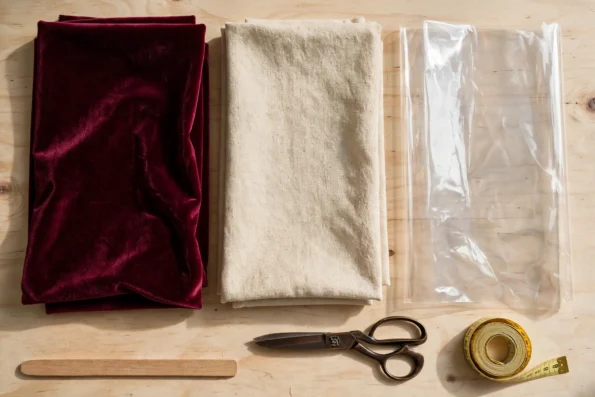
Burgundy velvet, natural cotton canvas and clear vinyl fabric swatches with dressmaking shears and a measuring tape

Upholstery Fabrics: Velvet, Canvas and Vinyl Compared

Three fabrics, three very different chairs Re-covering a chair, a cushion or a headboard starts with one decision: which fabric? Pick wrong and a beautiful chair becomes a chore — velvet on a kitchen chair stains at the first spill, canvas on a formal dining chair looks underdressed, vinyl on a headboard feels cold. Pick right and the piece looks better, lasts longer and is easier to live with. Velvet, cotton canvas and clear vinyl are the three fabrics most people reach for when they re-upholster at home. Velvet is soft, rich and dramatic. Cotton canvas is strong, plain and honest. Clear vinyl is not really a fabric at all — it is a transparent, waterproof sheet that protects the fabric underneath. This guide compares all three, so you can match the fabric to the piece. Velvet: the luxury look Velvet is the fabric you choose when the look matters most. Our Premium Velvet Fabric by the Yard is an ultra-soft stretch velvet in a flexible spandex blend, 58 inches wide, in 50+ vibrant, fade-resistant colours, cut fresh from the bolt as one continuous piece. The pile catches the light differently from every angle, which gives velvet its depth — a burgundy chair looks almost black in shadow and wine-red in the sun. That pile is also what makes velvet a commitment. It shows pressure marks, holds pet hair and dust, and needs brushing and the occasional steam to keep it standing up. The spandex blend helps here: the stretch pulls smooth over curves and corners, so a first-time upholsterer gets a tighter finish than with a stiff velvet. Velvet is best on pieces admired more than abused — accent chairs, headboards, formal dining chairs, ottomans. Save it for rooms where it can shine, and choose canvas for the kitchen chair, the child’s chair or anything that meets food and muddy paws. Cotton canvas: the workhorse Cotton canvas is the fabric you choose when the piece has to work hard. Our 7 oz Natural Cotton Canvas Fabric by the Yard is 100% cotton, 60 inches wide, a heavy-duty 7 oz canvas built for strength and durability, with a natural, unbleached finish. There is nothing flashy about it — and that is the point. Canvas takes staples cleanly, holds its shape over foam, and does not stretch out of true while you pull it tight. Canvas is the most forgiving of the three to sew and staple, which matters on a first re-upholstery project. It does not slip under the staple gun the way velvet pile can, it does not crease permanently the way vinyl does, and a seam slightly off can be unpicked and redone without leaving a mark. It is the right choice for dining chairs, bench cushions, slipcovers, pet beds and any piece sat on every day. The natural colour takes dye and paint well. Its weakness is stains: untreated canvas absorbs spills, so seal it or choose it where a washable slipcover is the plan. It will never have velvet’s drama, but it will outlast it on a hard-working chair. Clear vinyl: the protector Clear vinyl plays a different role: it protects. Our Clear Vinyl Fabric by the Yard is a waterproof clear vinyl, 54 inches wide, sold by the yard. It is not the fabric you sit on for comfort — it is the layer that keeps the fabric underneath looking new. Over a velvet dining chair, red wine wipes off instead of soaking in. Vinyl is the easiest of the three to clean and the hardest to make look invisible. A well-fitted cover is barely noticeable; a loose one wrinkles, fogs and crackles. Cut it a little generous, warm it gently so it relaxes, and fasten it snugly — elastic, ties or a hemmed edge, never staples through the middle of a panel. Use it where protection is the point: dining chair seats, table protectors, outdoor cushions, craft-table covers. Do not use it as the only layer on a seat people sit on for hours — it does not breathe, and it gets sticky in summer. Think of vinyl as the raincoat, not the outfit. Which fabric for which piece? Match the fabric to how the piece is used, not to how it looks in the shop. For a formal dining chair or an accent chair, velvet wins: the pile and colour range make the piece the centre of the room, and gentle use keeps the pile good. For an everyday dining chair, a bench cushion or a slipcover, canvas wins: strong, easy to staple, easy to wash or replace, and better with use. For a chair that must survive spills, rain or sticky hands, vinyl wins — as a cover over velvet or canvas, not on its own. Headboards are velvet’s best job in the house: the pile is soft to lean against, the colour makes the bed the focal point, and nobody eats dinner on a headboard. Cushions split by use: velvet for scatter cushions, canvas for seat cushions, vinyl for outdoor cushions. And if you are re-covering a set of dining chairs, consider mixing them — velvet on the two host chairs, canvas on the everyday chairs, vinyl covers ready for parties. How much fabric do you need? Measure before you order, and measure the piece, not the old cover. A dining chair seat usually needs about one yard, a full dining chair one and a half to two yards, an accent chair three to five yards, and a headboard two to four yards. Add half a yard for mistakes on a first project — pile direction and weave must run the same way on every panel, and a miscut in vinyl cannot be reused. Our yardage guide walks through measuring dresses, curtains and crafts, and the same measure-twice rule applies to furniture. Care and cleaning Care is where the three fabrics diverge most. Velvet needs the gentlest hand: brush it to lift the pile, vacuum with an upholstery attachment, and

CONTINUE READING ➞
My Cart
Wishlist
Recently Viewed
Categories

SPIN TO WIN!

  • Try your luck to get a discount coupon
  • 1 spin per email
  • No cheating
Try Your Lucky
Never
Remind later
No thanks