
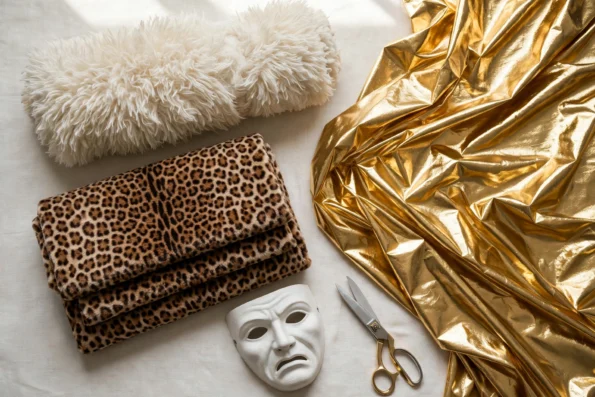
Cream shaggy faux fur, leopard-print velboa and gold metallic foil fabric with a theatre mask and shears

Costume Fabrics: Faux Fur, Velboa and Metallic Lamé

One costume, three fabrics — and each one does a different job Every great costume is really three decisions at once: the texture, the print and the shine. The texture makes an animal costume feel like fur. The print makes a leopard read as a leopard from across the room. The shine makes a superhero or a stage performer catch the light before anyone sees the face. Get those three decisions right and a homemade costume looks like a bought one. Faux fur, velboa and metallic lamé cover those three decisions between them. Faux fur gives you long, shaggy texture. Velboa gives you bold animal print in a short, easy-to-sew pile. Metallic lamé gives you the shine, with stretch that moves with the body. This guide explains what each one is, what it is best for, and how to mix them. Faux fur: the long-pile texture Faux fur is the drama fabric. Our Luxury Shaggy Faux Fur Fabric by the Yard is 100% polyester, 60 inches wide, with an extra-long, fluffy pile and a realistic fur-like finish, sold by the yard in continuous cuts. The pile is the point: it reads as real fur, and a single piece — a collar, a cape, a hood — changes the whole costume. That long pile is also what makes faux fur the hardest of the three to sew. The pile gets into the seams, the fabric sheds as you cut it, and the finished piece needs a shake and a brush before it looks its best. The payoff is worth it for anything that needs to look wild: animal costumes, mascots, fursuits, winter coats, yeti and monster outfits, and cosplay where the fur is the character. Keep the pile direction consistent across every piece — fur that runs in different directions looks patchy — and cut from the back so you cut the backing, not the pile. Our sewing with faux fur guide covers cutting, seaming and shedding. Velboa: the bold animal print Velboa is the practical costume fabric. Our Animal Print Velboa Faux Fur Fabric by the Yard is an ultra-soft, lightweight plush with a short, dense pile and bold animal prints, 60 inches wide, in 9 prints: giraffe, tiger, dalmatian, cow in black and white or brown, and leopard in pink and white, black and white, gold and white or purple. The prints are large-scale and photogenic — a dalmatian costume reads instantly from across the room. Velboa’s short pile is what makes it so beginner-friendly. It cuts cleanly, the edges do not fray the way long-pile furs do, and the seams stay tidy without special equipment, so a first costume sewn in velboa looks far better than one sewn in shaggy fur. It is the right choice when the print matters more than the pile: animal onesies and Halloween outfits, pet beds and toys, themed party décor and photo props. It is also the right choice for anything a child will wear: light, soft and easy to wash. Our What Is Velboa? guide explains the fabric, and our Faux Fur vs Velboa comparison puts the two head to head. Metallic lamé: the shine that stretches Metallic lamé is the stage fabric. Our Metallic Foil Fabric by the Yard is a shiny polyester-spandex blend with an all-over foil finish and 2-way to 4-way stretch, 58/60 inches wide, cut as one continuous piece, in 7 high-shine colours: Black, Fuchsia, Gold, Purple, Red, Royal Blue and Silver. The foil catches every light, and the stretch means the fabric moves with the body — which is why it is the fabric for dancewear, costumes and performance looks that need to flex, not fight. Lamé is the easiest of the three to fit and the trickiest to sew neatly. The stretch forgives a lot in fitting — leggings, bodysuits, fitted capes and gowns all sit better in a fabric that gives — but the foil surface shows every pin hole and uneven stitch, so sew with a stretch needle, a slightly longer stitch, and as few pins as you can manage. Line it where it sits against skin for long performances, and keep the iron away from the foil: press from the wrong side on low heat, or skip pressing. Which fabric for which costume? Match the fabric to the character, not to the pattern. Choose shaggy faux fur when the costume needs to look wild or wintry: a wolf, a yeti, a lion mane, a fur-trimmed coat or a mascot. The long pile does the acting for you, and one fur piece is often enough — a fur hood or a fur cape over a plain base outfit reads as a full costume. Choose velboa when the costume needs a recognisable print: a dalmatian, a leopard, a tiger, a cow. The print is the character, and velboa’s short pile keeps the print crisp. Choose metallic lamé when the costume needs to shine or to move: a superhero cape and bodysuit, a disco dancer, a mermaid tail, a robot, a pop-star outfit, a dance costume. The foil finish reads as metal, mirror or magic depending on the colour, and the stretch means the costume fits the performer. Lamé photographs brilliantly, so the costume looks as good in photos afterwards as on stage. Mixing all three in one costume The best costumes rarely use one fabric alone. A leopard velboa bodysuit with a shaggy faux fur collar and a gold lamé cape is three fabrics doing three jobs: the print reads as the animal, the fur reads as the wildness, the shine reads as the fantasy. A superhero outfit in lamé with a faux fur trim looks richer than lamé alone. A winter queen in lamé with a full faux fur cape looks like a character, not a dress. When you mix them, sew the easy fabric first. Build the velboa base, add the lamé panels, and finish with the fur trim — fur last, because it sheds into everything it touches and you
CONTINUE READING ➞
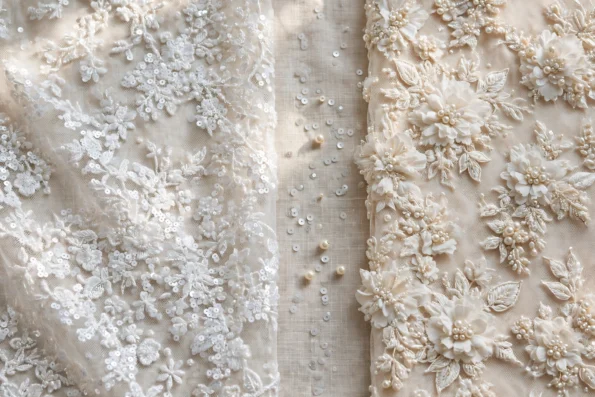
White floral sequin lace beside ivory 3D beaded lace with raised floral appliques, beads and pearls

Sequin Lace vs Beaded Lace: Which Shine for Evening?

Two evening laces, two very different kinds of shine Sequin lace and beaded lace are the two fabrics every evening dressmaker reaches for when a gown needs to sparkle — and they are easy to confuse. Both sit on a soft mesh ground and both are covered in floral work. But the shine they give you is not the same shine, and the dress you can make from each one is not the same dress. Sequin lace sparkles flat and even; beaded lace sparkles in depth, with raised flowers, beads and pearls that catch the light as you move. One is lighter and easier to cut; the other is heavier and more dramatic. This guide compares the two, so you can choose with confidence before you cut. What sequin lace is Sequin lace is embroidery plus sequins on a mesh ground. Our Floral Sequin Lace Fabric by the Yard (VT-10) is a good example: dense floral embroidery with shimmering sequins over a soft mesh, in 100% polyester, 51 inches wide, in 16 colours. The embroidery gives the lace its pattern; the sequins give it its sparkle. Because the sequins lie flat, the surface stays smooth and the fabric drapes like a normal lace. That flatness is sequin lace’s biggest practical advantage. It is the easier of the two laces to cut and sew: seams press flat, darts sit neatly, and a lining slips underneath without bulk. It is also lighter, so a full skirt or a long train moves freely. The trade-off is depth: from a distance it reads as one even field of sparkle. What beaded lace is Beaded lace builds its decoration upward instead of laying it flat. Our Premium 3D Beaded Lace Fabric by the Yard (VT-32) is the classic of the type: big dimensional floral appliqués over a soft mesh and tulle base, each finished with beads and sequins for depth and sparkle. It is polyester on a soft mesh base, approximately 54–55 inches wide, in 7 rich colours. The difference is in the hand: run your fingers over beaded lace and you feel the flowers standing proud of the mesh, the beads sitting in the centre of each bloom. That raised work gives beaded lace its occasion feel — it reads as couture even in a simple silhouette. The trade-off is weight and bulk: the appliqués make seams thicker, and the flowers need room, so cut too small a piece and you lose the motif. Shine, texture and drape compared Sequin lace gives you a bright, even sparkle that reads well in photographs and under party lighting, because hundreds of flat sequins reflect light in the same direction at once. Beaded lace gives you a slower, richer sparkle: the beads and raised petals catch light at different angles, so the fabric seems to change as the wearer moves. Sequin lace flashes; beaded lace glows. Texture follows the same split. Sequin lace feels like embroidered mesh with a light glitter — smooth enough to wear against the skin with a lining. Beaded lace feels sculptural and deliberately ornate, and most makers keep it away from areas that rub. Drape is where sequin lace wins outright: it falls in soft folds and suits flowing skirts. Beaded lace holds its shape more, which is why it suits structured bodices, statement sleeves and trains. Which lace for which dress? For a wedding dress, the choice depends on the look you want. Sequin lace suits the bride who wants sparkle everywhere — a full sequin-lace gown, a sequin overlay, or a veil with a sequin edge — because it is light enough to wear all day. Beaded lace suits the bride who wants one unforgettable focal point: a beaded bodice, a train edged with raised flowers. Our guide to choosing lace for a wedding dress covers bodices, sleeves and veils. For evening gowns, prom and pageant dresses, the same logic holds. A sequin lace gown suits a fitted silhouette that needs to move — the mesh gives a little and the sequins add no weight where the dress is tightest. A beaded lace gown suits a ballgown or an A-line, where the skirt has room for the appliqués. For quinceañera dresses, beaded lace is often the pick for the bodice alone, with a plainer skirt to balance it. Both laces work for overlays, bodices and statement sleeves; only sequin lace is comfortable for a long train worn for hours. Sewing and care: what to know before you cut Both laces sit on a mesh ground, so both need the same approach: a lining underneath, sharp scissors, and a plan for the motifs before the first cut. With sequin lace, remove the few sequins that fall on a seam line — a seam sewn over sequins will pucker and blunt the needle. Use a fine needle and a slightly longer stitch, and press gently from the wrong side with a pressing cloth, never a hot iron on the sequins. With beaded lace, the planning matters more. Lay the pattern pieces on the fabric until the flowers fall where you want them — a bloom centred on the bodice, a full motif on each sleeve — because once you cut through an appliqué it cannot be moved. Cut around the flowers where you can, and hand-tack them at the seams so they sit flat. Both laces should be dry-cleaned or hand-washed cold and laid flat to dry; never machine-wash beaded lace, and never tumble-dry either one. Our lace fabric types guide explains the 3D, beaded and embroidered families, including the Luxury Beaded Lace (VT-31), a 55-inch embroidered beaded tulle between the two styles. Cost, width and how much to buy Sequin lace VT-10 is 51 inches wide; beaded lace VT-32 is approximately 54–55 inches wide. That extra width matters, because the appliqués need space. Both fabrics are sold by the yard in one continuous piece at ValentinaTextile.com, so a three-yard order arrives as one uncut length. Allow two to three yards

CONTINUE READING ➞
My Cart
Wishlist
Recently Viewed
Categories

SPIN TO WIN!

  • Try your luck to get a discount coupon
  • 1 spin per email
  • No cheating
Try Your Lucky
Never
Remind later
No thanks