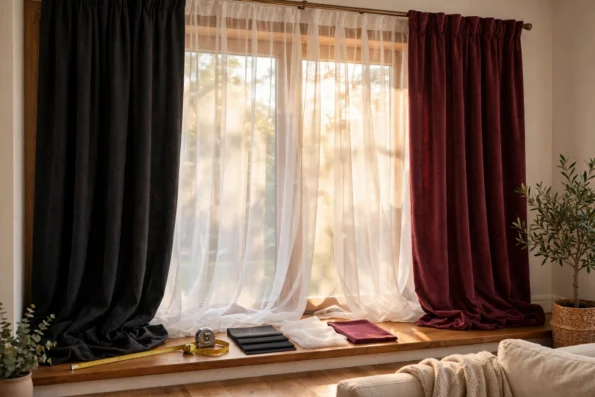
Window with blackout, sheer organza and velvet curtains, measuring tape and fabric swatches

How to Choose Fabric for Curtains: Blackout, Sheer and Velvet

The wrong curtain fabric fights you every day Curtains are the largest piece of fabric in most rooms, and the wrong choice announces itself every day: a sheer that leaves you on display at night, a blackout that hangs like a board, a velvet that swallows the light. Curtain fabric is not one decision — it is three. How much light do you want to block? How much privacy do you need? And how should the curtain fall? The three fabrics in this guide answer those questions in three different ways. Blackout blocks the light. Sheer organza filters it. Velvet frames it. Most well-dressed windows use more than one — a sheer for the day, a blackout or a velvet for the night — and this guide shows you how to choose, how much to buy, and how to sew each one. Blackout: total light control, day and night Blackout fabric exists for one job: stopping light. Our Blackout Drapery Lining Fabric by the Yard is 100% polyester, 60 inches wide, and built to block sunlight, cut UV exposure and darken a room properly. It is the fabric for bedrooms, nurseries, media rooms and any window that faces a streetlight or a sunrise. Blackout is usually used as a lining rather than the face fabric: it sits behind the curtain you actually see, doing the light-blocking work invisibly. That makes it the most forgiving of the three fabrics to sew — a smooth, stable polyester that cuts cleanly, feeds evenly under the presser foot and does not stretch or slip. Line a pair of curtains with it and you get the look of your chosen face fabric with the sleep of a blackout room. It also helps regulate room temperature and protects furniture from UV fading. The trade-off is the hand: blackout lining is heavier and stiffer than a sheer. Care is gentle — machine wash cold, tumble dry low, do not bleach. Sheer organza: light, privacy and a soft glow Sheer organza is the opposite of blackout: it does not block light, it transforms it. Our Sheer Crystal Organza Fabric by the Yard is 100% polyester, 58–60 inches wide, in 45 colours, and it is crisp, lightweight and sheer — the fabric that turns harsh daylight into a soft glow and gives a window privacy during the day without shutting the room in darkness. Organza is the daytime layer. Hung alone, it softens the view from the street while keeping the room bright — ideal for living rooms, dining rooms and kitchens, where you want light and a little privacy at the same time. Hung in front of a blackout lining or behind a heavier curtain, it does double duty: the sheer filters the day, and the heavier layer closes at night. Browse the Tulle & Organza collection to see the full sheer range and match the organza colour to the room. Organza needs a light touch at the machine: a fine needle, a short stitch, and French seams or a narrow rolled hem. It creases if crushed, so hang it as soon as it is sewn. Velvet: drama, warmth and a heavy drape Velvet is the statement fabric of the three. Our Premium Velvet Fabric by the Yard is a soft stretch velvet that falls in deep, even folds and catches the light on every fold — the fabric that makes a plain window look dressed. Browse the Velvet Fabric collection for the colour range, from deep burgundy and forest green for winter rooms to soft blush and sage for lighter spaces. Velvet’s strength is drape and presence. It hangs heavily, it pools beautifully on the floor if you want that look, and it absorbs sound — a velvet curtain makes a room feel quieter as well as warmer. It is the right choice for a feature window, a bedroom where you want a cocooned feel, or a living room where the curtains are part of the decoration. It also pairs naturally with the other two fabrics: velvet over a sheer organza gives you a sheer by day and a statement by night, and velvet lined with blackout gives you the warmest, darkest bedroom a curtain can make. Velvet is the hardest of the three to sew: cut it in a single direction, because velvet has a nap, and panels cut in opposite directions will look like two different colours. Use a walking foot if you have one, pin generously, and press from the back with a cool iron and a pressing cloth. How much fabric do you need? Curtain yardage follows one rule: fullness. A flat panel that just covers the window looks like a sheet; a curtain needs one-and-a-half to two-and-a-half times the width of the window in fabric. A sheer organza panel looks best at the full end of that range — two to two-and-a-half times the width — because the folds are what make a sheer beautiful. Blackout lining needs only the same width as the face fabric it lines, plus a little for hems. Velvet sits in the middle: one-and-a-half to two times the width gives you deep, even folds without making the curtain too heavy to draw. For length, measure from the rod to where you want the curtain to end and add eight to ten inches for the hems. Buy the whole drop in one continuous piece, and order both panels of a pair from the same cut so the colour and the nap match. If you are new to measuring, our Yardage Guide covers curtains as well as dresses. Which fabric for which room? Choose blackout lining for bedrooms, nurseries and media rooms — anywhere sleep or a dark room matters. It is almost always a lining, so pair it with whatever face fabric suits the room. Choose sheer organza for living rooms, dining rooms and kitchens, where you want daylight and daytime privacy, and for any window where the view matters — organza softens a view without hiding
CONTINUE READING ➞
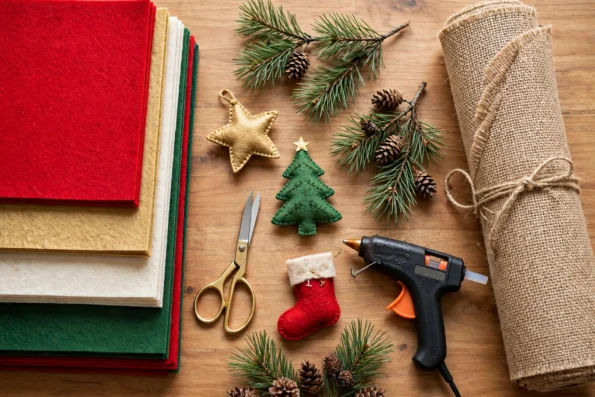
Colourful acrylic felt sheets beside a burlap roll with felt Christmas ornaments, scissors and a glue gun

Felt vs Burlap for Christmas Crafts

Two Christmas craft favourites, two very different looks Every December, the same question lands on the cutting table: felt or burlap? Both are Christmas craft staples, both are cheap and forgiving, and both give you a completely different Christmas. Felt gives you clean colour, crisp shapes and a polished handmade look. Burlap gives you rustic texture, a farmhouse feel and a tree that looks like it came from a country market. Neither choice is wrong, but they are not interchangeable. Felt cuts like paper and glues like a dream, while burlap frays and fights the scissors — and rewards you with a texture no other fabric can fake. This guide compares the two, so you can pick the right one for each project, or use both together. What felt brings to Christmas crafts Felt is the precision fabric of Christmas crafting. Our Premium Acrylic Felt Fabric by the Yard is 100% acrylic, 72 inches wide and 1.6mm thick, in 40 colours — and that wide cut is the first thing that matters. One yard gives you a huge sheet, so a single colour covers a whole batch of ornaments, a garland and a stocking without a single join. The second thing that matters is the edge. Felt does not fray. Cut a star, a tree or a stocking shape and the edge stays exactly as you cut it — no hemming, no sealing, no fray-check. That is why felt is the fabric for small, detailed work: ornaments with sharp points, appliqué letters on a stocking, layered trees where each layer must sit cleanly on the one below. It also takes glue beautifully — a hot glue gun bonds felt to felt in seconds, and felt to wood, cardboard or ribbon just as fast. Most of the no-sew projects in our Christmas Crafts with Felt guide use it for exactly that reason. What burlap brings to Christmas crafts Burlap is the texture fabric of Christmas crafting. It is a loose, open weave of natural jute fibre, and you can see and feel the weave in every piece you make. Where felt is smooth and flat, burlap is rough, slubby and full of character — and that character is the whole point. A burlap bow on a wreath, a burlap tree skirt, a burlap table runner under the candles: each one reads as rustic, warm and handmade in a way felt never will. Burlap is at its best in large, simple shapes, when you let the fabric do the work: a wide burlap ribbon tied in a loose bow, a tree skirt gathered in soft folds, a table runner with a frayed edge left deliberately unfinished. Browse the Jute & Burlap collection — natural jute burlap in a generous 40-inch width is the classic choice, and one yard covers a surprising amount of table or tree. It also layers beautifully with greenery: pine, holly and dried orange slices all sit naturally against burlap. Our Burlap vs Jute guide explains the fibre itself and when to choose burlap over its close cousin jute. Cutting and gluing: the practical difference This is where the two fabrics part company, and it decides most projects before you start. Felt cuts cleanly with ordinary scissors, holds a traced line, and keeps tiny details — a star point, a reindeer antler, a snowflake arm — intact. You can cut a dozen identical ornaments from one sheet and they will all match. Burlap, by contrast, is a woven fabric: the scissors have to cut through the weave, the edges fray the moment you touch them, and fine detail is almost impossible. Gluing tells the same story in reverse. Felt bonds fast and holds: hot glue, fabric glue and even a glue stick will hold felt to felt, and a felt ornament will survive being hung, handled and packed away for next year. Burlap bonds too, but the open weave drinks glue — you need more of it, and the bond is only as strong as the threads it grabs. Burlap is better sewn than glued for anything that carries weight: a tree skirt, a stocking, a banner. A simple running stitch through burlap is fast, strong and invisible in the weave. Our Felt Crafts for Christmas: A Beginner’s Guide to Cutting and Gluing Felt walks through the felt techniques step by step. Which fabric for which Christmas project? Choose felt for ornaments, garlands, stockings, advent calendars and anything with small shapes or lettering. A felt star ornament, a felt tree garland, a felt stocking with a name appliquéd on the cuff — these are felt projects, and burlap would only make them harder. Felt is also the right choice for anything children will make: it is safe to cut, easy to glue, and it does not shed fibres all over the table. Choose burlap for tree skirts, table runners, wreath bows, gift wrap and anything large and rustic. A burlap tree skirt hides the tree stand and softens the base of the tree in a way no felt sheet can. A burlap runner down the Christmas table, with a lace runner layered on top, is one of the easiest festive table looks there is. Use both together when you want the best of each. Felt ornaments hung on a burlap garland. A felt star sewn onto a burlap stocking. A burlap tree skirt with a felt appliqué border. The contrast is the design: the crisp colour of felt against the rough texture of burlap makes both fabrics look better than either does alone. Cost, mess and clean-up Both fabrics are budget-friendly, and both are sold by the yard in one continuous piece at ValentinaTextile.com. Felt’s 72-inch width is the bargain here: a single yard is a very large sheet, and because felt does not fray, every scrap is usable — offcuts become small ornaments, appliqué pieces or gift tags. Burlap’s 40-inch width is narrower, and you will lose a little to fraying at the cut edges, so buy

CONTINUE READING ➞
My Cart
Wishlist
Recently Viewed
Categories

SPIN TO WIN!

  • Try your luck to get a discount coupon
  • 1 spin per email
  • No cheating
Try Your Lucky
Never
Remind later
No thanks