
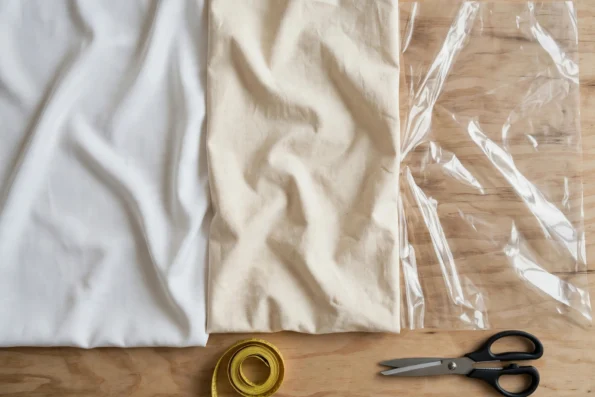
Polyester, cotton canvas and clear vinyl tablecloth fabrics with a measuring tape and scissors

Tablecloth Fabrics Explained: Polyester, Cotton and Vinyl

The tablecloth is the biggest piece of fabric in the room A tablecloth is the largest single piece of fabric in most rooms, which means the fabric you choose changes the whole look of the space — and the meal. The wrong fabric wrinkles before the guests arrive and stains at the first spill. The right one disappears into the background and lets the food and the people take over. The choice comes down to three fabrics — polyester, cotton and vinyl — and this guide explains which one fits your table, your event and your tolerance for laundry. Polyester: the workhorse for events Polyester is the fabric behind most event tablecloths, and there is a good reason for that: it is wrinkle-resistant, stain-proof and machine washable, which is what you want when a table must look good for hours and be ready again the next day. A Polyester Rectangular Tablecloth 60″x144″ is made for weddings, banquets and parties: durable polyester that holds its drape through a long evening and comes out of the machine ready to use again. Polyester is also the most forgiving fabric for a busy house: it does not absorb spills the way cotton does, so a knocked-over glass is a wipe rather than a stain. If you are choosing one tablecloth for many occasions — family dinners, holiday meals, birthday parties, a wedding reception — polyester is the safe first buy. It comes in the sizes events need: the rectangular 60″x144″ covers a long banquet table, and the 60″x108″ fits a standard dining table, as in our Gingham Tablecloth 60″x108″, a 100% polyester cover with a classic 1-inch check. The trade-off is feel: polyester lacks cotton’s soft, natural hand, but the tablecloth is under the plates, not in anyone’s hands. Cotton and cotton canvas: the natural choice for everyday tables Cotton is the fabric people reach for when they want a table to feel like home rather than an event venue. It is soft, breathable and natural to the touch, and it drapes in a relaxed way that suits farmhouse and kitchen tables. A cotton tablecloth feels comfortable in a way polyester never does. The price of that comfort is maintenance. Cotton wrinkles visibly: a cotton tablecloth needs ironing before guests arrive, and it will crease again where elbows rest during the meal. It absorbs spills, so a red-wine accident needs attention straight away. For a family dinner that is a fair trade; for a wedding with a hundred guests and a bar, it is a risk you do not need. Cotton canvas is the heavier, sturdier side of the cotton family — tightly woven, holding its shape better than a light cotton, good for a table that gets used hard. Browse the Cotton & Canvas collection, and remember that cotton by the yard lets you cut a cloth to your exact table size. Our Cotton vs Poly Cotton guide covers how cotton and synthetics behave when you sew with them. Vinyl: the protector that looks like nothing at all Vinyl plays a different role from the other two: it is not there to be admired, it is there to protect. Clear Vinyl Fabric by the Yard is waterproof PVC, 54 inches wide, available in 4, 8 and 10 gauge — and it is transparent, so it goes over the tablecloth you already love and protects it without hiding it. The pretty cloth underneath stays visible, and the spills, the candle wax and the children’s crafts stay on the vinyl. The gauge — the thickness — decides what the vinyl is for. The 4 gauge is the lightest, good for a quick cover during a party or for craft projects that need a waterproof layer. The 8 gauge is the everyday middle ground, sturdy enough for regular use. The 10 gauge is the heaviest, for tables that take real punishment: a craft table, a workshop bench, a dining table with small children. All three are sold by the yard, so you can cut a protector to your exact table size; for a very large job there is also a full 25-yard roll of 4-gauge clear vinyl at $89.99. Vinyl has two limits: it does not breathe, so it is not comfortable as a cloth on its own in a hot room, and it is a protector, not a decoration — pair it with a proper cloth underneath and let the vinyl be invisible. Which fabric for which table? For a wedding or banquet, choose polyester: wrinkle-resistant, stain-proof, machine washable, and still looking good in the last photo of the night. For a family dinner or farmhouse table, choose cotton or cotton canvas: it feels better and looks more natural, and the extra ironing is worth it. To protect a cloth you already own, choose clear vinyl in the gauge that matches the job, and let the pretty fabric show through. If you are still deciding between a runner, a cloth and an overlay, our How to Choose Table Linens guide covers the sizing for each one, and the Wedding Table Linens guide covers the same decisions for the biggest occasion of all. Sizing: measure twice, buy once Whatever fabric you choose, the sizing rule is the same. Measure your table, then add the drop you want on each side — 20 to 30 cm gives a casual look, while a drop to the floor is the formal choice for events. If you are buying fabric by the yard, add an extra half yard for hems and for the fabric to settle after its first wash. Care: how each fabric likes to be treated Polyester is the easiest: machine wash, tumble dry on low, and it comes out ready to use. Cotton needs more attention: wash in cool or warm water, iron while slightly damp, and expect some shrinkage on the first wash — which is why the extra half yard matters. Vinyl is the simplest: wipe it clean with a damp cloth and mild
CONTINUE READING ➞
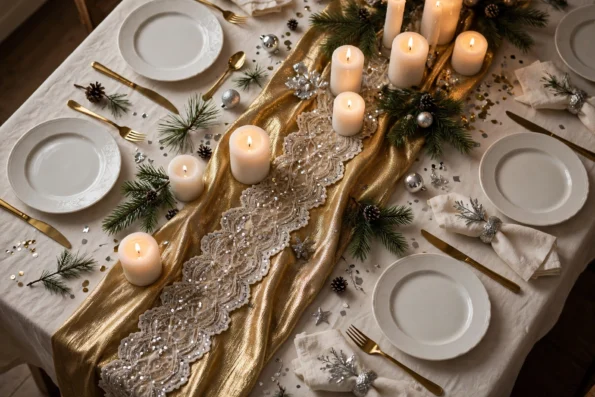
New Year's table with a gold metallic runner, beaded sequin lace, candles and white plates

New Year Table Décor: Gold, Silver and Sequin Shine

Ring in the New Year with a table that shines New Year’s Eve is the one night of the year when a table is allowed — expected, even — to sparkle. The countdown, the toast at midnight, the first meal of the new year: all of it happens around the table, and the table deserves to look the part. You do not need a professional stylist or a big budget to get that look. Three materials do almost all of the work: gold, silver and sequin. Together they give you a table that catches the candlelight and photographs beautifully, while still feeling like a real dining table. Why gold, silver and sequin work for New Year’s Eve Gold and silver are the traditional colours of the night, and they work precisely because they are opposites. Gold is warm, rich and festive; silver is cool, crisp and modern. Put them together and they balance each other — the gold stops the silver feeling cold, and the silver stops the gold feeling heavy. Sequin is the third element: not a colour but a texture, a scatter of tiny reflective points. Pick one metal as your lead — gold for a warm, classic New Year, silver for a cooler, more modern one — use the other as an accent, and keep sequin the smallest element: a runner or an overlay, never the whole table. Gold: the warm metal that sets the mood Gold is the natural lead for a New Year’s table: it reads as celebration — champagne, candlelight, fireworks — and flatters warm lighting better than any other colour. The easiest way to bring it onto the table is Nylon Metallic Tissue Lamé, made for this job. It is a crisp, lightweight fabric with a reflective metallic finish, 60 inches wide and sold by the yard, in a blend of 85% nylon and 15% metallic fibres. Because it is sold by the yard, you can cut exactly what you need: a runner, an overlay, or a full tablecloth. Use gold lamé as a runner down the centre of the table, over a plain cloth in ivory or black: it catches the light along the table and frames the plates without competing with them. It is semi-sheer, so it layers well over a solid-coloured cloth — try gold lamé over deep green or burgundy for a rich, festive depth. One practical note: lamé is hand wash cold and line dry, with a cool iron on the reverse if you need to press it. Silver: the cool metal that keeps it modern Silver is the cooler, more modern partner to gold, and the better lead if your New Year’s Eve style is crisp rather than cosy. Silver lamé in the same Metallic Tissue Lamé range gives you that cool shine in the same easy-to-work-with fabric — 60 inches wide, lightweight, sold by the yard, and just as simple to cut as a runner or overlay. Silver works best against dark colours. A silver runner over a black or deep navy tablecloth looks striking under candlelight, and silver pairs beautifully with white — white plates, white candles, white flowers — for a table that feels like a winter night. If you are mixing metals, let silver be the accent when gold leads: silver napkin rings, a silver charger under each plate, or a narrow silver ribbon alongside a gold runner. Sequin shine: the lace that finishes the table Sequin lace adds sparkle without adding another colour, and the best way to use it on a New Year’s table is as a narrow runner or an overlay over a plain cloth. Premium 3D Beaded Lace (VT-32) is a beaded and sequinned lace with a raised, three-dimensional floral pattern — it catches light from every seat at the table, and the beading gives it a weight and presence that a flat sequin fabric does not have. Lay a strip of beaded lace down the centre of the table, over your cloth and under your centrepiece, and let it do the work of a full decoration scheme. It pairs with either metal: warm and opulent over gold lamé, icy and elegant over silver. Keep the rest of the table simple when sequin lace is on it — plain plates, plain glasses, one low centrepiece — because the lace is already the decoration. Our New Year Party Décor guide shows it with satin and shimmer fabrics for the whole room. Store beaded lace rolled, not folded, so the beading does not crease, and keep it away from anything that could snag it. Building the table: cloth, runner, overlay A good New Year’s table is built in layers. Start with the base cloth, the quietest element: a plain polyester tablecloth in ivory, black or deep green, wrinkle-resistant and machine washable. Next comes the runner, which is where the metal belongs: a gold or silver lamé runner, cut to the length of the table plus a drop of about 30 cm at each end, gives you the shine in a controlled band. If you prefer, use the beaded lace as the runner instead and keep the metal for accents — both approaches work. Finally, the overlay: a sheer or sequinned layer over the top of the cloth, or a second runner crossing the first. One layer of sequin is enough. The test is simple: step back and look at the table with the lights on. If your eye goes to the plates and the people, the layering is right. If your eye goes to the fabric and nowhere else, take a layer away. Browse the Table Linens collection for the base cloth, and see our Wedding Table Linens guide for runner, cloth and overlay sizing — the same measurements work for New Year’s Eve. After midnight: care and storage After the party, five minutes of care gets the fabrics ready for next year. Shake crumbs off the lamé outdoors, then hand wash cold and line dry — never put lamé

CONTINUE READING ➞
My Cart
Wishlist
Recently Viewed
Categories

SPIN TO WIN!

  • Try your luck to get a discount coupon
  • 1 spin per email
  • No cheating
Try Your Lucky
Never
Remind later
No thanks