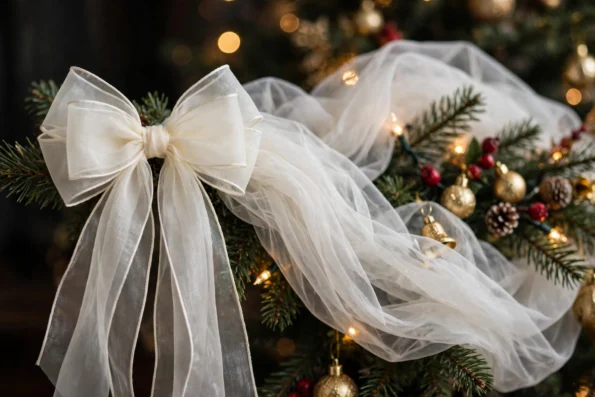
Ivory organza bow beside soft white tulle draped over a Christmas tree branch with warm lights

Organza vs Tulle for Christmas Décor: Bows, Trees and Table Dressing

The short answer: organza for crisp structure, tulle for soft volume Christmas decorating runs on sheer fabric. Bows on wreaths, swags on staircases, overlays on tables, wrapping around trees — so much of the festive look comes from translucent layers that catch the light. Two fabrics dominate that job: organza and tulle. They look similar on a bolt, they are both sheer, and they are both sold by the yard at ValentinaTextile.com — but they behave very differently once you start decorating, and choosing the wrong one is the difference between a bow that holds its shape all December and one that flops by the second week. The rule of thumb is simple: organza is crisp and structured, tulle is soft and voluminous. Organza holds a shape; tulle fills a space. This guide compares the two for the three big Christmas jobs — bows, trees and table dressing — so you can buy the right sheer fabric for each one. Both fabrics live in the Tulle & Organza collection; our Tulle vs Organza for Weddings guide covers the bridal version. Organza vs tulle at a glance Organza is a sheer, plain-weave fabric with a crisp hand. It feels smooth and slightly stiff, it holds folds and creases, and it has a subtle sheen that catches Christmas lights beautifully. That crispness is its great strength and its one limitation: organza makes shapes that stay put, but it does not drape in soft, flowing folds the way tulle does. Tulle is a soft net fabric with an open, hexagonal mesh. It feels light and airy, it gathers into clouds of volume with very little fabric, and it drapes softly rather than holding a sharp shape. Tulle’s strength is fullness: a little tulle goes a long way, and layered tulle gives trees, tables and staircases a snowy, frosted look that organza cannot match. Its limitation is structure — tulle will not hold a crisp bow loop on its own. Christmas bows: organza wins For wreath bows, pew bows, gift bows and chair bows, organza is the clear winner. A bow needs loops that stand up and tails that fall in clean lines, and organza’s crispness does exactly that. An organza bow made in early December still looks like a bow at New Year, where a tulle bow softens and loses its shape within days. Browse the Organza collection for colours that suit your scheme — classic red and gold for a traditional tree, ivory or champagne for a softer look, or deep green for wreaths. For a full, luxurious bow, cut your organza wide and make several loops; the fabric’s sheen means even a simple bow looks expensive under Christmas lights. If you love the softness of tulle, use it as a secondary layer behind an organza bow: the organza gives the structure, the tulle adds a whisper of volume around it. Christmas trees: tulle wins for volume, organza for accents On the tree itself, the two fabrics play different roles. Tulle is the best choice for filling out a tree and giving it a snowy, frosted finish. Wrap wide tulle loosely around the tree in a spiral, tucking it into the branches, or gather it into puffs between ornaments. Because tulle is so light and voluminous, it makes a slim tree look fuller, and it is far more forgiving than ribbon. Organza on a tree works best as an accent rather than a wrap: small organza bows clipped to branch tips, organza ribbon woven in short lengths between ornaments, or a crisp organza tree topper bow. The contrast is what makes a tree look designed rather than just decorated — soft tulle volume with crisp organza points catching the light. For tulle by the yard, the Tulle Bolt collection is the place to start. Table dressing: use both, in layers Christmas tables are where organza and tulle work best together. A tulle overlay over a tablecloth softens the whole table, adds a frosted, snowy layer, and makes centrepieces and candles look as if they are sitting on fresh snow. It is the fastest way to make an ordinary table look like a Christmas table, and it needs no sewing — just cut to length and let it fall over the edges. Organza on a table works as a runner or as chair sashes. An organza runner down the centre of the table adds sheen and colour without hiding the cloth beneath it, and organza chair bows tie the chairs into the same scheme as the table. Layered together — a tulle overlay with an organza runner over it — you get depth, sheen and softness in one table. For the full festive table picture, see our Christmas Table Settings guide. Which should you buy? Buy organza if your project needs shape: bows, sashes, runners, tree-topper bows and structured accents. Buy tulle if your project needs volume: tree wraps, table overlays, staircase swags and soft, snowy layering. Buy both if you are decorating a whole room — they are designed to work together, and a room with only one of them usually looks like something is missing. When you order, think in terms of the job, not just the length. Bows need width and several loops per bow, so allow more fabric than the finished bow measures. Tree wraps and table overlays need length plus a generous drop or drape, so measure your tree or table first and add extra for gathering — tulle in particular looks best when it is gathered rather than stretched flat. Check the exact colours and widths on the listing you buy, since the listing is the final word on what is in stock. Care and storage after Christmas Both fabrics are delicate, so handle them gently when you take decorations down. Fold organza rather than scrunching it, so its crisp finish survives to next year, and store it away from sharp ornaments that could snag it. Tulle can be rolled loosely; avoid tight folds that crease
CONTINUE READING ➞
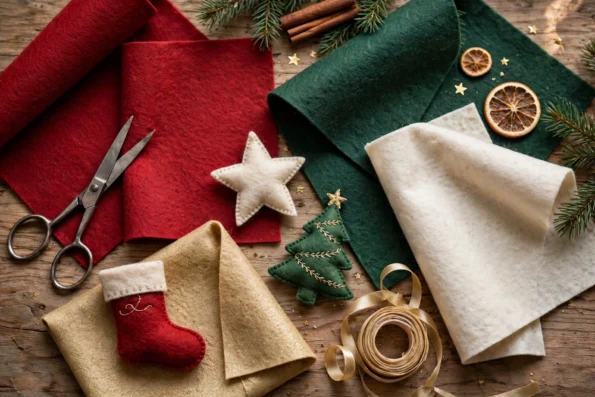
Red, green, cream and gold felt sheets with felt star, tree and stocking ornaments, scissors and ribbon

Christmas Crafts with Felt: Ornaments, Stockings and Garlands

The short answer: felt is the easiest Christmas craft fabric you can buy Christmas crafting should feel joyful, not stressful. You want projects that look good on the tree, survive a house full of guests, and do not demand expert sewing skills or expensive tools. Felt checks every one of those boxes. It cuts cleanly without fraying, it holds its shape without hemming, it glues beautifully, and it comes in the deep reds, forest greens, snowy whites and golds that Christmas decorating is built on. If you can cut a shape with scissors and squeeze a glue bottle, you can make Christmas decorations from felt — and because ValentinaTextile.com sells felt by the yard, you can buy exactly the colours and quantities your project list needs. This guide covers the three classic felt Christmas projects — ornaments, stockings and garlands — with beginner-friendly methods and tips for making them last. For how felt compares with other soft craft fabrics, see our Felt vs Fleece guide, and for a warm-up, our 10 Easy DIY Halloween Crafts with Felt uses the same techniques. Why felt works so well for Christmas crafts Felt is a non-woven fabric, which means its fibres are pressed together rather than woven or knitted. That single fact explains almost everything crafters love about it. Cut edges do not unravel, so ornaments need no hemming and garlands need no finishing. The fabric is firm enough to hold a star point or a tree shape, yet soft enough to cut with ordinary scissors and sew with a simple running stitch. It takes glue well, which makes it ideal for children, for classrooms, and for anyone who would rather glue than sew. Project 1: Felt Christmas ornaments Ornaments are the fastest felt project and the best place to start. Choose simple shapes: stars, trees, snowflakes, hearts, mittens and gingerbread people all work beautifully in felt, and all can be cut from a paper template you draw yourself or print at home. How to make a basic felt ornament Cut two identical shapes from felt, one for the front and one for the back. Decorate the front first, while it is still flat: sew or glue on buttons, beads, sequins or a smaller contrasting felt shape. Then place the two shapes together, sew or glue around the edge leaving a small gap, add a little stuffing or a scrap of felt for padding, and close the gap. Finish with a loop of ribbon or twine through the top for hanging. A single evening can produce a dozen ornaments, and a set of matching ornaments in two or three colours looks far more polished on a tree than a random mix. Ornament ideas that always look good Layered stars in red and cream, with a gold button in the centre, are a classic. Mini stockings in green with a white cuff make a sweet matching set. Snowflakes in white and pale blue, cut with simple slits rather than fiddly points, look elegant against dark green branches. And felt gingerbread people, with white blanket stitch around the edge and tiny button eyes, are a favourite with children — and they never go stale. Project 2: Felt Christmas stockings A felt stocking is a bigger project than an ornament, but it is still a beginner project. The stocking shape is simple, the seams are straight or gently curved, and there is no lining to fuss over if you do not want one — a single layer of felt holds its shape well enough to hang on a mantel. Cut two stocking shapes, decorate the front with a cuff, an initial, or a small appliqué shape such as a tree or a snowman, then sew or glue the two layers together around the edge, leaving the top open. Add a hanging loop at the top corner. For a stocking that will actually hold small gifts, sew the seam rather than gluing it, and choose a sturdy felt; a glued seam is fine for a purely decorative stocking. Personalise each stocking with a felt initial or a name cut from contrasting felt — it is the detail that turns a craft project into a keepsake that comes out every December. Project 3: Felt garlands Garlands use felt’s best quality — its clean, no-fray edge — better than any other project. Cut a string of shapes, thread or glue them onto ribbon, twine or yarn, and you have a garland for the mantel, the staircase or the tree, with no hemming at all. The simplest garland is a row of circles or stars in alternating Christmas colours, spaced evenly along a length of twine. A step up is a garland of small trees, each with a tiny button or bead at the top like a star. For a mantel garland, larger shapes work better: big stars, holly leaves with red berry circles, or a mix of trees and snowflakes. Because felt is light, a felt garland hangs without pulling its ribbon down, and it stores flat in a bag or box until next year — just roll it gently rather than folding it sharply, so the shapes keep their form. Choosing colours and quantities A good Christmas felt palette starts with the classics: deep red, forest green, cream or white, and a touch of gold. From there, add one accent colour that suits your home — burgundy for a traditional room, icy blue for a winter look, or blush pink for a softer, modern tree. Buying felt by the yard, rather than in small pre-cut sheets, makes large projects such as stockings and long garlands far more practical, and it keeps the colour consistent across every piece in a set. Check the exact colours and widths on the listing you buy — the listing is the final word on what is in stock. Tips for felt crafts that last past Christmas Keep felt decorations away from open flames and hot lights — battery lights are safer for

CONTINUE READING ➞
My Cart
Wishlist
Recently Viewed
Categories

SPIN TO WIN!

  • Try your luck to get a discount coupon
  • 1 spin per email
  • No cheating
Try Your Lucky
Never
Remind later
No thanks