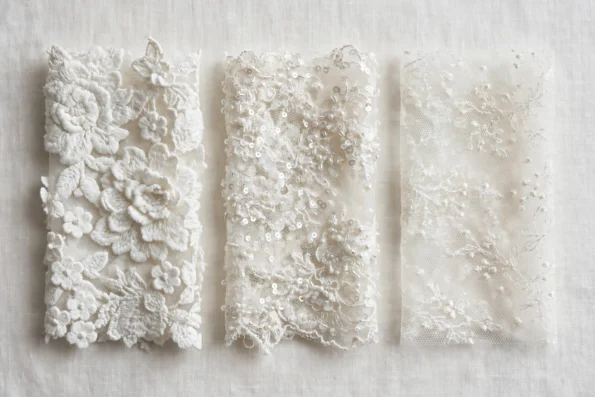
Three lace swatches: raised 3D floral lace, beaded sequin lace, and delicate embroidered mesh lace

Lace Fabric Types Explained: 3D, Beaded and Embroidered Lace

The short answer: choose by dimension, sparkle, and structure Lace looks simple from a distance — an open, patterned fabric — but up close it splits into very different types, and the wrong choice can flatten a design that should stand out. A flat embroidered lace, a raised 3D lace, and a beaded lace do not behave the same way, do not catch the light the same way, and do not suit the same projects. If you buy by colour alone, you may end up with a bodice that sparkles when it should whisper, or a table runner that lies flat when it should rise off the cloth. This guide explains the three main lace types Valentina Textile shoppers ask about most — 3D lace, beaded lace, and embroidered lace — so you can choose with confidence. What is 3D lace? 3D lace is lace with raised motifs: flowers, leaves, or other shapes that sit proud of the mesh ground instead of lying flat on it. Run your hand over it and you feel the pattern rise; hold it up and the motifs cast tiny shadows, which gives the fabric depth even in a single colour. That dimension makes 3D lace a favourite for bridal bodices, sleeves, and overlays. Valentina Textile’s 3D Beaded & Sequin Lace (VT-32) combines that raised dimension with beading and sequins, so it brings both texture and sparkle to a single fabric. 3D lace is also a strong choice for table runners and event décor, where the raised motifs catch the light and give a plain table a finished, layered look. What is beaded lace? Beaded lace is lace decorated with beads, pearls, sequins, or a combination of them, stitched or bonded onto the lace ground. The beads add weight, movement, and sparkle: the fabric glitters as it moves, which is why beaded lace is so popular for evening wear, bridal gowns, and occasion pieces that will be seen under event lighting. Valentina Textile’s Pearl & Bead Embroidered Lace (VT-31) pairs pearl and bead embroidery with an embroidered ground, giving a softer sparkle than a heavily sequinned lace — elegant rather than flashy. Beaded lace needs a little more care in sewing, because beads near seam lines can break a needle if they are not moved aside. What is embroidered lace? Embroidered lace is lace whose pattern is stitched onto a mesh or net ground, usually in thread alone, without beads or raised appliqué. It is the lightest and most versatile of the three types: soft, flexible, and easy to drape, with a pattern that reads clearly without adding weight or bulk. Browse the full Lace Fabric collection at ValentinaTextile.com to compare embroidered, beaded, and 3D styles side by side, all sold by the yard. 3D, beaded, and embroidered lace compared Look and texture 3D lace has the most texture: you can feel the raised motifs, and the fabric has a sculptural quality even before it is sewn. Beaded lace has the most sparkle: beads and sequins catch the light with every movement, so the fabric changes as the wearer moves. Embroidered lace has the cleanest, softest look: the pattern is clear and detailed, but the fabric stays flat, light, and flexible. Weight and drape Embroidered lace is the lightest and drapes most easily, which suits sleeves, veils, and flowing overlays. 3D lace is heavier, because the raised motifs add bulk, and it holds its shape more — good for structured bodices and statement runners. Beaded lace is the heaviest of the three, because beads add real weight, and that weight gives a beautiful, liquid drape on a gown but can pull a light garment out of shape if it is not supported. Best uses for 3D lace Choose 3D lace for bridal bodices and sleeves, statement overlays, formal table runners, and any project where the lace itself should be the feature. It is especially effective in a single colour, where the raised pattern does all the talking without needing contrast or sparkle to be noticed. Best uses for beaded lace Choose beaded lace for evening gowns, bridal gowns, pageant and prom dresses, and occasion wear that will be seen under lights. Best uses for embroidered lace Choose embroidered lace for everyday elegance: blouses, sleeves, overlays, veils, christening gowns, and table runners that will be used again and again. It is the easiest lace to sew, the easiest to care for, and the easiest to pair with other fabrics, from satin to chiffon. Sewing with lace Cutting and matching the pattern With all three types, plan your cuts around the pattern repeat: a flower cut in half at a seam looks like a mistake, while a motif placed whole at a neckline or hem looks deliberate. With 3D and beaded lace, also check where beads and raised motifs fall on seam lines, and move or remove the few that sit exactly on a seam before you sew. Seams and finishing Lace seams are usually sewn with a narrow seam and finished carefully, since the open mesh shows more than a solid fabric would. A French seam or a neatly overlocked edge keeps the inside as clean as the outside. For beaded lace, use a sturdy needle, sew slowly over beaded areas, and hand-finish any beads that sit close to a seam. Layering lace over other fabrics Lace is almost always worn over something: a lining, a satin, or a solid fabric that gives it a background. The underlayer changes the lace completely — ivory lace over white reads soft and bridal, while the same lace over a coloured satin reads bold and modern. Test your combination before you cut. Our Table Linens Guide shows how lace runners pair with tablecloths for events, if your project is for the table rather than the wardrobe. Care: what to check before you buy Care varies by product, so the listing for the exact lace you are considering is the final word. As a general rule, lace needs gentle
CONTINUE READING ➞
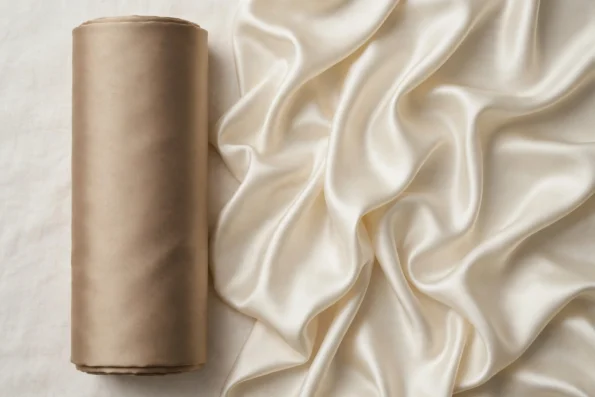
Structured satin roll beside fluid ivory charmeuse satin drape

Satin vs Charmeuse: Shine, Drape and Care Compared

The short answer: charmeuse is satin, but not all satin is charmeuse If you have ever stood in front of two shiny fabrics and wondered why one drapes like water while the other holds its shape, you have met the satin and charmeuse problem. The confusion is understandable, because charmeuse is a type of satin weave, not a separate family altogether. Yet in practice the two behave very differently once you cut and sew them, and choosing the wrong one can change a whole garment. This guide explains the difference in plain terms — shine, drape, weight, best uses, sewing, and care — so you can order the right fabric the first time. What is satin? Satin is a weave, not a fibre. In a satin weave, most of the threads run across the surface of the fabric, which is what gives satin its smooth, light-catching face and its duller back. That weave can be made from many fibres, and the result varies a great deal. The satins sold at ValentinaTextile.com cover that whole range, from fluid Charmeuse Satin to the firmer, more structured finishes in the broader Satin Fabrics collection, all sold by the yard. What is charmeuse? Charmeuse is a lightweight satin with a very soft hand and a liquid drape. Its face is glossy and smooth, its back is matte, and it falls in soft, flowing folds rather than holding a shape of its own. Touch it and it slips through your fingers; hold it up and it pours rather than stands. That fluid quality is what makes charmeuse the go-to choice for bias-cut dresses, flowing blouses, lingerie, and scarves — anything that should move with the body and catch the light as it moves. Browse the Charmeuse Satin collection at ValentinaTextile.com to compare colours, all sold by the yard. If you love the look of satin but want it to feel like a second skin, charmeuse is usually the version you are imagining. Satin vs charmeuse compared Shine and surface Both have the smooth, light-catching face that defines satin, but charmeuse tends to show a softer, more liquid shine because its light surface moves with every fold. A heavier, more structured satin shows a broader, more even sheen across a flat surface, which reads as more formal and more deliberate. Neither is better in the abstract — the right shine depends on whether your project should glow softly as it moves or present a smooth, polished surface that stays put. Drape and silhouette This is the difference that matters most. Charmeuse drapes and clings: it follows curves, falls in narrow folds, and gives a soft, body-skimming silhouette. A more structured satin drapes in wider, cleaner folds and holds volume where the design puts it. For a bias-cut gown, a flowing skirt, or a draped top, charmeuse gives you the movement for free. For a structured bodice, a full skirt that needs to keep its shape, or formal drapery, a firmer satin does the structural work for you. Best uses for charmeuse Choose charmeuse for bias-cut dresses and gowns, flowing blouses, camisoles and lingerie, scarves, and any garment where softness and movement are the point. It is also a lovely choice for lining a flowing garment, where its smooth face lets layers slide over each other instead of catching. If the garment will be worn against the body and should feel light and fluid, charmeuse is almost always the right answer. Best uses for other satins Choose a more structured satin for bridal gowns and formal wear where the silhouette comes from the cut, for structured bodices and jackets, for full skirts that need to keep their volume, and for event décor such as table runners and drapery where a smooth, polished surface matters. For bridal projects specifically, our Bridal Satin Buying Guide explains weights and finishes in more detail, and the broader comparison in Velvet vs Satin helps if you are still choosing between fabric families. Sewing with satin and charmeuse Cutting a slippery fabric Both satins can shift while you cut, and charmeuse shifts the most. Cut on a surface the fabric will grip, such as a cutting mat, pin generously, and cut in a single layer when accuracy matters. A rotary cutter often gives a cleaner edge than shears on slippery satin, and pattern weights beat pins for holding charmeuse flat without distorting it. Take your time here: a slipped cut is the most common reason a satin garment ends up uneven. Seams and hems Use a fine, sharp needle and a slightly shorter stitch length than you would for cotton, and test on a scrap first — satin shows needle holes and puckering more readily than a textured fabric. For structured satin, a standard seam and a pressed hem work well, and the firmer cloth is more forgiving of topstitching. Pressing without marking Press satin from the wrong side, on a low to medium heat, with a pressing cloth between the iron and the fabric. A hot iron pressed directly onto the shiny face can leave a permanent mark or a dull patch, and that damage is hardest to hide on charmeuse, where the whole appeal is the unbroken shine. Test your iron setting on a scrap, and press seams open gently rather than forcing them flat. Care: what to check before you buy Care varies by product, so the listing for the exact satin you are considering is the final word. As a general rule, satin needs gentle handling and low heat to keep its smooth face looking new, and charmeuse in particular should be treated as a delicate fabric. If your project will be washed often, check the care instructions before ordering rather than after. Which should you buy? Ask yourself one question: should this project flow, or should it hold its shape? If it should flow — a bias dress, a draped blouse, lingerie, a scarf — buy charmeuse. If it should hold its shape — a structured gown,

CONTINUE READING ➞
My Cart
Wishlist
Recently Viewed
Categories

SPIN TO WIN!

  • Try your luck to get a discount coupon
  • 1 spin per email
  • No cheating
Try Your Lucky
Never
Remind later
No thanks