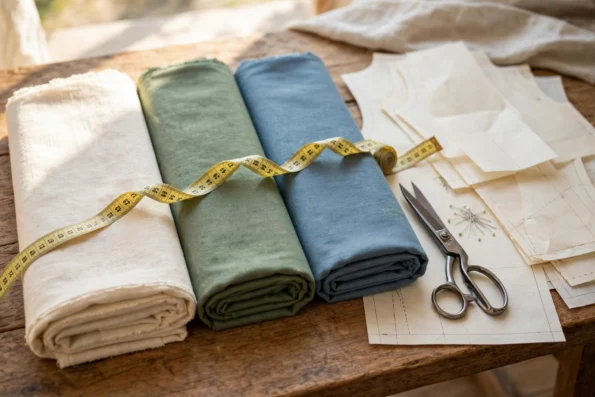
Fabric rolls in cream, sage and blue with a measuring tape, scissors and a sewing pattern

How Much Fabric Do I Need? A Yardage Guide for Dresses, Curtains and Crafts

The short answer: start from your pattern, then add a little extra Running out of fabric halfway through a project is one of the most frustrating sewing mistakes, and it is almost always avoidable. The fix is simple: work out your yardage before you order, using your pattern or your measurements, not a guess. This guide explains how fabric is sold by the yard, how width changes everything, and how much to allow for dresses, curtains, and common crafts — with a simple method for any project. How fabric by the yard actually works When you buy fabric by the yard, you are buying a length of cloth cut from a bolt: one yard is a length of 36 inches, and the width is the width of the bolt itself. That width matters as much as the length, because a wider bolt fits more pattern pieces side by side, so you may need fewer yards. Always check the width on the exact product page before ordering — widths vary by product, and a yardage estimate made for one width will be wrong for another. At ValentinaTextile.com, fabric is sold by the yard in one continuous cut, so a multi-yard order arrives as one piece. Browse the Shop to see the full range. The yardage method: four steps for any project Step 1: Start with your pattern If you are using a commercial pattern, it will list yardage by size and fabric width — that chart is your best starting point, because it accounts for every piece. Trust it over any general guide, including this one. If you are sewing without a pattern, measure the finished length you need, then add seam and hem allowances, and plan the layout across the width. Step 2: Measure twice, in the right places For a dress, the key measurements are the length from shoulder to hem, sleeve length, and the widest point the pattern must fit around. For curtains, measure the finished drop from rod to hem and the total width to be covered, then decide how full you want them — flat panels need less fabric than gathered ones. Write the numbers down. Step 3: Allow for pattern, nap, and direction Some fabrics need extra yardage. Large prints and stripes need matching at the seams, which can use extra length. Fabrics with a nap or pile, such as velvet, must be cut with the nap running the same way on every piece — see the Velvet Fabric collection for a nap-fabric example — and that one-way layout can need more cloth. Directional prints work the same way. Step 4: Add a safety margin For most projects, adding a little extra is cheap insurance. A quarter to half a yard extra covers cutting mistakes or a longer hem, and is far cheaper than reordering — especially if the dye lot has changed by then. For matching pieces, buy all the yardage in one order so the colour matches throughout. How much fabric for a dress? As a starting estimate only, a simple knee-length dress for an adult often takes around 2 to 3 yards, while a full-length or full-skirted dress can take 4 yards or more, depending on the width of the fabric, the size, and how full the skirt is. Sleeves, a lining, and a wide skirt all add yardage. These are rough starting points, not a substitute for your pattern’s chart: a narrow fabric calls for more yards than a wide one, and a larger size needs more than a smaller one. The Satin Fabrics collection shows a fluid dress fabric. How much fabric for curtains? Curtains are measured by drop and by fullness. First measure the finished drop and add hem allowances. Then decide the finished width: a flat look needs about the window width; a soft gather, one and a half to two times it; a full gather, two to three times. Multiply the widths needed by the drop for a starting length — then round up and add a margin for hems and pattern matching. Always measure your own window. How much fabric for crafts and home projects? Table runners and tablecloths A table runner needs the length of the table plus the drop you want at each end, plus hem allowances — measure your own table. A tablecloth needs the table length and width plus twice the drop on each side, plus hems. Cushions, bags, and small crafts One yard goes furthest on small projects: usually plenty for a pair of cushion covers, a tote bag, or several small craft pieces. For cushions, measure the form and add seam allowances; for bags, allow for body, lining, pockets, and straps. Blankets and throws A throw needs at least its finished length plus hem or binding allowances, and a double-layer blanket needs twice that if both layers come from the same fabric. Width matters here: a wide fabric may cover a throw in one width, while a narrower one may need two joined. Measure the bed or sofa it is for; a slightly generous blanket is far more useful than a slightly short one. Five yardage mistakes to avoid First, ordering by length alone, ignoring width — the same project can need very different yardage on different widths. Second, forgetting seam and hem allowances. Third, buying exactly the pattern’s minimum with no margin. Fourth, reordering later and finding the dye lot has changed. Fifth, ordering matching pieces in separate orders. Avoid those five, and most yardage problems disappear. Shop fabric by the yard at ValentinaTextile.com Once you know your yardage, ordering is the easy part. Shop the Shop at ValentinaTextile.com, check the width and care details on the exact product page, and order your full yardage in one continuous cut — with a small margin for mistakes, so the project you planned is the project you finish. Frequently asked questions Is one yard enough for a dress? Usually not for an adult dress, though one yard can be enough
CONTINUE READING ➞
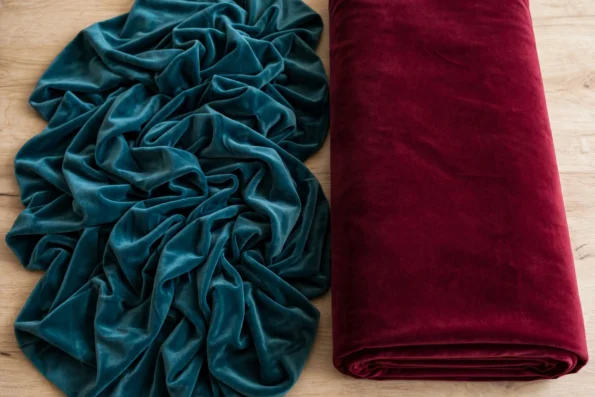
Stretch velvet in teal beside structured royal velvet in burgundy

Stretch Velvet vs Royal Velvet: Which Velvet Do You Need?

The short answer: stretch for movement, royal for structure Both are velvet, both have that soft pile and rich colour, but they behave very differently once you start sewing. If you buy the wrong one, the dress will not fit the way you imagined, or the curtains will not hang the way you planned. Stretch velvet gives and moves with the body, which makes it the natural choice for fitted clothing. Royal velvet holds its shape, which makes it the better choice for structured garments, upholstery, and drapery that needs to keep its form. This guide compares the two side by side — stretch, drape, best uses, sewing, and care — so you can order the right velvet the first time. What is stretch velvet? Stretch velvet is velvet with give built in, so it stretches and recovers rather than staying rigid. That elasticity is the whole point: it hugs curves, moves when you move, and forgives small fitting differences that a non-stretch fabric would punish. It still looks like velvet — soft pile, deep colour, a gentle sheen — but it feels softer and more giving in the hand. Browse the Stretch Velvet collection at ValentinaTextile.com to compare colours, all sold by the yard. What is royal velvet? Royal velvet is the structured side of the velvet family: a plush, non-stretch velvet with a firm hand and a dense, even pile. It holds a fold, keeps a silhouette, and gives weight and presence to anything made from it. That is why it has long been associated with formal rooms and occasion wear — it looks deliberate and luxurious, and it keeps its shape. Browse the Royal Velvet collection at ValentinaTextile.com to compare colours, all sold by the yard. Stretch vs structure: the key difference The difference between the two is not the pile — both are soft and plush — it is what happens when you pull the fabric. Stretch velvet extends and springs back, which suits anything worn close to the body. Royal velvet barely gives at all, which suits anything that needs to stand on its own. That single difference drives almost every other choice: fit, pattern, and project type. Stretch velvet vs royal velvet compared Fit and comfort Stretch velvet is the comfortable choice for clothing. A fitted dress, a leotard, a dance costume, or a snug top in stretch velvet moves with you, needs less precise fitting, and stays comfortable through an evening of sitting, dancing, and standing. Royal velvet fits the way a tailored fabric fits: the shape comes from the cut, not from the cloth giving. That suits a structured gown or jacket, but the fit has to be right, because the fabric will not forgive a tight seam. Drape and silhouette Stretch velvet drapes softly and clings, following the body and falling in gentle folds. It is ideal for bias-style dresses, draped tops, and costumes where the fabric should move like a second skin. Royal velvet drapes with weight and authority: it falls in broader, cleaner folds and keeps volume where the design puts it. For full skirts, structured capes, and drapery, that weight is exactly what you want — the fabric itself helps the design hold its shape. Best uses for stretch velvet Choose stretch velvet for fitted dresses, dance and theatre costumes, leotards, leggings, wrap tops, and children’s costumes that need to be comfortable and easy to move in. It is also forgiving for beginners, because the give hides small fitting errors. If the garment will be worn against the body and needs to flex, stretch velvet is almost always the right answer. Best uses for royal velvet Choose royal velvet for structured gowns, jackets, capes, and formal wear where the silhouette matters more than the stretch. It is also the better velvet for home projects: upholstery, cushion covers, headboards, and curtains that need to hang in full, even folds. Sewing with each velvet Cutting and marking Both velvets share one rule: cut with the nap running the same way on every piece, or the colour will look different from one panel to the next. With stretch velvet, lay the fabric flat and do not pull it while cutting, or the pieces will spring back smaller than you cut them. With royal velvet, the firmer cloth is easier to control, but pin generously and cut in a single layer when you can. Seams and hems Stretch velvet needs a stitch that stretches with it — a zigzag or a stretch stitch — or the seam will pop the first time the garment is pulled on. Royal velvet takes a normal straight stitch happily, and its stable structure makes neat, crisp seams easier to achieve. For hems, both benefit from a finish that does not flatten the pile; always test your stitch on a scrap first. Pressing without crushing the pile Never press velvet flat with a hot iron straight onto the pile — it will crush it and leave a shine. Use a low heat, a pressing cloth, and steam from the wrong side, or press over a thick towel so the pile has somewhere to go. This matters most for royal velvet, where a crushed patch is hard to hide. Care: what to check before you buy Care varies by product, so the listing for the exact velvet you are considering is the final word. As a general rule, velvet needs gentle handling and low heat to keep the pile looking new. If your project will be washed often, check the care instructions before ordering. Which velvet should you buy? Ask yourself one question: does this project need to move, or does it need to hold its shape? If it needs to move — a fitted dress, a costume, anything worn close to the body — buy stretch velvet. If it needs to hold its shape — a structured gown, a jacket, upholstery, or drapery — buy royal velvet. If you are still unsure, order with the project

CONTINUE READING ➞
My Cart
Wishlist
Recently Viewed
Categories

SPIN TO WIN!

  • Try your luck to get a discount coupon
  • 1 spin per email
  • No cheating
Try Your Lucky
Never
Remind later
No thanks