
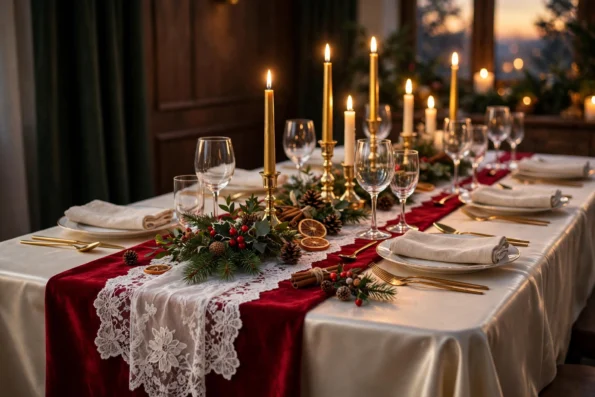
Festive Christmas table with a red velvet runner, satin tablecloth and white lace runner, gold candles and greenery

Christmas Table Settings: Velvet, Satin and Lace for a Festive Table

The short answer: layer a satin cloth, a velvet runner, and a lace runner — and let the fabrics do the decorating A Christmas table does not need a cupboard full of decorations to look festive. The fastest way to a table that photographs beautifully and feels special to sit at is to layer fabrics: a smooth tablecloth as the base, a rich runner down the centre, and a delicate lace runner over the top. Each layer adds colour, texture, and light, and together they turn an ordinary dining table into a Christmas setting. This guide shows how to build that layered look with velvet, satin, and lace from ValentinaTextile.com. Start with the base: a satin tablecloth The base layer sets the mood. A satin tablecloth gives you a smooth, light-catching surface that instantly reads as occasion wear for the table. Ivory or champagne satin is the most versatile Christmas base: it flatters candlelight, suits both gold and silver accents, and lets a coloured runner take centre stage. A deep red or forest green satin base works too, if you want a bolder, more dramatic table — just keep the runner in a contrasting tone so the layers stay visible. Browse the Satin Fabrics collection at ValentinaTextile.com for base cloths sold by the yard. Measure your table first, add the drop you want on each side — a formal drop reaches the seat of the chair, a casual drop hangs eight to twelve inches — and cut a single continuous piece so there is no seam across the middle of the table. Add richness: a velvet runner The second layer is where the Christmas colour arrives. A velvet runner in burgundy, deep red, forest green, or navy brings the depth and richness that says Christmas without a single ornament. Velvet’s pile catches the light differently from every angle, so the runner looks alive under candles and lamps, shifting subtly as guests move around the table. Choose from the Velvet Fabric collection at ValentinaTextile.com. For a classic look, pick a runner in a single deep colour and let it run the full length of the table, with a drop of twelve to eighteen inches at each end. For a longer banquet-style table, two shorter runners laid end to end can be easier to handle than one very long piece, and they make it simpler to wash one section after the party. Add delicacy: a lace runner over the top The third layer is lace, and it is the layer that makes the table look finished rather than simply dressed. A lace runner laid over a velvet runner softens the bold colour, adds an open, airy pattern, and catches the light in a completely different way. White or ivory lace over a red or green velvet runner is the classic Christmas combination: the lace pattern shows up crisply against the dark velvet, and the whole table gains a handmade, heirloom feel. Valentina Textile’s lace runners are made to be used exactly this way. The Beaded Lace Table Runner (VT-33) brings a little sparkle with its beading and sequins, perfect for an evening Christmas dinner under lights. The Floral Lace Table Runner (VT-18) offers a softer embroidered floral pattern that suits a daytime Christmas lunch. Both are sold by the yard, so you can cut the exact length your table needs. Browse the full Lace Fabric collection to compare patterns side by side. Christmas colour palettes that always work Classic red, gold, and ivory Ivory satin base, burgundy or red velvet runner, ivory lace runner, gold candles and cutlery. This is the palette that never fails: warm, traditional, and flattering in photographs. It suits a formal Christmas dinner and a family lunch equally well. Forest green and champagne Champagne satin base, forest green velvet runner, ivory lace runner, with greenery and white candles — quieter and more elegant than red and gold. Navy and gold for a modern Christmas Navy velvet runner over an ivory satin base, ivory lace on top, gold candles and cutlery — dramatic under low evening light. How long should each layer be? The base cloth should cover the table plus the drop you want on all sides. The velvet runner should run the full length of the table plus a drop of twelve to eighteen inches at each end — that overhang is part of the look, so do not cut it flush with the table edge. The lace runner can match the velvet runner’s length, or sit slightly shorter, ending just inside the velvet drop so the velvet frames it. If you are using a lace runner on its own, without velvet underneath, the same length rule applies: full length plus a drop at each end. Our Table Linens Guide explains how runners and cloths pair for events of every size. Centrepieces that work with layered fabrics Once the fabrics are layered, the centrepiece should be low and simple. Tall arrangements fight with the layers and block conversation across the table. Instead, try a low garland of greenery down the centre of the runner, with candles of varying heights tucked into it, or a row of small glass candle holders with a few pinecones and dried orange slices. Keep the centrepiece narrow so the lace pattern stays visible. Care: keeping Christmas fabrics beautiful Care varies by product, so the listing for the exact fabric you buy is the final word. As general guidance, satin and velvet prefer gentle handling: blot spills quickly rather than rubbing them, and avoid pressing velvet flat with a hot iron, which crushes the pile. Lace runners should be handled gently and kept away from open flames and sharp candle holders. After the party, shake out crumbs outdoors, treat any stains promptly, and store runners rolled rather than folded, so creases do not set into velvet or lace over the year. Which fabrics should you buy for your Christmas table? Start with the base: an ivory or champagne satin cloth. Add the
CONTINUE READING ➞
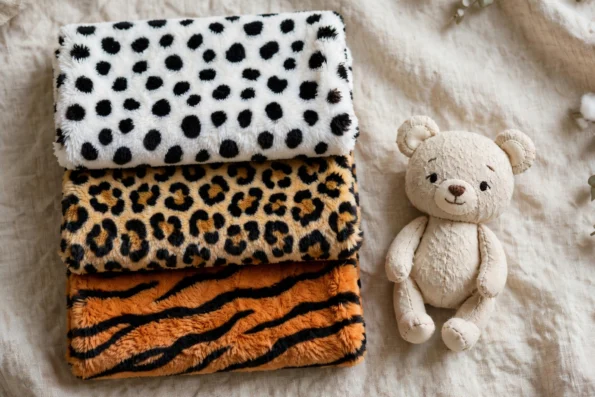
Folded velboa fabric in dalmatian, leopard and tiger animal prints beside a plush teddy bear

What Is Velboa? The Plush Fabric Behind Costumes and Plush Toys

The short answer: velboa is a short-pile plush fabric that looks like fur but sews like a stable knit If you have ever picked up a plush toy, a costume, or a soft throw and wondered why the surface feels velvety rather than shaggy, you have probably touched velboa. Velboa is a short, dense pile fabric with a smooth, velvet-like hand. It gives you the softness and warmth of a plush fabric without the long, unruly pile of a shaggy faux fur, and that combination is exactly why costume makers, toy makers, and home sewers reach for it again and again. This guide explains what velboa is, how it differs from faux fur and minky, and what it is best used for — so you can buy the right plush fabric the first time. What is velboa? Velboa is a knitted plush fabric with a short, even pile standing on a stable backing. Run your hand across it and the fibres feel soft and uniform, almost like velvet, rather than long and hair-like. The pile is short enough that printed patterns stay sharp: spots, stripes, and rosettes print cleanly on the surface instead of disappearing into long fibres. That is why velboa is the go-to fabric for animal prints. Browse the Animal Print Velboa collection at ValentinaTextile.com to see how crisp leopard, tiger, giraffe, cow, and dalmatian prints look on this fabric. Velboa is a synthetic plush fabric, so it is cruelty-free, colourfast in most prints, and generally easier to care for than real fur. It is sold by the yard at ValentinaTextile.com, in one continuous cut, so a costume or a set of plush toys can be cut from a single piece without a join in the middle. Velboa vs faux fur: what is the difference? The main difference is pile length and behaviour. A shaggy faux fur, such as Valentina Textile’s Luxury Shaggy Faux Fur, has a long, flowing pile that moves, drapes, and sheds a little when cut. It looks dramatic and realistic, which is perfect for a monster costume, a lion mane, or a luxurious throw. Velboa, by contrast, has a short pile that stays put. It holds its shape, keeps printed patterns readable, and is far easier to cut and sew accurately. Think of it this way: choose shaggy faux fur when you want movement and drama, and choose velboa when you want a clean shape and a clear print. A dalmatian costume made from velboa will read as a dalmatian from across the room, because the spots stay sharp. The same costume in a long-pile fur would blur the spots into a soft, spotted cloud. Our Minky vs Faux Fur guide compares pile and softness across plush fabrics in more detail. Velboa vs minky: which is softer? Minky is the softest of the plush family: an ultra-soft, silky fabric that is the favourite for baby blankets and snuggly throws. Velboa is soft too, but with a slightly firmer, more velvety hand and a more stable backing. That stability is the trade-off, and it is a useful one. Minky can stretch and shift under the presser foot, which frustrates beginners, while velboa stays where you put it. For a first plush project, velboa is often the easier fabric to sew well. What is velboa used for? Plush toys and stuffed animals Velboa is a classic toy fabric. Its short pile is soft enough to cuddle, stable enough to sew small pieces accurately, and printed beautifully for animal toys. A dalmatian puppy, a leopard cub, or a tiger made from velboa looks like the animal it is meant to be. The Dalmatian Velboa Dog Print is a perfect example: black spots on a white ground, printed on a soft, short pile that sews cleanly even in small pieces. Costumes and cosplay Costume makers love velboa because it holds a shape. Animal costumes, mascot-style outfits, and character costumes cut from velboa keep their silhouette on stage and at a party, and the prints stay readable under lights. It is also a popular choice for children’s costumes, since the short pile is less likely to shed all over the house than a long-pile fur. Home décor and upholstery accents Velboa works beautifully for cushion covers, throw pillows, and small upholstery accents. Its velvety surface adds warmth and texture to a chair or a bed, and animal prints bring a bold, playful accent to a plain room. Because the pile is short, velboa cushions do not flatten into a matted mess the way a long-pile fur can after months of use. Animal prints on velboa: which print should you choose? Animal prints are velboa’s signature, and the print you choose sets the whole mood of the project. Dalmatian is playful and instantly recognisable, ideal for children’s costumes and toys. Leopard and cheetah read as glamorous and bold, perfect for a statement jacket, a costume, or a striking cushion. Tiger stripes are dramatic and graphic, while giraffe and cow prints bring a softer, more whimsical feel. Zebra is the most graphic of all, with high-contrast stripes that work for both costumes and modern décor. Sewing with velboa: tips that make it easy Cutting Cut velboa from the back, with the pile lying flat, and mark your pattern on the backing rather than the pile side. A rotary cutter or sharp scissors both work, but keep the blade sharp: a dull blade drags the pile and leaves a ragged edge. Cut pieces in a single layer when the print direction matters, so spots and stripes run the same way on every piece. Seaming Use a standard sewing needle and a medium stitch length, and sew with the pile side facing in where possible. Velboa’s stable backing means it feeds well under a standard presser foot, and you usually do not need a walking foot, although one can help on thicker, layered seams. Press seams gently from the backing side, never with a hot iron directly on the pile, or you

CONTINUE READING ➞
My Cart
Wishlist
Recently Viewed
Categories

SPIN TO WIN!

  • Try your luck to get a discount coupon
  • 1 spin per email
  • No cheating
Try Your Lucky
Never
Remind later
No thanks